Nicolas Cage Once Shared His Top Five All-Time Favorite Films


Nicolas Cage has opened up about the five films that shaped his approach to acting and left a lasting impact on him as a performer.
Speaking with Rotten Tomatoes, Cage shared the titles that inspired him and explained why they hold such significance in his career and understanding of cinema.
At the top of his list is Elia Kazan’s 1955 adaptation of John Steinbeck’s East of Eden, starring James Dean. Cage describes Dean’s performance as transformative: “I was 15, and I’d seen Bergman’s Seventh Seal and Fellini’s Juliet of the Spirits and Welles’ Citizen Kane — great films. But when I saw Dean in that, it really put the hook in me because I felt like him, and I knew then the power of film acting, and I knew then what I wanted to be, what I wanted to do to try to move people with motion pictures.”
Dean’s portrayal of a young man struggling for his father’s love has been widely praised for its raw intensity and emotional depth. Critics have long hailed it as one of Dean’s most powerful performances, cementing the actor’s status as a symbol of teenage angst and cinematic authenticity.
The film itself, while not an immediate box office hit, gained critical recognition over time for its layered storytelling and character complexity.
Cage’s next pick is Kazan’s A Streetcar Named Desire, featuring Vivien Leigh as Blanche DuBois.
Cage says, “It was because of Vivien Leigh’s performance as Blanche that I would put that as one of my favourite movies. Such a powerfully vulnerable, tragic performance.” Leigh’s work in the film is often considered one of the finest performances in cinema history, and the movie itself received strong critical acclaim for its bold adaptation of Tennessee Williams’ play. Marlon Brando’s turn as Stanley Kowalski also revolutionized screen acting with its naturalistic style, which continues to influence actors today.
For his third and fourth choices, Cage turns to the visionary work of Stanley Kubrick. 2001: A Space Odyssey, released in 1968, earns praise for its revolutionary visual effects and philosophical depth.
Cage notes, “It remains a mystery to me, even today, where I can view it annually, three times a year, and still find something new in it.” Critics have consistently celebrated the film as one of the greatest achievements in cinematic history, lauding its ambitious storytelling and iconic imagery, from the monolith to the Star Gate sequence.
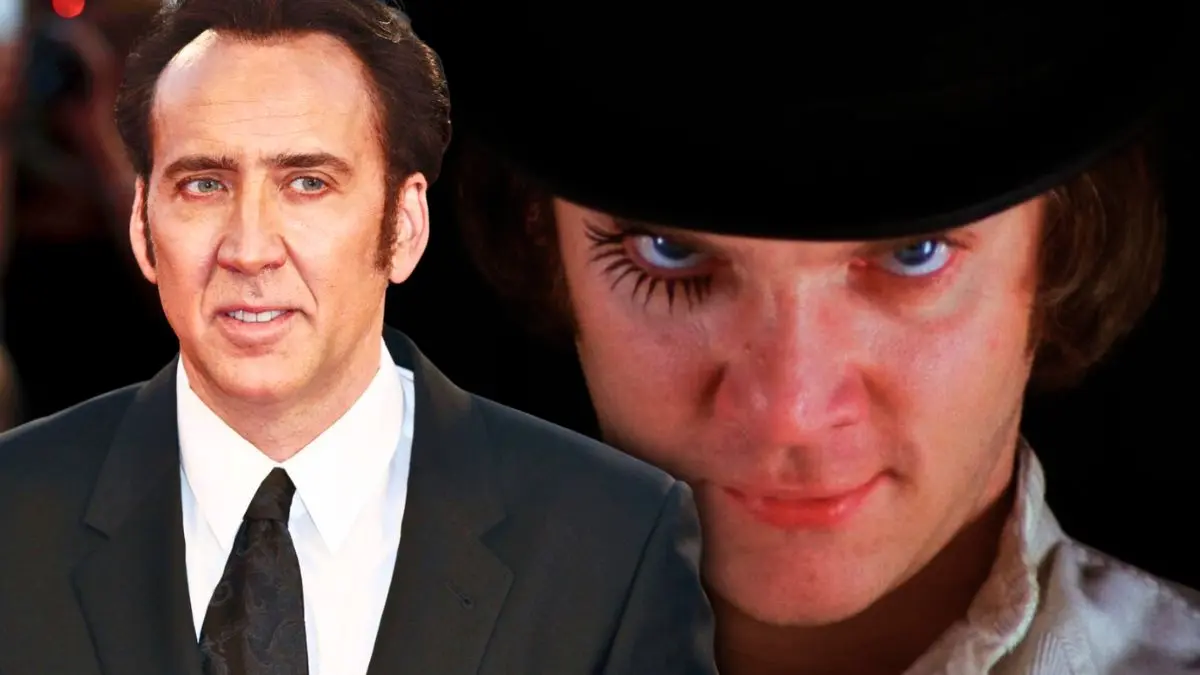
Kubrick’s A Clockwork Orange is Cage’s fourth selection. The film’s disturbing exploration of violence and morality, through the character of Alex, continues to provoke debate. Cage reflects, “Stanley Kubrick’s treatment of the subject of violence and the mystery of nature… all these questions that came out of the absurdist and evocative film that is Clockwork Orange, again, is everlasting.”
Upon its 1971 release, the film drew intense controversy for its explicit content, yet it also received critical acclaim for its innovative direction, thematic daring, and Malcolm McDowell’s unforgettable performance.
Finally, Cage’s list includes the visually and emotionally complex work of Apocalypse Now, Francis Ford Coppola’s 1979 war epic. The film’s portrayal of the psychological toll of conflict and its groundbreaking cinematography have earned it enduring praise, making it a landmark in American cinema.
Through these films, Cage explains, he learned the power of performance, the influence of strong direction, and the lasting impact of storytelling. His list highlights not only his personal inspirations but also movies that have defined cinematic history.
What do you think of Nicolas Cage’s picks? Do any of these films inspire you the way they inspired him? Share your thoughts in the comments.