‘Seven Years in Tibet’ Arrived in Theaters 28 Years Ago and Instantly Got Brad Pitt Banned From China



Few Hollywood films have caused as much diplomatic heartburn as a mountaineering drama. Brad Pitt was already a bona fide movie star in the late 1990s, but his next project would turn him into an unwelcome guest in one of the world’s biggest film markets. That film was ‘Seven Years in Tibet’, and its legacy is as much about politics as it is about cinema.
The movie, directed by Jean-Jacques Annaud, came together as an epic with a huge budget and an even bigger sense of scale. It was a sweeping biographical story shot across several continents, built around an unlikely friendship between a mountaineer and a young spiritual leader. And when it finally reached audiences, the reaction from Beijing was swift.
The film opened commercially in the U.S. and Canada on Oct. 8, 1997, after premiering at the Toronto International Film Festival the month before. Some sources list a slightly later release date, but the Oct. 8 date is the one commonly given in coverage of its opening. It runs 136 minutes and was made on a budget of $70 million.
Based on Austrian mountaineer Heinrich Harrer’s memoir, the story follows Harrer, played by Pitt, as he escapes a prisoner-of-war camp in British-ruled India during World War II with fellow climber Peter Aufschnaiter, played by David Thewlis. The pair make a dangerous trek across the Himalayas and eventually reach Tibet, which was then largely closed off to outsiders. In Lhasa, Harrer becomes a tutor and friend to the young 14th Dalai Lama, played by Jamyang Jamtsho Wangchuk, until the Chinese invasion upends everything.
The film’s portrayal of the Chinese takeover proved unacceptable to Beijing. The Chinese government condemned it for depicting Communist officers as rude and arrogant, and for presenting the Dalai Lama in a positive light. As a result, Pitt, Thewlis and Annaud were barred from entering the country, and Sony’s future films were also reportedly blocked.
That is a heavy price for a studio drama. According to reports, the dispute even put Sony’s broader business interests in China at risk, though the company resumed operations there the following year. The film itself was never shown in China.
The pressure didn’t begin at release. The production originally planned to shoot in Ladakh, India, but it moved to Argentina after the Chinese pressured the Indian government, which reportedly threatened to cut electricity to the set and blocked a bank account tied to the film. Other footage was shot in Nepal, Austria and Canada.
Annaud later confirmed that 2 crews secretly filmed roughly 20 minutes of material in Tibet itself. Composer John Williams provided the score, featuring a cello performance by Yo-Yo Ma, and it earned a Golden Globe nomination. Pitt was also recognized, winning a Rembrandt Award for Best Actor, though he picked up a Stinkers nomination for his accent.
Commercially, the film performed respectably if not spectacularly. It earned about $131.5 million worldwide, with roughly $38 million of that coming from North America. Audiences were more positive than critics, giving it an A- CinemaScore.
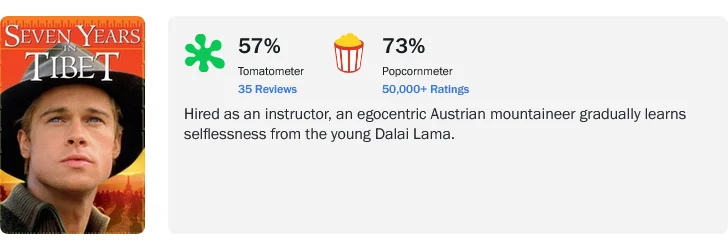
Critics were divided. It holds a 58% score on Rotten Tomatoes and a 55 on Metacritic, which indicate a mixed response. Roger Ebert gave it 2.5 out of 4 stars, arguing that the story was being told from the wrong character’s perspective, while Variety praised the production values but wanted more emotional drama.
The film also drew criticism for how it handled its protagonist. The real Harrer was an SS non-commissioned officer, a fact that some commentators argue the movie downplays. The film also adds a storyline about his relationship with his son that is not supported by the book.
That complexity has shaped how the movie is remembered. It is both a celebrated visual achievement and a reminder that Hollywood biography often smooths over uncomfortable details.
The punishments eventually eased. Annaud was welcomed back in 2012 to chair the jury at the Shanghai International Film Festival, and Pitt visited China in 2014 and again in 2016. Coverage differs on exactly when the ban formally ended, with some reports pointing to 2016, when the film ‘Allied’ was released.
For many fans, ‘Seven Years in Tibet’ remains one of Pitt’s more ambitious and unusual performances, and it still sparks debate about art, politics and the risks of telling certain stories.
Was China right to ban Brad Pitt over Seven Years in Tibet?
Have something to add? Let us know in the comments!