‘Wicker’ Ending Explained: Why the Fisherwoman Chose Love Over Conformity


The modern cinematic landscape rarely makes room for unapologetic adult fairy tales that balance bawdy satire with genuine emotional earnestness. Adapted from Ursula Wills’ 2008 short story ‘The Wicker Husband’, the dark fantasy comedy ‘Wicker‘ arrived in theaters as a refreshing subversion of traditional romance tropes. Directed by Alex Huston Fischer and Eleanor Wilson, the project gained strong buzz on the festival circuit before reaching wide release.
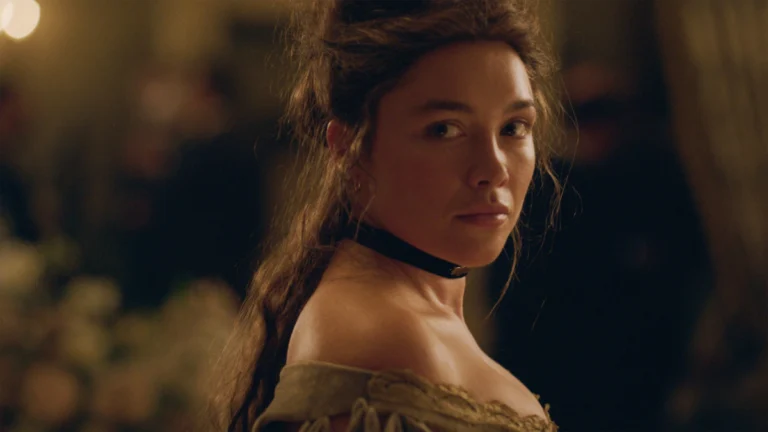
Set within a timeless seaside village, the story crafts an insular world where inhabitants are defined solely by their vocational titles rather than proper names. In this conservative community, social order is enforced through patriarchal submission, visually underscored by married women wearing heavy ceremonial metal collars. Existing on the periphery is the Fisherwoman, an ostracized spinster mocked by neighbors for her unkempt appearance and distinct odor.
Tired of the relentless mockery led by the spiteful Tailor’s Wife, the Fisherwoman commissions the reclusive Basket Weaver to craft her a spouse out of willow. To the town’s disbelief, the resulting Wicker Husband emerges not as a simple statue, but as a living, sentient partner whose tender devotion awakens her self-worth. Lead star Olivia Colman observed that the narrative “gently laughs” at the absurdities of marital traditions and communal pressure, speaking to the BBC.
The Conspiracy of the Wicker Baby
The central conflict ignites because the Wicker Husband’s unconditional affection directly threatens the fragile power dynamics of the entire township. While local women envy the Fisherwoman’s romantic bliss, the town’s husbands feel insulted by a man who prioritizes his wife’s pleasure rather than treating her as property. Desperate to restore the traditional hierarchy, the Tailor’s Wife orchestrates an elaborate scheme designed to tear the couple apart.
The spiteful villagers secretly commission the Basket Weaver to weave a miniature wicker infant, presenting it as proof of the husband’s infidelity with the Bottlewasher’s Wife. Blinded by sudden heartbreak and public humiliation, the Fisherwoman loses faith in her partner and hurls a lit oil lantern at him during an argument. The dry willow instantly ignites, sending the burning husband fleeing into the dark wilderness as the Fisherwoman believes she has killed him.
The Basket Weaver’s Revelation and Renewal
Overcome with grief, the Fisherwoman retreats from the village and subsequently discovers the abandoned wicker infant left in the woods. Moved by lingering tenderness for her lost companion, she takes the woven infant home and nurtures it. The story takes its pivotal turn when the Basket Weaver arrives at her cottage to reveal the full truth behind the village’s plot.

The craftsman explains that woven beings cannot reproduce, revealing that the infant was merely a commissioned prop created to fuel toxic town gossip. Even more crucially, the artisan confesses that he rescued the burning husband and spent days painstakingly repairing his damaged frame. Reunited at the workshop, the Fisherwoman offers a tearful apology for her mistrust, which her revived husband warmly forgives.
Escaping Conformity to Build a Chosen Family
Rather than seeking vengeance against the village, the restored couple makes a decisive break from the toxic community once and for all. Taking the orphaned wicker infant with them, the pair quietly departs the seaside hamlet to start life on their own terms. By choosing exile together, they leave the bitter villagers trapped within miserable marriages, petty gossip, and stifling traditions.
This resolution elevates ‘Wicker’ beyond simple fantasy into a sharp critique of societal conformity and patriarchal control. Co-director Eleanor Wilson noted that “during the writing, we’re always trying to follow the thread of what feels honest to us, and most of the time that leans comedy,” adding that because the original fable takes a dramatic turn, “you’ve got to pay service to that,” in an interview with AwardsWatch. Her filmmaking partner, Alex Huston Fischer, highlighted that the townsfolk are fundamentally threatened because the couple claims true agency and autonomy.
The couple’s choice to forge an unconventional household demonstrates that genuine intimacy cannot exist under forced societal expectations. The filmmakers pursued the project precisely because the premise felt “unpitchable” on paper yet carried profound emotional resonance, as The Hollywood Reporter detailed. Ultimately, the Fisherwoman never dons the symbolic collar of subservience, proving that lasting devotion thrives only through mutual freedom and shared respect.
What did you think of the emotional conclusion to ‘Wicker’, and did the couple make the right choice to leave the village behind?