‘Luce’ Ending Explained: The Real Meaning Behind the Goldfish, Speech, and Final Run


When Julius Onah’s psychological thriller ‘Luce’ debuted at the 2019 Sundance Film Festival, critics praised its complex, provocative approach to modern American anxieties. Shot on 35mm film and adapted from J.C. Lee’s 2013 Lincoln Center stage play, the 109-minute feature premiered before Deadline reported its Sundance acquisition by Neon and Topic Studios. Released in U.S. theaters in August 2019 and earning over $2.3 million worldwide, the movie’s ambiguous closing act continues to spark debate among viewers.
Set in Arlington, Virginia, ‘Luce’ centers on high school senior Luce Edgar, played by Kelvin Harrison Jr., a debate captain and track standout adopted at age seven from war-torn Eritrea. After years of therapy, his liberal white parents, Amy (Naomi Watts) and Peter (Tim Roth), view him as an idealized success story. Everything unravels when his Black history teacher, Harriet Wilson (Octavia Spencer), flags a paper Luce wrote from the perspective of revolutionary theorist Frantz Fanon and discovers illegal fireworks in his locker.
What Actually Happens in the Final Act of ‘Luce’
The third act transforms a battle over reputation into a chilling study of selective truth, culminating in an explosion inside Harriet’s classroom desk that leads Principal Dan Towson (Norbert Leo Butz) to place her on leave. When Amy rushes home and discovers the fireworks she had hidden from Luce are missing, Peter suspects their son orchestrated the fire, while Amy insists on protecting him. Crucially, in J.C. Lee’s original stage play, Harriet went to the hospital after the blast—a “much more violent ending” than the film’s psychological reckoning.
Everything shifts when Luce visits Harriet’s house bearing flowers, seemingly expressing concern while confronting her for ruining his friend DeShaun Meeks’s (Brian Bradley) track scholarship over marijuana. Harriet accuses Luce of hypocrisy for using marginalized classmates like his ex-girlfriend Stephanie Kim (Andrea Bang)—who previously told Harriet that Luce assaulted her—to fight his battles. Outside, Amy secretly follows Luce to a hideout where he has sex with Stephanie, whose unreactive gaze through the window silently confirms to Amy that the two conspired against Harriet.
Decoding the Goldfish Bag and Amy’s Choice
Returning home to the spot where she had hidden the fireworks, Amy faces the collapse of her certainty. Luce arrives carrying a paper bag—echoing the undisclosed bag placed inside a locker in the opening shot—only to reveal a goldfish he wants to keep as a pet. Instead of exposing him, mother and son tearfully hug, choosing to preserve their fragile family bond even as the truth remains buried.
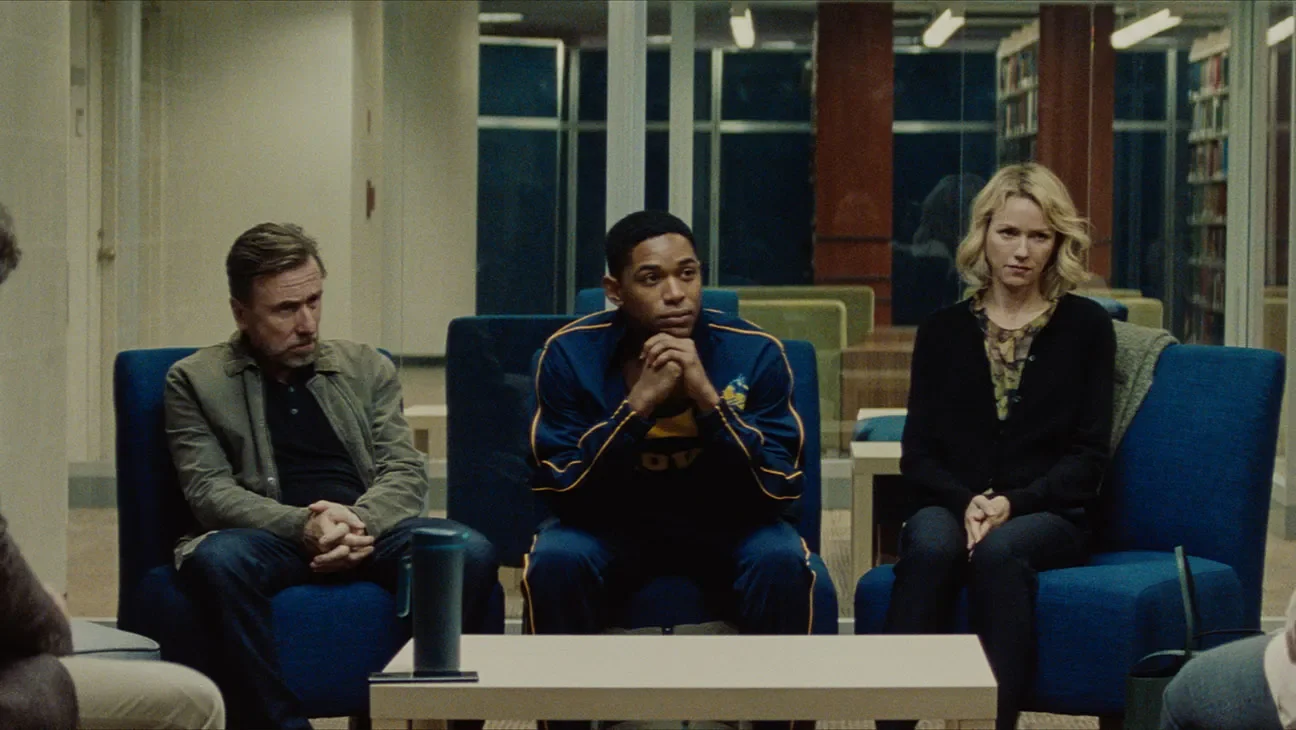
That uneasy truce reflects Onah’s deliberate refusal to flatten his protagonist into either a saint or a monster. As Onah explained in an interview with We Live Entertainment, “when we deify them and say they’re the best version of what they are, it is the inverse of that problem, which is being afraid to recognize them for who they are, and what’s the truth in the middle, the gray, the humanity, the perfection and the imperfection and the multitudes that we all contain”. By shooting the story through what he called “objective subjectivity,” Onah keeps viewers inside Luce’s calculated headspace while forcing them to question their own assumptions.
The Meaning of the Speech and Luce’s Final Run
Following his reconciliation with Amy, Luce delivers a polished school speech recounting how his adoptive parents chose his name because it means “light”. Thanking Amy and Peter for giving him a second chance in America to tell his own story, he seamlessly slips back into the model-student persona. Harrison Jr. reflected on that layered performance while speaking to The Independent, noting, “It was so cool to apply all the things I acquired in my own life to the part, like code-switching”.
Yet ‘Luce’ refuses to conclude on that triumphant public address, cutting instead to Luce going out for a jog, visibly upset and pushing himself harder. Even after outmaneuvering Harriet and securing his parents’ silence, he remains burdened by the pressure of living on a symbolic pedestal where he cannot afford a single misstep. The frantic final sprint reveals that no matter how convincingly Luce performs as the shining poster child, he cannot outrun his trauma or the box everyone around him insists on keeping him inside.
Do you believe Luce orchestrated Harriet’s downfall from the very start, or was he driven to fight back by an impossible standard—share your interpretation in the comments below.