Christopher Nolan’s $250 Million ‘The Odyssey’ Depends on 41 Theaters and a Rare Skill Only 90 People Have



‘The Odyssey’ has already become known for its staggering budget and its sprawling cast, but the real story behind Christopher Nolan’s latest epic might be happening far away from any red carpet. Long before critics weighed in or box office numbers rolled in, the film had already made history simply by being screened at all in its intended format.
Nolan shot ‘The Odyssey’ entirely on IMAX film cameras, making it the first feature-length movie in history to be captured this way from start to finish. That achievement required reviving a corner of the film industry that most studios had written off years ago, since digital projection had long been considered cheaper and easier to distribute at scale.
What that revival actually looks like on the ground is a level of scarcity that has turned 70mm IMAX tickets into one of the hottest resale items in entertainment this year. There are only a small number of theaters worldwide capable of projecting true IMAX 70mm film, with reports putting the number of confirmed venues in the high 30s to low 40s, depending on the source and the date checked, and every single print shown at those theaters has to be physically struck and shipped from a single facility.
That facility is FotoKem in Burbank, California, the last remaining motion picture lab in the world still capable of producing 70mm prints. Every one of the thousands of cuts in the finished film had to be spliced together by hand, and the production burned through more than 2 million feet of IMAX negative getting the movie made, all of which had to be processed and printed at that same lab before making its way out to theaters.
The scarcity extends well beyond the lab itself. Each finished 70mm IMAX print reportedly costs around $80,000 to produce, and even that price tag does not cover what individual theaters have had to spend just to keep their aging equipment running. One Las Vegas theater reportedly spent $16,000 apiece on 2 humidifiers just to keep its physical print from drying out and becoming brittle inside the projection booth.
Running the format also requires a level of specialized human expertise that has all but disappeared from the industry. One veteran IMAX projectionist told the Las Vegas Review-Journal that the community currently keeping the format alive amounts to a group chat of roughly 90 people worldwide, including administrators and non booth personnel, who know how to operate a 70mm IMAX film projector, a number that underscores just how niche the skill set has become since studios largely abandoned film projection for digital over the past two decades.
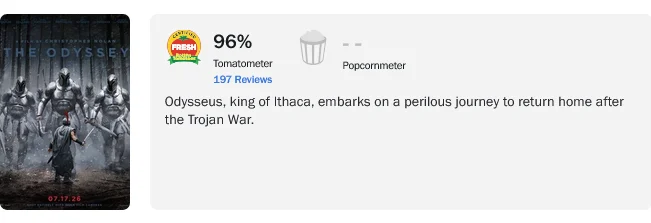
That scarcity has translated directly into demand. When Universal put select opening weekend IMAX 70mm screenings on sale a full year before the film’s release, 95 percent of those seats sold within an hour, generating roughly $1.5 million despite the deliberately small pool of tickets available. Retail prices for those seats ran between $25 and $28, but resellers quickly began flipping tickets for anywhere between $200 and $1,000, depending on the market and the seat.
Nolan has spent nearly 20 years championing IMAX film as a format worth preserving, dating back to his early use of the cameras on ‘The Dark Knight’. With ‘The Odyssey’, he effectively turned that scarcity into the centerpiece of the film’s marketing, betting that audiences would travel across state lines and pay well above face value just to see the movie the way he intended it to be seen.
Would you go out of your way to watch ‘The Odyssey’ in IMAX 70mm?
‘The Odyssey’ opens in theaters on July 17, following preview screenings the night before, and stars Matt Damon as Odysseus alongside Anne Hathaway, Tom Holland, Zendaya, Robert Pattinson, Lupita Nyong’o, and Charlize Theron.
Have something to add? Let us know in the comments!