Did Odysseus and Circe Really Have a Son? The Myth Behind Christopher Nolan’s ‘The Odyssey’


Christopher Nolan’s take on Homer’s epic has audiences digging back into the original poem, and one question keeps surfacing among curious moviegoers. Did Odysseus actually father a child with the sorceress Circe, and does that storyline show up anywhere in Nolan’s new film.
The answer involves a lesser known piece of Greek mythology that never actually appears in Homer’s original text. It comes from a separate, mostly lost epic, and it centers on a son named Telegonus, whose fate is tied directly to the ending of Odysseus’s own story.
The Myth of Telegonus and Circe
In Greek mythology, Telegonus is described as the youngest son of Circe and Odysseus, making him brother to figures like Nausithous depending on the source. His story does not come from Homer’s ‘Odyssey’ itself but from a separate, now lost epic called the Telegony, which was attributed to Eugammon of Cyrene and served as a sequel that concluded the larger Epic Cycle.
According to the surviving summaries of that poem, Telegonus was raised on Circe’s island of Aeaea and eventually set out in search of his father without knowing who he truly was. When he landed in unfamiliar territory, he mistakenly believed he had arrived on Corcyra rather than Ithaca, and hunger drove him to start plundering the island for supplies.
That decision led to a fight nobody saw coming. Telegonus unwittingly killed his own father with a spear tipped with the point of a venomous stingray, which fulfilled an old prophecy that death would come to Odysseus from the sea. It is a strange, almost accidental patricide that has drawn comparisons to the myth of Oedipus for its cruel irony.
The aftermath is just as unusual as the killing itself. Telegonus brought Odysseus’s body back to Aeaea along with Penelope and Telemachus, and Circe made the survivors immortal. In the strangest twist of all, Circe then married Telemachus while Telegonus married Penelope, tying the two households together in a way that feels almost too tidy for a tragedy.
Circe’s Role in Homer’s ‘Odyssey’ v. the Movie
It is worth remembering that this entire storyline sits outside the poem most readers actually know. Within Homer’s ‘Odyssey’, Circe is the powerful sorceress who crosses paths with Odysseus and famously turns his men into animals before he eventually continues his journey. There is no mention of a child in that version of events, since the Telegonus material comes entirely from the separate Telegony.
Nolan’s film leans on that same core dynamic between Odysseus and the enchantress. Circe plays a significant role in Homer’s original poem as the enchantress who transforms Odysseus’s men into animals, and Nolan’s adaptation reportedly elevates the character beyond her archetypal roots in the source material.
Reports on the casting have varied, with some outlets naming Charlize Theron in the part and others pointing to Samantha Morton, but the character’s function as a dangerous detour on Odysseus’s voyage home remains consistent across the coverage.
Fans hoping to see Telegonus pop up on screen may be disappointed, since nothing in the current reporting on the film’s plot suggests his storyline made the final cut. The focus instead stays on the parallel journeys of Odysseus trying to get home and Telemachus trying to find him, which Nolan has described as blending a homecoming story with a coming of age story.
How the Telegonus Storyline Changes the Ending of the Myth
The Telegonus material actually reshapes how Odysseus’s entire saga concludes, and it is worth laying out clearly for anyone confused about where ‘The Odyssey’ technically ends. Homer’s poem wraps up with Odysseus reuniting with his father Laertes and Athena stepping in to stop a war with the families of the suitors he killed. The Telegony picks up the story afterward and takes it somewhere much darker.
That lost sequel is where Odysseus’s son with Circe sets off to look for him, unknowingly lands on Ithaca for supplies, and ends up killing his own father with the stingray spear before the two recognize each other as Odysseus dies. It is a jarring contrast to the relatively hopeful note Homer’s original poem strikes, and it explains why casual readers rarely encounter Telegonus at all outside of classics courses.
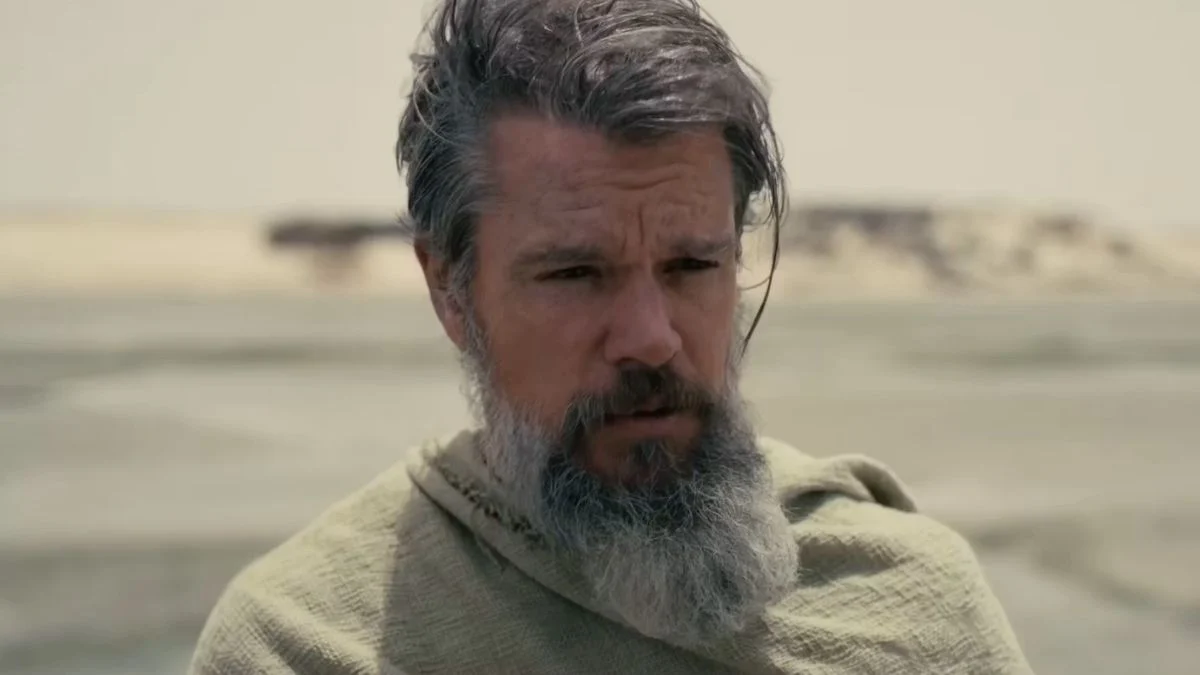
Nolan’s film takes its own liberties with how the larger story wraps up, and it does not appear to borrow from the Telegony at all. The movie ends with Odysseus and Penelope choosing to go into exile together, leaving Telemachus behind to rule Ithaca, a decision tied to a task the underworld’s shades assign Odysseus involving honoring the dead in a distant land.
That is a significant departure from both Homer’s ending and the myth of Telegonus, and it suggests Nolan was more interested in giving Penelope and Odysseus a shared final chapter than in exploring the darker fate the ancient sources set up for the hero.
Why This Mythological Detail Still Fascinates Fans
Part of the reason this question keeps circulating is that ‘The Odyssey’ has always invited this kind of digging. Nolan has said he wants the film to work for the full range of people’s relationship with the text, from those who know it well to those who know nothing about it at all, and that accessibility seems to be sending curious viewers straight back to the source material and its stranger offshoots.
Telegonus may not appear in theaters this summer, but his myth remains one of the more haunting footnotes in the entire Greek epic tradition, a reminder that Circe’s island held consequences that outlasted Odysseus’s visit by years. Given how much creative license Nolan has already taken with the ending, would you have wanted to see Telegonus and that fateful stingray spear make it into ‘The Odyssey’ at all?