Disney Names Adobe Its ‘Official AI Innovation Partner’ as the Studio Tries Again After Its Sora Collapse

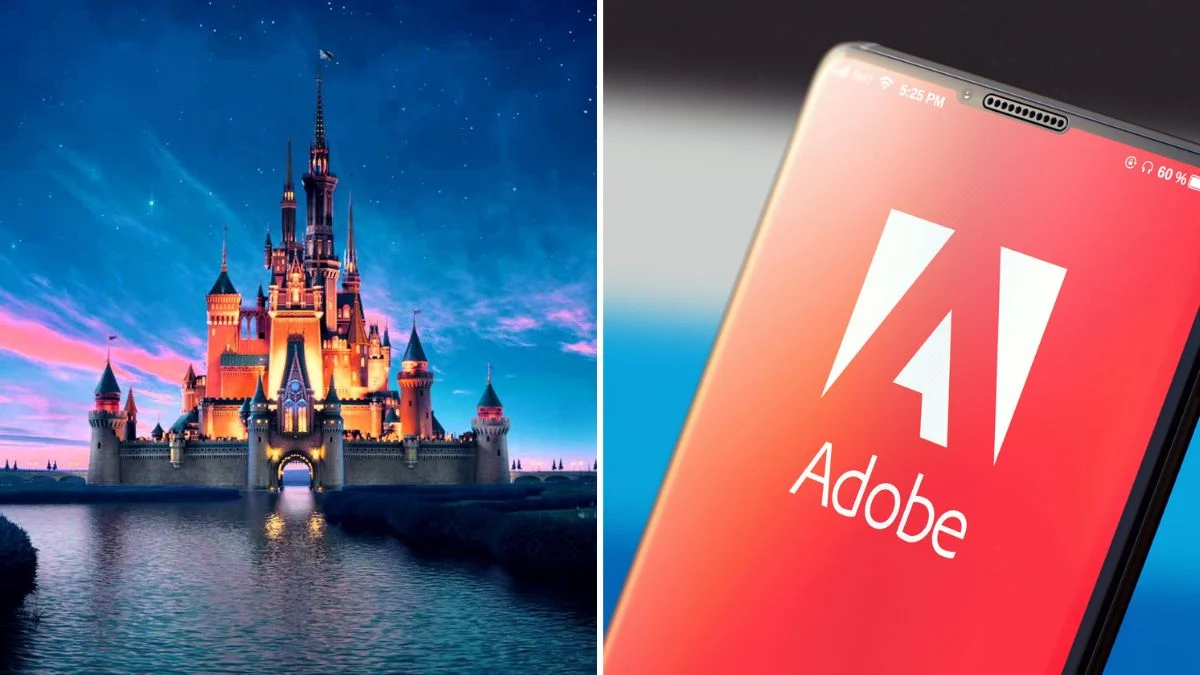
Disney and Adobe are far from strangers. The two companies have worked together for decades, and Disney’s creative teams have long relied on Adobe’s Creative Cloud tools. What is changing is the scale of the relationship, and the technology at its center.
The new Disney and Adobe AI partnership arrives after a turbulent year for the studio’s generative AI plans. In December 2025, Disney announced a $1 billion deal with OpenAI that would have licensed more than 200 characters to the Sora video tool. OpenAI shut Sora down about 3 months later, and Disney confirmed it was exiting the arrangement just as Josh D’Amaro was settling in as CEO.
Now Disney has found a new partner. Adobe is the company’s Official AI Innovation Partner under a multiyear strategic alliance announced Monday at Adobe MAX in Miami Beach. Financial terms were not disclosed.
The centerpiece is Adobe Firefly Foundry, a platform for building private generative models. Disney will work with Adobe to train custom models on its own characters, worlds and art styles. The idea is that outputs stay consistent with Disney’s look and are safe for commercial use.
Disney also gets early access to Adobe’s newest tools, including Firefly, Photoshop and Premiere. Adobe will add dedicated engineering and research support on top. Both companies have described the approach as responsibly developed AI meant to support Disney’s creative teams.
The deal reaches well beyond the studio lot. Adobe’s presence will expand across Disney’s media platforms, theme parks, cruise line and ESPN through marketing activations and other initiatives. Concept work for parks and cruise development is part of the package.
Adobe is also joining StudioLAB, the innovation hub of The Walt Disney Studios, as a partner. At ESPN Edge, the companies will explore AI for fan engagement and ways to bring the network’s huge archive back into view. Co-innovation projects with both groups are already underway, and more activations are expected over the life of the deal.
This isn’t Disney’s first experiment with Firefly Foundry. In June, Disney and Adobe announced that Walt Disney Imagineering Research & Development would use custom models to speed up design and pre-production for parks. Axios reported that the models draw on characters from franchises including ‘Frozen’, ‘Moana’, ‘Lilo & Stitch’ and ‘Cars’.
Two early workflows turn rough hand-drawn sketches into rendered 2D concept art and convert concepts into 3D prototypes. Disney’s Kyle Laughlin, who leads Imagineering R&D, summed up the philosophy by saying, in Disney’s own words, “our product is emotion.” He argued that these tools help make that connection faster. The models are built on licensed and proprietary assets and customized with decades of Imagineering work.
The timing is hard to miss. The OpenAI arrangement would have put Disney characters into an outside platform where users could generate their own content. The Adobe approach keeps the models private, trained on Disney’s material and used by Disney’s own teams.
That distinction fits the message D’Amaro has repeated since taking over in March. He has said that creativity at Disney is led by people and that AI should empower creators rather than replace them. Disney says its custom models will support artists instead of replacing the human creative process.
For Adobe, the win is significant. Tech coverage has framed Disney as one of the biggest clients the company could land for Firefly Foundry, at a moment when investor sentiment around its AI offerings has been pessimistic. Hannah Elsakr, Adobe’s vice president of generative AI new business ventures, called the deal the next chapter of the relationship and said AI should serve as an accelerant for artistic vision.
The news lands against an uneasy backdrop. Benzinga noted that the agreement comes as Disney is reportedly considering eliminating thousands of jobs to cut costs. That report has not been confirmed in the sources reviewed, but it adds tension to a deal about speeding up creative work.
Creative workers have been wary of AI tools since long before this week, and the Sora saga made Disney a lightning rod. Promising that artists remain in control is one thing, while proving it as the tools scale is another. Disney also faces the practical question of how much of its pipeline, from park attractions to ESPN archives, will quietly run on generative models in the coming years.
For now, the message is cautious ambition. Disney has chosen a partner that lets it keep its characters on its own servers and its own terms, and it has chosen to say so publicly. Whether that is enough to ease creative anxiety will be tested by what actually gets made.
What is your biggest concern about Disney’s new AI partnership with Adobe?
Have something to add? Let us know in the comments!