Here’s What Warner Bros.’ Animated Movie ‘The Cat in the Hat’ Is Actually Based On

Adapting classic children’s literature for modern theatrical audiences has always walked a delicate tightrope in contemporary Hollywood. Beloved bedtime stories possess unmatched multigenerational nostalgia, but their brief page counts often present massive screenwriting hurdles for feature films. Studio executives have spent decades searching for the right formula to transform minimalist storybooks into expansive cinematic universes.
Over the past two decades, cinematic interpretations of mid-century illustrated books alternated between live-action experiments and high-gloss digital animation. Early theatrical efforts frequently divided purists by shoehorning juvenile Hollywood tropes into delicate storybook mythologies. As visual technology matured into celebrating stylized illustration, filmmakers began rethinking how to honor historical source material with genuine depth.
At its foundational root, the 2026 animated comedy ‘The Cat in the Hat’ is based on the legendary 1957 children’s book ‘The Cat in the Hat’ by Theodor Geisel, known globally as Dr. Seuss. Geisel famously crafted the beginner primer using a strict list of only 236 unique words to provide an imaginative alternative to traditional literacy primers. While that 61-page masterpiece serves as the direct creative springboard, this theatrical reboot radically expands beyond the domestic boundaries of the original text.
From Rainy Day Mischief to an Interdimensional Odyssey
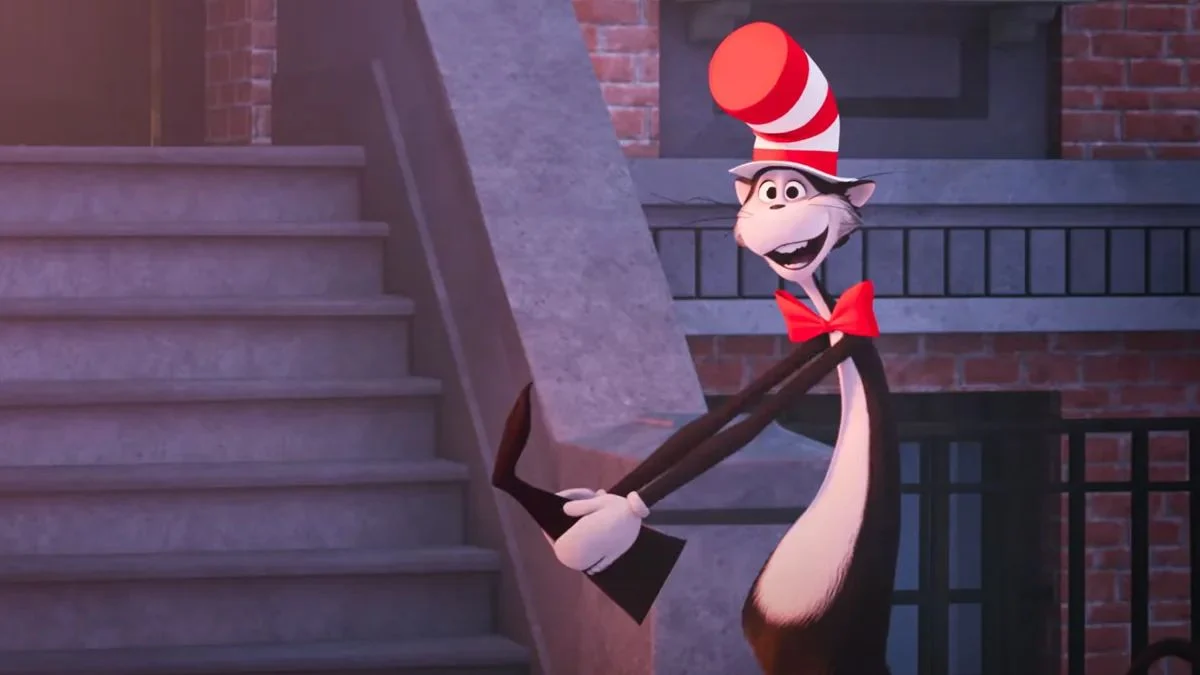
In Geisel’s seminal 1957 book, the premise centered entirely on two homebound children whose dreary afternoon is upended by an eccentric feline in a striped stovepipe hat. Rather than stretching that brief cleanup routine across a feature runtime, filmmakers utilized the house-wrecking incident as an introductory prologue. The animated film swiftly transitions from domestic chaos into a vast fantasy adventure, establishing an institutional backstory behind the feline’s chaotic interventions.
Written and directed by Alessandro Carloni and Erica Rivinoja, the narrative reimagines the Cat as an operative working for the Institute for the Institution of Imagination and Inspiration, LLC. Co-director Alessandro Carloni described the protagonist as “the quintessential ‘carpe diem’ guy and the keeper of the theme of our movie, which is about living in the present,” as Carloni explained to Variety. That thematic setup reframes the Cat’s unpredictable antics as his official mission to spark wonder in struggling kids.
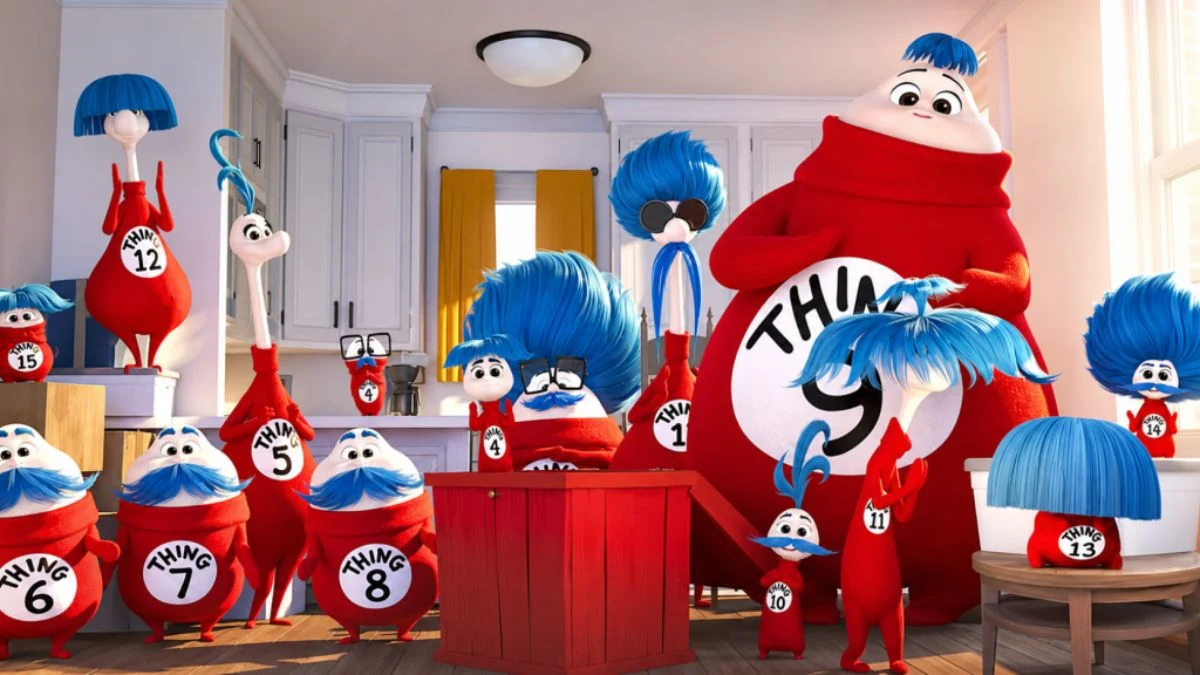
Assigned to cheer up two siblings named Gabby and Sebastian as they struggle with a move to a new town, the Cat takes them on a time-bending journey across fantastical dimensions. Along the way, the film introduces expanded legions of Things beyond the iconic Thing One and Thing Two, populating the universe with dozens of rhyming animal professionals.
An All-Star Ensemble Reinterprets Iconic Roles
Leading the voice cast is Bill Hader, stepping into the role after years of openly coveting a proper Seussian adaptation. Rather than channeling the divisive 2003 live-action rendition or his parody on ‘Saturday Night Live’, Hader built a manic, family-friendly energy grounded in physical booth comedy. Supporting performers include Matt Berry as Waffles the fish, Xochitl Gomez as Gabby, and Giancarlo Esposito as Mr. Hoogeboom.
Co-star Quinta Brunson voices the Cat’s exasperated HR colleague Sherry, anchoring the workplace comedy dynamic within the imagination institute. Brunson praised the production’s warmth after watching an early cut with young viewers, noting how immediately the physical humor connected. She revealed in an interview with The Hollywood Reporter that the enthusiastic reaction was a “reminder that this is a movie for kids and families to have a good time”.
The vocal ensemble also features Bowen Yang, Paula Pell, America Ferrera, and Tituss Burgess, giving the expanded Seussian world the brisk comedic timing of a high-end sketch showcase. By grounding the magical high jinks in authentic comedic chemistry, the film preserves the heart of childhood play while offering sharp entertainment for older family members.
Launching a Broader Warner Bros. Animated Universe
Beyond serving as a standalone story, ‘The Cat in the Hat’ carries major strategic significance as the flagship theatrical release from Warner Bros. Pictures Animation. Produced in direct partnership with Dr. Seuss Enterprises, the project anchors an interconnected slate of animated features based on Geisel’s literary portfolio. Studio executives plan to follow this debut with upcoming adaptations of ‘Oh, the Places You’ll Go!’ and other beloved children’s classics over the coming decade.
DNEG Animation developed a distinct visual pipeline to translate Geisel’s mid-century linework into expressive computer graphics across contrasting worlds. By combining the unmistakable spirit of the 1957 book with bold corporate satire and sci-fi worldbuilding, the film modernizes a timeless classic. It honors Theodor Geisel’s celebration of unstructured play while granting his most famous creation room to roam far beyond the rainy house.
What do you think of this animated reinvention of Dr. Seuss’s timeless classic, and are you excited to see Bill Hader voice the iconic feline?