If ‘I Love Boosters’ Left You Buzzing, These Are the Films You Need to Watch Next

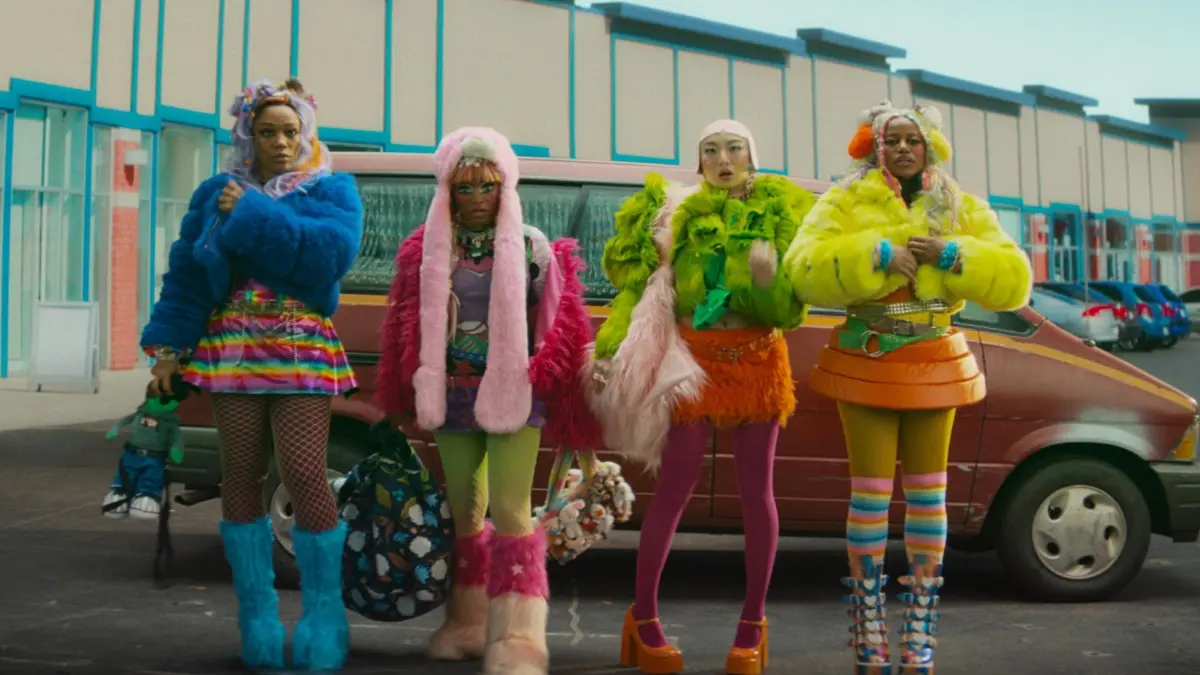

Boots Riley’s ‘I Love Boosters’ has arrived like a neon-lit wrecking ball aimed directly at the fashion industry and late-stage capitalism in general. The film had its world premiere as the opening film at the South by Southwest Film and TV Festival on March 12, and has since earned a 93% critical approval rating on Rotten Tomatoes. It is already one of the most talked-about releases of the year.
The film follows the Velvet Gang, a crew of professional shoplifters led by aspiring designer Corvette, played by Keke Palmer, who target cutthroat fashion icon Christie Smith when she steals one of Corvette’s designs, eventually sparking an unexpected movement for retail and factory workers around the world. If that premise has you hungry for more, here are the films that belong on your watchlist immediately.
The Film That Started It All: ‘Sorry to Bother You’ and the Boots Riley Playbook
No list of movies sharing DNA with ‘I Love Boosters’ can begin anywhere other than Riley’s own debut. ‘Sorry to Bother You’ is the story of a telemarketer named Cassius Green who adopts a white voice and works his way up inside an evil tech corporation, a film noted for its audacity and a third act that embraces unimaginable levels of sci-fi and surrealism. It remains the essential primer for understanding what Riley is doing as a filmmaker.
Similar to how ‘Sorry to Bother You’ uncovered a dystopian conspiracy in which powerful white men profited off the backs of Black workers, ‘I Love Boosters’ spirals into a galaxy-brained tangle of out-there ideas rooted in Riley’s publicly communist worldview. The two films are practically companion pieces, with ‘Sorry to Bother You’ offering the quieter, more grounded entry point before ‘I Love Boosters’ turns the chaos dial all the way up.
Riley’s latest teems with tangential asides and unpredictable twists that impress in their sheer unconventionality, much the same way his debut did, suggesting a filmmaker whose second film is essentially a defiant doubling-down on everything that made the first one extraordinary. If you have not revisited ‘Sorry to Bother You’ recently, now is the perfect time.
The Anti-Capitalist Heist Masterclass: ‘Parasite’ and Its Class-War Cousins
For viewers drawn to the class-struggle architecture underneath ‘I Love Boosters,’ ‘Parasite’ is the undeniable next stop. Bong Joon-ho’s film made history when it became the first non-English-language film to win the Academy Award for Best Picture, with Bong also collecting statues for Best Director, Best Screenplay, and Best International Film. It remains one of the sharpest cinematic examinations of economic inequality ever committed to film.
‘Parasite’ frames capitalism as the villain rather than outright demonizing the wealthy as caricatures, presenting everyone suffering under the same system in different ways, which gives it a more nuanced and ultimately more devastating emotional weight than a simple good-versus-bad narrative would allow. That moral complexity is part of what makes it so difficult to shake after the credits roll.
Also worth seeking out in this lane is the Coen Brothers-adjacent tradition of class inversion comedies like ‘Trading Places,’ where Dan Aykroyd and Eddie Murphy star as an upper-class commodity broker and a lower-class street hustler who get to see how the other half lives, generating rich comic material from the collision of privilege and street reality. The laughs feel like protest songs in disguise.
Surreal Satire Films That Weaponize Absurdity
‘I Love Boosters’ belongs firmly in a tradition of films that use visual and narrative chaos to sharpen their political points. Critics have compared the experience of watching it to Ken Russell’s ‘The Devils’ and Yorgos Lanthimos’ ‘Poor Things,’ films where maximalist sensory assault is the deliberate vehicle for the message rather than a distraction from it. Both titles are worth discovering if they have escaped your radar.
‘Everything Everywhere All at Once,’ the unlikely A24 hit that went on to win seven Oscars including Best Picture, is also cited alongside ‘I Love Boosters’ as a signal of renewed audience interest in risk-taking cinema that refuses to stay in a recognizable lane. The Daniels film offers a similarly chaotic emotional and visual journey that somehow coheres into something genuinely moving.
Terry Gilliam’s ‘Brazil’ also functions as a satire of totalitarian governments, consumerism, and the industrial world, featuring the same kind of bonkers sense of humor that Riley utilizes in his work, with a low-level bureaucrat navigating a technocratic future society that mirrors the absurdist world-building Riley has made his signature. It is a film that rewards multiple viewings for the detail hidden in every frame.
Movies Like Boots Riley That Celebrate Working-Class Rebellion
Several films capture the same spirit of working-class protagonists turning the systems above them inside out. ‘Blindspotting,’ a comedic drama following lifelong friends in Oakland, uses its Bay Area setting to dig into issues of race, cultural displacement, and the struggles of staying true to oneself in a world that’s constantly shifting through a seamless mix of sharp humor and heartfelt drama. The shared Oakland geography with Riley’s films makes for a particularly resonant double feature.
‘Catfight’ is another criminally overlooked film that functions as a hilarious examination of class and privilege, starring Sandra Oh and Anne Heche as former college frenemies on opposite ends of the economic spectrum whose rivalry escalates into something wildly unexpected. Its dark comic energy runs on a similar frequency to the Velvet Gang’s escalating scheming.
At its core, ‘I Love Boosters’ is a film about real anger meeting real joy, where the absurd and the political are not opposites but partners, and that particular combination is what makes it genuinely rare in contemporary cinema.
The films above each carry that same charge in their own distinct ways, and together they form a kind of unofficial curriculum for viewers who want their entertainment to mean something. Which of these films are you planning to watch first, and do you think anything else in recent cinema comes close to what Boots Riley is building with the Velvet Gang?