If ‘Pressure’ Left You Breathless, These WWII Tension Dramas Need to Be on Your Watchlist

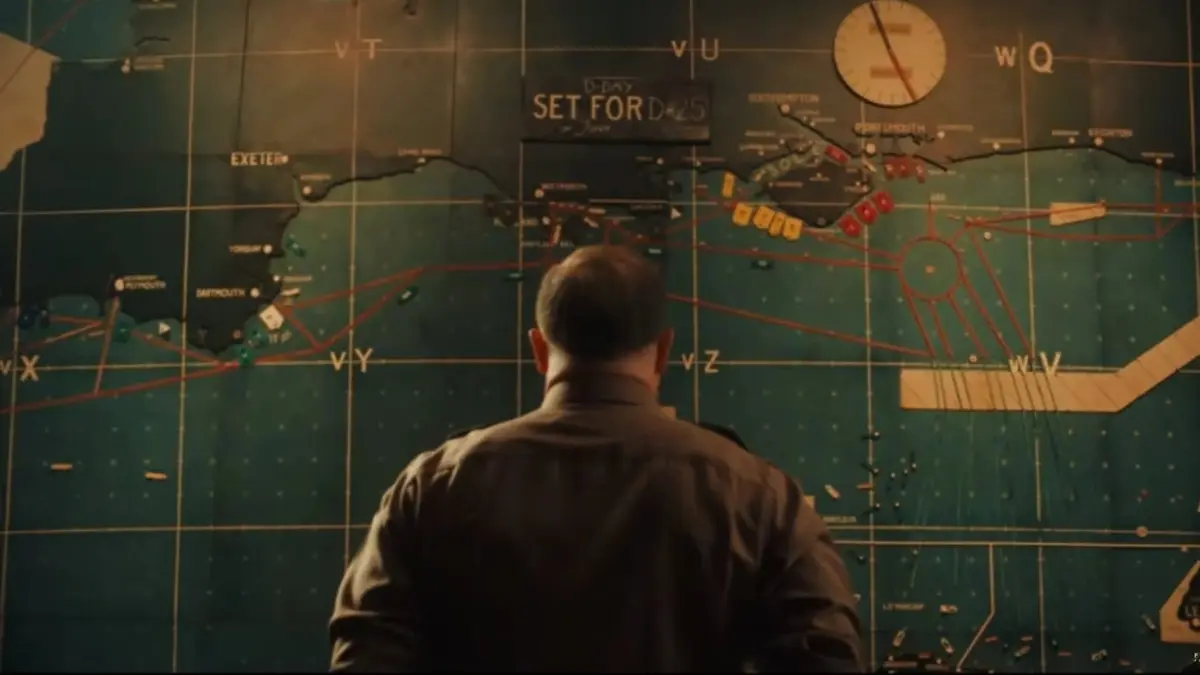

The countdown to D-Day has never felt quite this claustrophobic on screen. ‘Pressure’ follows General Dwight D. Eisenhower and Captain James Stagg as they face an impossible choice in the tense 72 hours before D-Day, with the fate of the free world hanging in the balance. It is the kind of historical war drama that strips away battlefield spectacle and replaces it with something far more nerve-shredding, the unbearable weight of a single decision.
Starring Andrew Scott as meteorologist James Stagg and Brendan Fraser as Eisenhower, and directed by Anthony Maras, ‘Pressure’ is adapted from David Haig’s 2014 stage play and produced by Working Title Films. If watching two men argue about the weather while the entire war teeters on the outcome sounds like your kind of cinema, you already have very specific taste. And there is a whole roster of films built for exactly that.
What Makes ‘Pressure’ a New Kind of Historical War Drama
One early reviewer noted that while the world does not need another WWII film, David Haig and Anthony Maras manage to find a story that feels fresh, following James Stagg as a meteorological procedural that Maras punches up into something that plays like a thriller. That is the key ingredient these films share with ‘Pressure’: tension that comes not from bullets but from the horror of not knowing whether the right call was made.
The feature is based on the true events leading up to the D-Day invasion, with Eisenhower and Stagg forced into a conversation about weather conditions that would determine the fate of the Normandy landings. It is a war film where the battlefield is a conference room, and the most terrifying weapon is uncertainty. That tonal DNA connects directly to a wave of modern WWII dramas that similarly found their power in restraint.
Distributed by Focus Features, ‘Pressure’ arrives in theaters on May 29, 2026, pitting it against the upcoming horror film ‘Passenger’ at the box office. Whether or not it breaks out commercially, it belongs in a conversation with some of the most acclaimed war films of the past decade.
‘Darkest Hour’ and ‘The Imitation Game’: WWII Decision-Making Movies Done Right
‘Darkest Hour’, directed by Joe Wright, is a historical drama that follows Winston Churchill’s early days as Prime Minister during World War II, exploring his leadership during a critical moment as he faces opposition, doubt, and the looming threat of Nazi invasion. Like ‘Pressure’, it is fundamentally a film about one man in a room being asked to do the impossible, with the whole of history watching and waiting.
Gary Oldman plays a newly appointed Prime Minister Churchill who must confront the ultimate choice of whether to negotiate with Hitler and save the British people at a terrible cost, or rally the nation and fight on against incredible odds. Oldman’s performance is the kind that makes you forget you’re watching a film at all, and the moral architecture of the story sits uncomfortably close to what ‘Pressure’ excavates through Stagg’s weather forecast dilemma.
‘The Imitation Game’ stars Benedict Cumberbatch as Alan Turing, who decrypted German intelligence messages for the British government during World War II, directed by Morten Tyldum and written by Graham Moore, based on the biography ‘Alan Turing: The Enigma’. The film earned over $233 million at the global box office, which says everything about the public appetite for WWII stories driven by intellect rather than infantry.
Turing was tasked by the British government to help crack the Enigma codes, which were incredibly complex and changed every 24 hours, placing him at the center of one of the war’s most consequential intelligence operations. The impossible time pressure, the weight of lives hanging on a technical answer, and the loneliness of being the only person in the room who truly understands the stakes all feel like a close cousin to what ‘Pressure’ delivers.
‘Dunkirk’ and ‘1917’: Tense Films That Redefine War Cinema
Some of the best films like ‘Dunkirk’ include ‘1917’, ‘Saving Private Ryan’, ‘Greyhound’, ‘Hacksaw Ridge’, and ‘Darkest Hour’, all of which share a focus on serious, suspenseful, and realistic portrayals of military conflict. What Christopher Nolan’s ‘Dunkirk’ did was prove that a war film could work almost without dialogue, leaning entirely on atmosphere and structure to generate dread.
‘Darkest Hour’ and ‘Dunkirk’ are connected by the real-life events they portray, with Churchill’s famous speech built up through the course of ‘Darkest Hour’ being heard in ‘Dunkirk’s’ final moments. Watching the two back to back creates one of the more remarkable double-feature experiences in modern cinema, with ‘Pressure’ now offering a third angle on the same war, this time through a forecast.
‘1917’ follows two young British soldiers given a seemingly impossible mission to cross enemy territory and deliver a message that will stop a deadly attack on hundreds of lives, and is described as visually stunning and tense. Sam Mendes constructed the film as a single unbroken shot, turning the act of running through a war zone into something almost unbearably intimate, a formal choice that echoes the real-time pressure at the heart of ‘Pressure’.
‘Greyhound’ and the Lonely Burden of Command at Sea
‘Greyhound’ is described as less a traditional war epic and more a stripped-down simulation of survival at sea, locking viewers into the relentless tension of an Atlantic crossing hunted by U-boats from the first scene to the last, never allowing a moment of relief. It is, in its own way, another 90-minute pressure chamber built around one man making decisions no one should ever have to make alone.
Tom Hanks, who also co-wrote the script, turns in a performance as a restrained and sharply focused commander who pauses momentarily to weigh each decision, representing a film with an almost documentary feel with scant secondary plots, making it all about the battle. That stripping back of conventional narrative drama is precisely what ‘Pressure’ does with Stagg’s forecasting standoff, keeping the camera close and refusing to let the audience look away.
‘Greyhound’ was written and produced by Hanks and directed by Aaron Schneider, treating combat as a job to be done and focusing more on logistics than character arcs or emotional revelations. For viewers who respond to ‘Pressure’s’ procedural energy and its interest in the mechanics of war-time decision-making, ‘Greyhound’ is the most direct companion piece on this list.
There is clearly something that audiences and filmmakers alike keep returning to in these war stories built around a single impossible judgment call, a weather report, a cracked code, a destroyer convoy threading through wolf-pack submarines. If ‘Pressure’ hits the way its early buzz suggests it will, it could reignite conversation around the whole genre, so which of these films do you think captures that unbearable burden of command most powerfully?