‘Pressure’ Ending Explained: What Stagg’s Weather Forecast Really Decided on the Eve of D-Day



The most gripping war film hitting theaters right now does not feature a single beach landing. ‘Pressure,’ the new WW2 drama from director Anthony Maras, builds its entire climax around a weather map and one man’s refusal to tell powerful people what they want to hear. It is a thriller operating in briefing rooms, not on battlefields, and that restraint makes its ending hit harder than most combat sequences ever could.
The film centers on the tense 72 hours before D-Day, as General Dwight D. Eisenhower and Group Captain James Stagg face an impossible choice: launch the largest and most dangerous seaborne invasion in history, or risk losing the war altogether. For audiences leaving the theater wondering exactly what they just witnessed, here is a full breakdown of what the ending means and why it matters.
The Stagg vs. Krick Forecasting Conflict
The engine powering ‘Pressure’ from start to finish is a battle between two competing weather predictions. One meteorological system relies on pattern recognition and insists the skies will be clear, while Stagg’s forecast predicts a devastating storm. As the invasion deadline inches closer, the film turns meteorology into a ticking clock.
Rival forecaster Krick, played by Chris Messina, embodies the American military’s preference for optimism over accuracy. Against this pressure, Stagg emerges as the adult in the room, his unwavering fealty to the facts making him the unlikeliest of heroes.
The material, based on David Haig’s 2014 stage play, offers a welcome argument, much needed in these anti-science times, of how, as one character puts it, “Data — that’s what counts.” It is a line that doubles as the film’s thesis statement.
Director Anthony Maras co-wrote the screenplay with David Haig, and they make the story so urgent that audiences almost forget they already know the historical outcome. That is no small filmmaking achievement.
What Happens at the End of ‘Pressure’
In the final act, General Eisenhower rejects the optimistic forecast of the rival American meteorological team and bases the invasion entirely on Stagg’s prediction. The Allied fleet is held back on June 5, saving them from a massive, unpredicted squall in the English Channel. When the brief weather window Stagg promised opens on June 6, Eisenhower gives the final “Go” order.
It is portrayed as a supreme commander submitting to the scientific method. Eisenhower’s choice to trust a prickly, insubordinate Scottish meteorologist over his own brass is the moral pivot of the film. It defines leadership not as the ability to give orders, but as the capacity to tolerate uncertainty and trust the right expert.
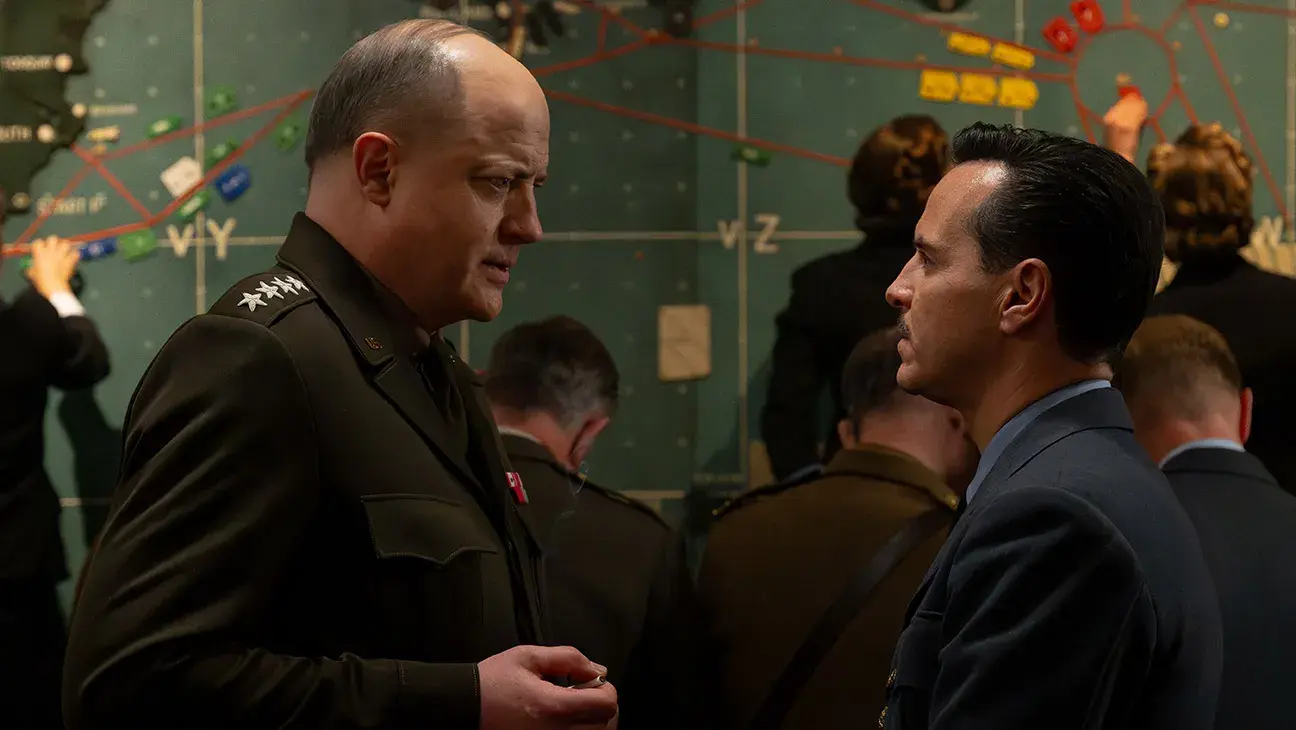
The film concludes by cross-cutting between the clearing skies over the Channel and Stagg collapsing in exhaustion, having secured both the invasion’s viability and survived the agonizing wait for news of his wife’s safety during a London bombing raid.
Few actors working today handle emotional devastation as well as Andrew Scott, whose moving portrait finds him touching his wedding ring as he gives a bad forecast to his commander, all while thinking of his wife and child.
The Personal Stakes: Stagg’s Pregnant Wife and the Bombing Subplot
A critical thread running beneath the strategic drama is the fate of Stagg’s family back home. Stagg must leave his pregnant wife, Liz, to serve his country during a crucial moment in history. When the hospital Liz is giving birth in is bombed, Stagg has the added trauma of not knowing whether she survived.
‘Pressure’ solves the challenge of dramatizing barometric charts by tethering the macro stakes of D-Day to the micro stakes of Stagg’s pregnant wife, who is caught in a bombing raid back home. By the time the ending arrives, Stagg has been denied any communication with her.
Critical opinion on this subplot is divided. Some reviewers describe it as a late-breaking and apparently fictional development that feels gratuitous and merely in service of an emotionally manipulative ending rather than a legitimate narrative development. Others argue the opposite. The subplot involving Stagg’s wife ups the stakes and avoids feeling corny or over-the-top, with everything presented in a believable way.
Kerry Condon plays Kay Summersby, Eisenhower’s assistant, and the screenplay uses her primarily to provide Stagg with empathy when there is a scare involving his wife.
Andrew Scott, Brendan Fraser, and What the Performances Add to the Ending
The emotional weight of ‘Pressure’s’ final moments depends entirely on the performances carrying the audience through two hours of dialogue-heavy tension. Critics have highlighted the cast, which includes Brendan Fraser, Kerry Condon, and Andrew Scott, as excellent, with one reviewer noting that for a movie about the weather, it is pretty exciting.
Anthony Maras turns a meteorological standoff into a legitimate thriller. Andrew Scott is quietly electric as James Stagg, and Brendan Fraser holds his own as Eisenhower. The dynamic between the two leads gives the ending its emotional resolution, as a powerful general chooses to believe the man the entire institution has been trying to silence.
Another critic described ‘Pressure’ as a thoughtful film about people facing the direst problems with honor, intelligence, and courage that goes beyond the physical to include fearlessness about pursuing the truth. That framing illuminates exactly why the ending lands.
The Real Historical Significance Behind the Finale
‘Pressure’ is adapted from David Haig’s stage play, which premiered in Edinburgh in 2014 and later moved to the West End. The story it tells is not speculation. The June 6 window that Stagg identified was real, and the consequences of ignoring it would have been catastrophic.
While the audience knows the historical outcome, the film successfully traps viewers in the 72 hours where the Allies nearly sent hundreds of thousands of men into a maritime slaughter, simply because the American forecasters wanted the sun to shine. That is the emotional trap the story sets and the reason the ending feels like a release of genuine tension rather than a mere formality.
The film is an adaptation determined to convince viewers this is an all-important story that needed to be told, and on the question of whether one meteorologist’s stubbornness genuinely changed the outcome of World War II, the history itself does most of the convincing.
If Stagg had backed down, there would have been no window, no June 6, and no Allied victory at Normandy as the world came to know it. Whether you left the theater satisfied by that quiet, exhausted ending or wishing the film had trusted its central premise a little more from the start, it is worth asking: did ‘Pressure’ make you feel the full weight of what Stagg risked by refusing to change his forecast?