Inside Netflix’s ‘Shipwrecked: Nightmare at Sea’ and the Harrowing Real Story Behind the Costa Concordia Disaster


Netflix has once again turned its lens toward maritime horror, and this time the subject is one of the most infamous cruise ship catastrophes of the modern era. ‘Shipwrecked: Nightmare at Sea’ pulls viewers back into the night the Costa Concordia capsized off the coast of Italy, weaving together survivor testimony and archival footage to recreate a tragedy that shocked the world. The documentary debuted on the streaming platform on July 10, 2026, offering never-before-seen footage and survivor accounts of the collision, capsizing, and evacuation.
For anyone who only remembers the headlines from over a decade ago, the film serves as a sobering reminder that the real story behind the sinking is far more chaotic and human than the news cycle ever captured. The incident remains the deadliest cruise ship disaster in modern history, with 32 people losing their lives that night. The documentary does not just recount facts, it puts faces and voices to a tragedy that unfolded in real time.
The Night the Costa Concordia Capsized
The Costa Concordia left the port of Civitavecchia at 19:18 local time on January 13, 2012, setting off on a week long Mediterranean cruise carrying 3,206 passengers and 1,023 crew members. What was supposed to be a routine detour turned catastrophic almost immediately.
Captain Francesco Schettino had decided to treat a crew member to a sail by salute past the Tuscan island of Giglio, where the staff member’s family lived, a maneuver meant to bring the ship close to shore so its horn could greet people on land.
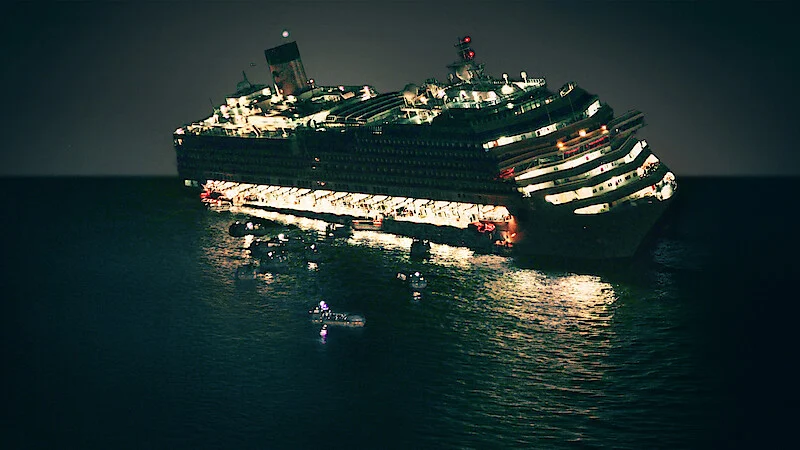
That impromptu decision ended in disaster. It was clear from the audio log retrieved from the ship’s black box that while the captain had ordered the ship steered hard portside, the helmsman misunderstood the order and steered toward starboard instead. The rocks tore a 53 meter gash in the hull, and the damage was catastrophic.
The response from the crew only made matters worse. The general emergency alarm was not raised until 22:33, and the order to abandon ship did not come until 22:54, more than an hour after the initial impact. By midnight, dozens of passengers were still on board, some clinging to the exposed side of the tilting vessel as rescue boats and helicopters worked to reach them.
Survivor Accounts Bring the Chaos Into Focus
What separates ‘Shipwrecked: Nightmare at Sea’ from a standard news retrospective is its reliance on the people who actually lived through the sinking. The film interweaves eyewitness accounts from survivors, cell phone footage taken the night of the tragedy, and translations of the ship’s black box recordings, which expose the dangerous decisions made by the captain.
The rescue itself was a massive, improvised operation. The island of Giglio opened its church to survivors, turning it into a makeshift shelter and a meeting point for families who had been separated during the chaos.
Rescue operations continued through the entire night and into the next day, with some survivors airlifted by helicopter and others located by specialized diving teams.
The scale of the tragedy becomes even more apparent in the final count. It was ultimately determined that 32 people aboard the Costa Concordia, including 27 passengers and 5 crew members, lost their lives in the accident. For survivors, the emotional wounds have never fully closed, and the documentary gives many of them a platform to describe what that night actually felt like from the inside.
Captain Francesco Schettino and the Fallout That Followed
No retelling of the Costa Concordia disaster is complete without addressing the man at the center of it, and the documentary does not shy away from his role. Schettino was dubbed the Coward Captain by the Italian press and became public enemy number one in the aftermath of the sinking.
The legal consequences were significant, though many felt they came slowly. On February 11, 2015, Schettino was convicted of manslaughter, causing a maritime accident, and abandoning ship, and Italian courts sentenced him to a total of 16 years in prison. He is currently serving his sentence in Rome and has exhausted all of his appeals as of 2017.
Schettino was not the only person implicated in the disaster. Five other Costa Cruises employees who were on board were convicted of manslaughter, negligence, and shipwreck, although none of them ever served prison time despite the convictions. Costa Cruises itself paid a corporate fine of one million euros, roughly 1.1 million dollars, and did not face a criminal trial, though the company did pay out settlements to passengers ranging from 11,000 to 92,700 euros.
Reactions to the sentencing were mixed among those who lived through the tragedy. In comments reported by TODAY, survivor Blake Miller of Austin, Texas pointed out that the punishment felt disproportionate to the loss of life involved. That kind of raw, unfiltered reaction is exactly what gives the documentary its emotional weight, since it refuses to let the story end with a simple court verdict.
Behind the Camera of Shipwrecked Nightmare at Sea
The documentary comes from a filmmaker with a track record of turning real events into gripping television. Director Chiara Messineo, known for Stanley Tucci Searching for Italy, interviewed passengers, crew members, and rescue and forensics teams to dissect exactly what went wrong during the disaster.
Netflix has increasingly leaned into this genre of maritime true crime storytelling. The film was made by the same team behind the ‘Trainwreck’ documentary series, and it delivers a similarly intriguing and moving analysis of the accident. In June 2025, Netflix released a ‘Trainwreck’ episode covering the 2013 poop cruise aboard the Carnival Triumph, and in July 2025 the platform released the three part miniseries ‘Amy Bradley Is Missing.’
Fans of the genre are already speculating about what disaster the platform might tackle next. While no future cruise related documentary topics have been officially announced, potential subjects floated by outlets include the implosion of the Titan submersible and other maritime emergencies. For now, though, ‘Shipwrecked: Nightmare at Sea’ stands as one of the more haunting entries in Netflix’s growing catalog of real life disaster storytelling.
The physical remnants of that night have not disappeared either. According to reporting from TODAY, the ship remained partially submerged for years before an enormous salvage operation refloated it and towed it away for scrapping, and residents of Giglio still describe the wreck as a permanent scar on their community’s identity.
Watching survivors recount the confusion, the fear, and the painful wait for rescue makes it clear why this story continues to resonate more than a decade later, and it raises the question of whether anyone who lived through that night on Giglio could ever fully leave it behind, so what part of the Costa Concordia’s story do you think deserves even more attention than this documentary gave it.