Does Athena Actually Love Odysseus? Nolan’s ‘The Odyssey’ Reframes an Ancient Question



Greek mythology has never fully settled the question of what exactly binds the goddess Athena to the mortal king Odysseus, and audiences leaving theaters after Christopher Nolan’s ‘The Odyssey‘ are asking that same question all over again.
Zendaya plays Athena in the film, described in the production’s own credits as the goddess of wisdom, warfare, and handicraft who protects Odysseus throughout his journey. It’s a role that leans directly into one of Homer’s oldest and most debated dynamics.
In the original poem, Athena’s devotion to Odysseus reads less like romance and more like fierce, protective favoritism. She repeatedly intervenes on his behalf, disguises herself to guide his son Telemachus in his absence, and champions him specifically because they share the same instincts for cunning and strategy.
That devotion has fueled centuries of scholarly debate over whether her attachment is loyalty, obsession, or something closer to love, and Nolan’s adaptation seems to be leaning into that ambiguity rather than resolving it.
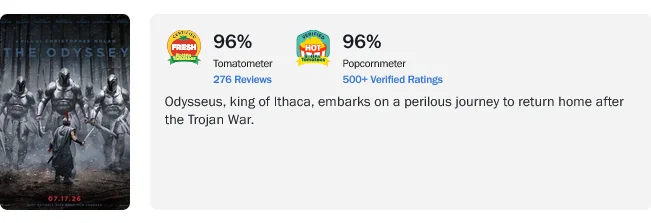
That ambiguity is exactly what critics are picking up on in the finished film. One review raised the question directly, asking whether the goddess is truly appearing before Odysseus at all, or whether her image is a manifestation of his own guilt and the only source of reckoning that can eventually reunite him with his family. The review noted that Nolan’s script is built so that either interpretation works, which is a notably modern way to handle a two thousand year old relationship.
Several other reviews describe Athena functioning almost like an internal voice rather than a traditional deity. One review described Odysseus as stoic in public but shown second guessing every decision during private conversations with a vision of Athena, suggesting she operates as his conscience as much as his protector.
Another review went further, characterizing her appearances as a kind of judgment, comparing her disapproving presence to the look a spouse gives when a chore gets done wrong.
Not every critic reads the dynamic as combative. One review described Athena as an ethereal, almost ghostly presence who, alongside Odysseus’ second-in-command Eurylochus, functions as a sounding board representing the pull between gods and mortals throughout the journey. In one key exchange highlighted by a separate review, Zendaya’s Athena warns Odysseus that his cleverness will get him into trouble, a line that plays out exactly as promised over the course of the film.
Small as her screen time reportedly is, Zendaya’s performance has been singled out as a major contributor to the emotional weight of the film’s third act. Whether Nolan’s Athena loves Odysseus in any traditional sense may be beside the point. What the film seems interested in is whether that devotion, real or imagined, is what ultimately gets him home.
How do you interpret Athena's relationship with Odysseus in The Odyssey?
Have something to add? Let us know in the comments!