The AI Odyssey: An Interview with Pablo Starr on the New Creator Economy and “BoredSpace” (EXCLUSIVE)

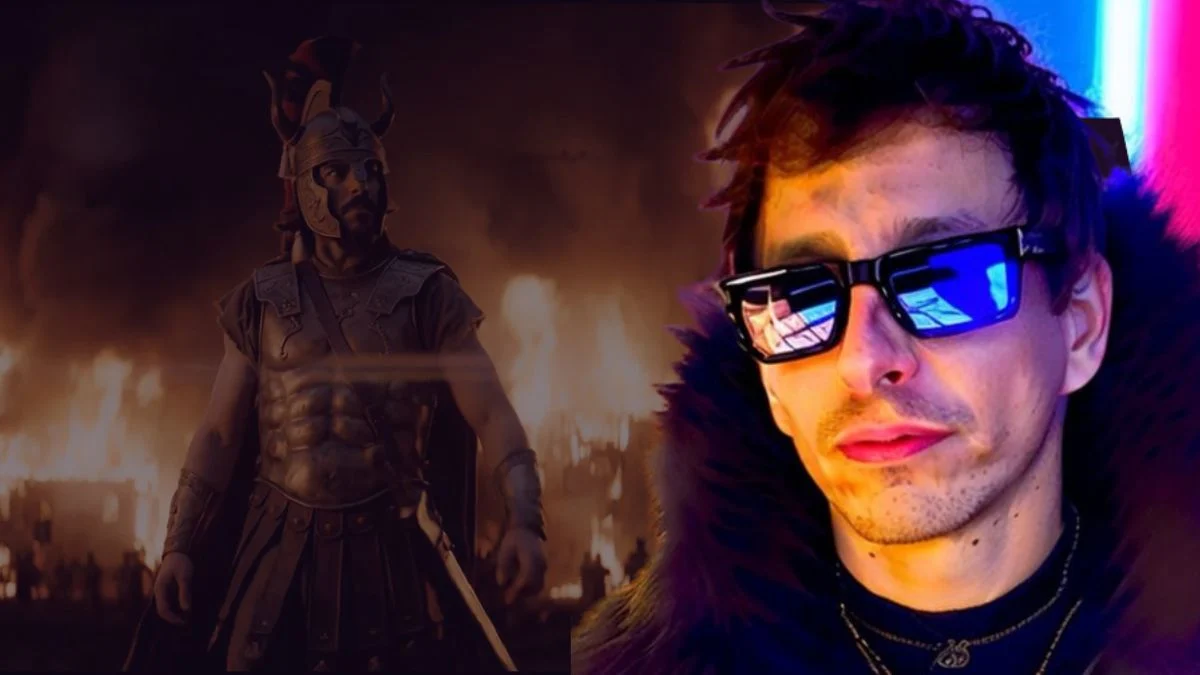

This week, the landscape of independent cinema felt a seismic shift. News that Ash Koosha’s AI-generated feature Odysseus The Fall landed in the trades right alongside Christopher Nolan’s upcoming take on the same epic story marks a defining moment: AI filmmaking is officially leaving the “slop” box behind and entering the realm of serious festival and trade coverage.
At the forefront of this creative revolution is Pablo Starr, a creative tech founder with a footprint spanning high fashion, graphic novels, and screenwriting. As the founder of global fashion platform Fashion Week Online and the mastermind behind Brain Poison Studios, Starr is proving that the future of cinema isn’t about generic AI prompts—it’s about leveraging original, deeply-rooted IP.
With his upcoming sci-fi feature BoredSpace slated for release later this year, and the highly anticipated trailer launch of his graphic novel 10 Million AD, Starr is demonstrating how a controlled, multi-tool AI workflow can slash a six-figure production budget down to just $500, without losing an ounce of artistic control.
We caught up with Pablo Starr to discuss the “Odysseus” turning point, the economics of the new creator economy, and how he translates decades of storytelling into the AI-driven future of film.
Comic Basics: The press release notes that Ash Koosha’s Odysseus The Fall is being treated with a level of seriousness usually reserved for traditional film. In your view, why is this specific moment a turning point for AI-generated cinema, and what does it signal to the wider industry?
There is a quiet but significant shift underway in how AI-generated work is being framed, and Ash Koosha’s Odysseus: The Fall sits squarely at its center. What makes this moment notable is not simply the technology itself, but the decision to treat the output with the same editorial seriousness, critical framing, and distribution logic as traditional cinema. That signals a move away from novelty and towards authorship, intent, and cultural legitimacy. Positioning AI films within the conventions of film, such as press releases, critical discourse, and festival consideration, like Koosha’s Dreams of Violets at Tribeca, suggests that the industry is beginning to recognize AI not as a tool adjunct to filmmaking, but as a medium capable of producing work that demands to be engaged with on its own terms.
Two days ago, George Lucas said AI filmmaking is the future. Martin Scorsese is using AI for storyboarding. Ash Koosha’s film is simply the latest recognition that it’s not about the tools. It’s about the vision behind the tools.
There’s a lot of hate for AI cinema, and I totally get it, but let me give you my two cents on it.
The first thing you need to understand is that photography and filmmaking are not art forms. Baudelaire was very clear that photography is the refuge of failed painters. After all, the photographer does nothing creative, right? All they do is point the box, open the aperture, and real life floods in, captured forever. They didn’t paint a single stroke! Where’s the art?
Similarly, it’s easy to see how pointless a director is. They didn’t write the score, play any of the instruments on the score, shoot the scenes, cast the talent, or deliver any of the lines. Most of the time, they don’t write the script. How can you call a director an artist? What a bum!
Well, in both cases, specific creative choices are being made that result in something original or provocative, beautiful or horrible, but at any rate, something some people feel is worth looking at.
So the art comes from the curation, and the mind of the artist(s) involved, not how laborious or hands-on the process may be.
Next let’s talk about a related topic: “AI slop.”
Imagine a situation where lots of people have an idea for a cool photograph. But for some reason, a single camera costs at least $1 million. But usually more than $5 million.
As a result, very few photographs are released every year. (And some of them cost $100 million or more, and people still don’t like them!) But at least there aren’t many to choose from.
Then something weird happens.
Cameras become free. Now you’re flooded with pictures, and most of them are crap.
Do you really resent the camera, or do you resent the fact that a lot of people suddenly have access to a camera? If you’re someone who could afford a camera before, maybe it makes you feel less special. Maybe it makes you feel afraid. That’s reasonable.
But maybe it’s not the sheer number of new photos that bothers you. Maybe you feel resentful that AI has been trained on the whole of human art. “Plagiarism!” you say.
Then you should probably sue all rock, country, rap, and jazz artists for ripping off the blues, Citizen Kane for copying Stagecoach, Star Wars for ripping off Kurosawa, Einstein for building on Hendrik Lorentz, and West Side Story for stealing the plotline of Romeo and Juliet.
But now your lawyers are really going to need a time machine, because they also have to sue Shakespeare for ripping off Arthur Brooke, Brooke for ripping off Boaistuau, Boaistuau for ripping off Bandello, and Bandello for ripping off Luigi da Porto.
The bottom line is that AI is a tool. Most people don’t have the imagination to do anything very interesting with it. Some people are going to use it well. And occasionally someone will come along who will do something amazing with it, like Robert Johnson might pick up a pawn shop guitar and make it sing, Michelangelo might use some colorful goop to paint the Sistine Chapel, or Henri Cartier-Bresson might blow your mind by pointing a cold metal box at the street and pressing a button.
(Final note: If none of this sways you, and your problem is that AI is using water, the livestock industry uses roughly 200 times more water than AI data centers. Look it up.)
You emphasize that Brain Poison Studios builds upon your own IP rather than relying on generic AI prompts. How does starting with established IP fundamentally change the narrative depth and visual consistency of the final product compared to standard generative approaches?
I still believe that, at the end of the day, Story is everything.
I have a MA in Creative Writing and spent many years after college studying story: books, beat sheets, character sheets, theories of what makes story work. Important concepts like what the character wants versus what the character actually needs.
Ultimately, everything boils down to character and the character’s journey. If you don’t care about the character, you don’t care about anything.
Having existing IP is extremely helpful because you know the characters thoroughly: what makes them tick, what pisses them off, what they’re chasing and why, what childhood wounds they’re trying to correct for. And you have a whole story arc in mind already.
For me it’s so important to know as much as possible before you begin writing or creating anything. Hemingway called that Iceberg Theory. If you understand the backstory and the characters, people will sense that, even if you don’t tell them directly.
Now, that’s not a one-size-fits-all thing. Stephen King just wings it, and last I checked, he was doing pretty well.
But for me, it’s really helpful coming in because you aren’t just putting in a prompt and hoping something cool and surreal will pop out. (Although I do love that stuff. In the right hands, AI can create such cool, surreal imagery. And if you think it’s easy, try it yourself.)
But specifically, I’ve been trying to use AI to create the movies I’ve always seen in my head.
You mentioned a case study where a 90-second sequence was produced for $500, a scene that would normally cost six figures. Can you elaborate on the “controlled multi-tool AI workflow” that enables this level of cost reduction while maintaining professional quality?
I start with Midjourney, as many do, because it creates some of the most visually striking imagery. After that, I’m constantly trying different tools and seeing what I can tease out of them. Kling and Seedance are currently two of the models I use most often. It feels like there’s always a different platform with another supposedly easy workflow, but the fact of the matter is, no matter which one you use, the process is still incredibly frustrating.
Yes of course, “realism” is a challenge. But what type of “realism” are you going for? Gritty like Ridley Scott? Ethereal like Stanley Kubrick? Cinéma vérité like Cassavetes?
You have choices to make, whether you think so or not.
And what about “casting?”
For example, I say, “generate her grandfather, a professor.” The first one looks severe and diabolical. The next one looks too comical. So you keep generating until you feel you have a professor that feels right.
Now let’s talk about “acting.” Getting a single good “line read” you want from a character might take 20 or more iterations.
Ellie, a character who has existed in a screenplay for two decades, has to explain to her friend that her grandfather’s time machine really worked.
The line is simple: “It sent the watch into the future!”
First, she seems too calm. No, that won’t work. Her grandfather died a laughingstock, so this is a big discovery. Not to mention the scientific weight of it. So let’s put “very excited.” Now she sounds upset, like she didn’t want it in the future. Oops. So we put “very happy and excited.” Now she sounds manic, like someone hallucinating. So we put “she sounds vindicated.” Now we’re getting a little closer.
That’s it! The perfect “read!” But wait! The phone line passed through her body. Let’s start again.
Each of these generations is costing you money, so you’re watching the money trickle away right in front of your eyes, trying to balance cost and gauge your level of exhaustion and whether you should cut your losses and move on to the next line.
For literally every aspect of the production, this is the process. It’s brutal, and you keep about 3% of all the stuff you generate.
And you better believe that after a few days of work generating, sorting, throwing 97% out, editing in DaVinci Resolve, color grading, mixing the sound, and agonizing over the final product, someone is going to come by who has never created anything in their life, just to inform you how bad your work is, spot the small thing you missed, or simply leave a clever GIF about your “boring AI slop.”
This is the way.
AI filmmaking is currently struggling with a reputation for producing “slop” or low-quality, incoherent content. What, in your experience, is the crucial difference between that “slop” and the festival-ready work being produced at Brain Poison Studios?
The bottom line is that most people pick up oil paints, and what they create is beautiful and personal, but probably not interesting enough for anyone to care about.
The same is true of AI. You can create something really boring, really fast, or you can create something really nuanced and beautiful, or just entertaining.
But the problem isn’t the medium.
A camera itself is a soulless machine until someone behind it does something interesting with it. The medium is not the problem. The problem is and will always be the mind behind the medium. Hopefully, all of us slowly get better as we go, whether that means in terms of writing, technical skill, or creative decision-making in general.
Having said that, most people are creating the best thing they know how. Being mean to them is time that could be better spent doing something productive in your own life.
One of the biggest technical challenges in AI filmmaking is maintaining character consistency and narrative flow over the runtime of a feature film. How do you exercise “tight control” over your characters and storyboards to ensure they don’t break continuity?
This is a constant challenge. Right now, you can upload character references and all kinds of things, but they still slip constantly.
For example, I was trying to make a version of Ellie who was 12 rather than 16. None of the models seemed to understand what that age should look like. The choices seemed to be 9 or 18. These are the kind of nuances you’re constantly trying to work around.
The tools are getting better, and I think this will be solved in the next year or so.
Until then, much of this is about being willing to sit for 12-hour days until you have something you feel might be decent enough to show people.
And just like Baudelaire called photographers failed painters, there will always be someone to tell you that what you’re doing is easy and worthless, because they don’t understand the process and probably wouldn’t care if they did.
You have a unique background as the founder of Fashion Week Online. How has your experience in the high-fashion industry influenced the visual aesthetic and “look” of your upcoming films like BoredSpace?
My favorite director is Stanley Kubrick. And I love Luc Besson. Besson comes from the French sci-fi tradition rather than the American. Both of these directors are extremely attentive to the aesthetic aspect of everything, from the costumes to the music.
For a long time, sci-fi, particularly American sci-fi, was inspired by astronauts one way or another. Cold, clinical spaces with perfect shine. Or, on the other hand, gritty industrial spaces.
The more interesting question is: what’s the culture? It’s a question that takes a lot longer to answer and requires a lot more world-building. What music do they listen to? What kind of clothes do they wear? What kind of food do they eat? What are the fast food chains? What are some weird memes going around?
Space is something lived in. People use products. They see commercials. These are the things I find really fascinating and fun. I love Rick and Morty and Guardians of the Galaxy for this kind of stuff.
When I was younger, I loved a lot of the New Hollywood movies. Alice Doesn’t Live Here Anymore, The Conversation, A Woman Under the Influence, Chinatown. (Interestingly, all of these came out in 1974.) Another one of my favorite movies is Black Orpheus, although that came out earlier.
I also love 70s sci-fi and horror. I like anything with a Moog soundtrack. But most of all, I like characters going through things. I like to see them come unraveled. I like to know why they’re so angry.
You talk about a “new creator economy” built on original IP. Do you believe this technology will eventually democratize filmmaking to the point where an individual creator can outcompete traditional indie studios, or will it simply become another tool in the studio arsenal?
Studios will pledge not to use the technology, right up until they’re competing with films that cost $100,000 versus their $220 million. The studios are all about money, and that will never change.
As always, the best and most interesting stories are the ones that will rise to the surface. That probably won’t be mine. But they won’t need the permission of studio executives and financiers. That means a lot of predatory companies and people out there that make money from hopefuls will have to find something else to do.
For those curious about the technical process: when you speak of a controlled workflow, are you acting as a one-man show, or are you utilizing a pipeline of specialized teams/tools that allow you to scale your production?
Currently, I write the script, Sam Bermudez creates the art for the graphic novels, but when I bring it over to my AI workflow, all bets are off.
For example, originally, I created a trailer for BoredSpace that matched the graphic novel from the point of view of the protagonist. Chathura is the one trying to save her little sister by selling a seemingly worthless necklace. Obviously, it should start with her, just like it does in the graphic novel.
But actually seeing it on the screen, I was a little bored. As a viewer, I have the attention span of a parakeet. I want to be in something exciting right away.
Then I realized a more interesting perspective was from Grova, the assistant of the antagonist, whose life is in constant danger. I’d just watched Invitation to Hell, a 1984 Wes Craven made-for-TV movie with Susan Lucci, which came out right before Nightmare on Elm Street.
Suddenly, I had the idea of creating something with that same sort of low-budget sci-fi vibe with ridiculous silver jumpsuits and a little Moog soundtrack thrown in. And we see it from the point of view of Grova, who’s in the middle of this crazy world where death is around every corner.
Was it a good choice? Who knows. But if you’re not having fun, there’s no point in doing it.
With 10 Million AD launching on GlobalComix and BoredSpace set for release later this year, what are the primary benchmarks you’re looking to hit to prove that your AI-driven features can compete commercially with traditional indie cinema?
For the 10 Million AD trailer, I felt it was important to show that I (hopefully) understand what a traditional movie is supposed to look like from the point of view of solid story mechanics.
I’ve always had ideas for movies that are more quirky and artistic, and others that are more like those wonderful movies I grew up on. There’s a place for Logan’s Run, and a place for Raiders of the Lost Ark.
I’d like to see Brain Poison Studios producing both types. For that, I’ll need some really skilled people who understand how to use the tools well and creatively.
As with any production, they will have to bring their own creativity and originality to it.
If you’re a director, you don’t hire just any makeup artist or VFX artist. You hire one who is a genius at what they do, with a vision that is compatible with what you are trying to create.
It’s the same thing with these tools.
Any monkey can generate with AI. Just like any monkey can operate a camera.
The question is, who is the person behind the tool?
Looking five years ahead, do you envision a shift where audiences won’t even be able to tell if a film was “AI-driven” or traditionally shot, and what do you think that shift will do to the value of human-led storytelling?
Not long ago, AI couldn’t create a video of someone eating spaghetti reliably. In a year or two, the difference will be negligible, if that.
But it was never about how things looked. That’s why you see movies coming out that cost tens of millions of dollars that later flop at the box office.
If you don’t care about the characters and the writing, no amount of money is going to fix that. If the editing drags, it doesn’t matter how good the actors are. If the actors aren’t right, a bigger VFX budget can’t save it.
Everything always boils down to creative choices.