Behind the Scenes of ‘The Odyssey’ Reveals a 60 Foot Contraption Built to Bring the Cyclops to Life


Christopher Nolan has spent his entire career finding ways to avoid a computer screen when a practical solution will do, and Homer’s mythological beasts gave him one of his biggest challenges yet.
Bringing a story stacked with fantastic creatures to the screen while still capturing the same grounded realism he brought to Gotham City or the far reaches of space in ‘Interstellar’ meant finding a genuinely physical way to make a one-eyed giant feel like it was actually standing in the room.
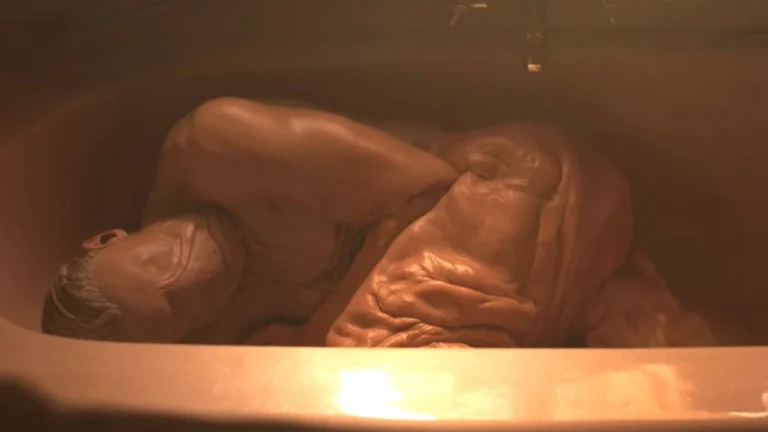
That giant is Polyphemus, the man-eating Cyclops who traps Odysseus and his crew in a cave during one of the story’s most harrowing sequences. Rather than generating the creature digitally, Nolan and his team built an enormous 60-foot mechanical contraption to physically realize the monster on set, giving his actors something tangible to actually react to rather than performing against an empty green screen.
Speaking to Empire, Nolan explained the thinking behind that decision, saying that everything about the Cyclops sequence was built around imagining what the encounter would genuinely feel like in real life.
He said he deliberately avoided approaching the creature or the moment from a storybook or cartoonish perspective, instead grounding the entire sequence in how Odysseus and his men would have actually experienced it.
The physical puppet itself was overseen by Bill Irwin, the performer previously known for voicing and puppeteering the robot TARS in Nolan’s ‘Interstellar’. According to Matt Damon, who plays Odysseus, Irwin was present on set for the entire shoot, providing the creature’s voices and physical noises throughout filming rather than having the actors simply imagine a reaction to something that would be added later.
Filming took place inside Nestor’s Cave near Voidokilia Beach in Greece, a genuinely historic location that added its own layer of atmosphere to the sequence. Nolan has described the choice to shoot inside a real cave as giving the scene a sense of oppressive reality that building a set from scratch simply could not replicate, leaning the sequence closer to horror than traditional fantasy adventure.
That approach lines up with Nolan’s broader track record of favoring practical effects wherever possible. During production on ‘Oppenheimer’, he famously recreated the Trinity test explosion using miniatures and controlled detonations rather than digital effects, and built an actual rotating hallway set for a fight sequence in ‘Inception’, all part of a filmmaking philosophy that consistently prioritizes tangible, in-camera solutions over relying on post-production trickery.

Early reactions to the Cyclops footage have leaned heavily into that same sense of visceral dread Nolan was aiming for. Fans reacting to trailer footage online have described the creature as genuinely unsettling, with some comparing the sequence’s use of forced perspective to classic stop motion era fantasy filmmaking like ‘Jason and the Argonauts’, a comparison that speaks directly to the tactile, handcrafted quality Nolan was chasing.
Do practical effects make scenes more impressive?
For a director whose entire career has been built around making audiences believe the impossible is actually happening in front of them, the Cyclops sequence stands as one of the clearest examples yet of just how far Nolan is willing to go to avoid a digital shortcut.
Have something to add? Let us know in the comments!