Zach Cregger Reveals the Wild Camera Trick Behind ‘Resident Evil’s Gunfights


Video game adaptations have struggled for decades to capture what actually makes gameplay feel immersive on a movie screen, often settling for shaky handheld chaos instead of anything resembling a controller-in-hand experience. Zach Cregger’s ‘Resident Evil’ reboot set out to solve that problem differently, leaning directly into the franchise’s roots as a survival-horror game rather than dressing it up as a standard action movie.
That ambition became one of the film’s defining talking points well before release, with Cregger repeatedly emphasizing how closely he wanted the camera work to mirror the feeling of actually playing the games. Now that the film has hit theaters, the director is opening up about just how far his team went to pull that off practically, without relying on digital trickery.
Zach Cregger says the first-person shooter scenes in ‘Resident Evil’ were created using camera rigs mounted directly onto guns and, at times, onto star Austin Abrams’ own head, according to DiscussingFilm. “We mount it to a machine gun & shotgun… you have to mount it rigidly to the gun to get that first person ratio… If the barrel’s too high in the frame or slightly not aiming dead center it feels dead wrong,” Cregger explained.
Zach Cregger says first person shooter scenes in ‘RESIDENT EVIL’ are created by camera rigs on guns & sometimes Austin Abrams' head.
— DiscussingFilm (@DiscussingFilm) September 19, 2026
“We mount it to a machine gun & shotgun… you have to mount it rigidly to the gun to get that first person ratio…
If the barrell's too high in… pic.twitter.com/9XgyxQw0kf
That level of detail speaks to how meticulously Cregger approached the film’s most video-game-inspired sequences, treating even small misalignments as enough to break the illusion entirely. Rather than simulating the perspective digitally in post-production, the team opted to physically rig cameras to the weapons themselves, ensuring the barrel’s position in frame matched exactly what a player would see holding the gun on screen.
Mounting a camera to Abrams’ head for certain shots added another layer to that realism, letting the film capture his character’s literal point of view as he moved through Raccoon City’s chaos. It’s a technique that trades the flexibility of a traditional camera operator for something closer to the locked-in, first-person feel longtime fans of the games would instantly recognize.
‘Resident Evil’ follows Bryan, a medical courier played by Abrams who gets pulled into a nightmarish fight for survival after hitting a woman with his car and refusing to leave her behind. Cregger has described the character as “more of an Ethan than a Leon,” someone who would realistically “miss like 90 percent of the shots he takes with a gun,” a deliberate departure from the trained, gun-savvy heroes typically associated with the franchise.
That choice shapes how the first-person sequences function within the story, since Bryan’s lack of combat experience makes every gunfight feel less like a power fantasy and more like a desperate scramble. The camera’s shifting between third-person and first-person perspectives was designed specifically to track his attention as it darts between threats, rather than sticking to one fixed visual style throughout.
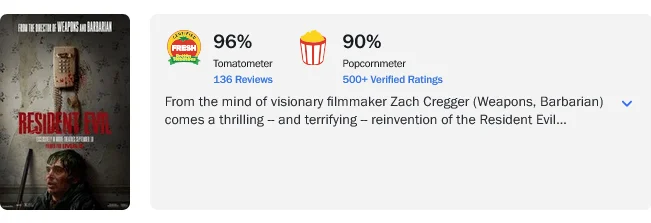
Cregger has said the first-person sequences draw direct inspiration from ‘Resident Evil 7: Biohazard,’ ‘Resident Evil Village,’ and ‘Resident Evil Requiem,’ games that similarly used perspective shifts to heighten tension. The film also leans into other recognizable series elements, including environmental exploration, item scavenging, weapon upgrades, and callbacks like green herbs and typewriters scattered throughout Raccoon City.
Joining Abrams in the cast are Zach Cherry, Kali Reis, and Paul Walter Hauser, rounding out a story co-written by Cregger and Shay Hatten. The film arrived in theaters and IMAX on September 18, positioning it as one of the more ambitious attempts yet to translate interactive horror gameplay into a purely cinematic format.
The first trailer for Zach Cregger's ‘RESIDENT EVIL’ has been released.
— DiscussingFilm (@DiscussingFilm) April 30, 2026
In theaters on September 18. pic.twitter.com/eeVCAGzy6M
Fans and critics alike have pointed to the practical camera work as one of the film’s most distinctive elements, with the rig-based approach standing out in an era where most blockbusters lean heavily on visual effects to achieve similar results. Cregger’s insistence on physically mounting cameras rather than faking the perspective digitally reflects a broader commitment to grounding the film’s horror in tangible, hands-on filmmaking.
That dedication to precision, right down to worrying about a barrel sitting slightly too high in frame, suggests just how seriously the production treated its source material’s legacy.
What do you think of Zach Cregger mounting cameras directly to guns and actors for first-person scenes?
Have something to add? Let us know in the comments.