‘Being Heumann’ Ending Explained: How the 1977 Sit-In Changed Civil Rights History

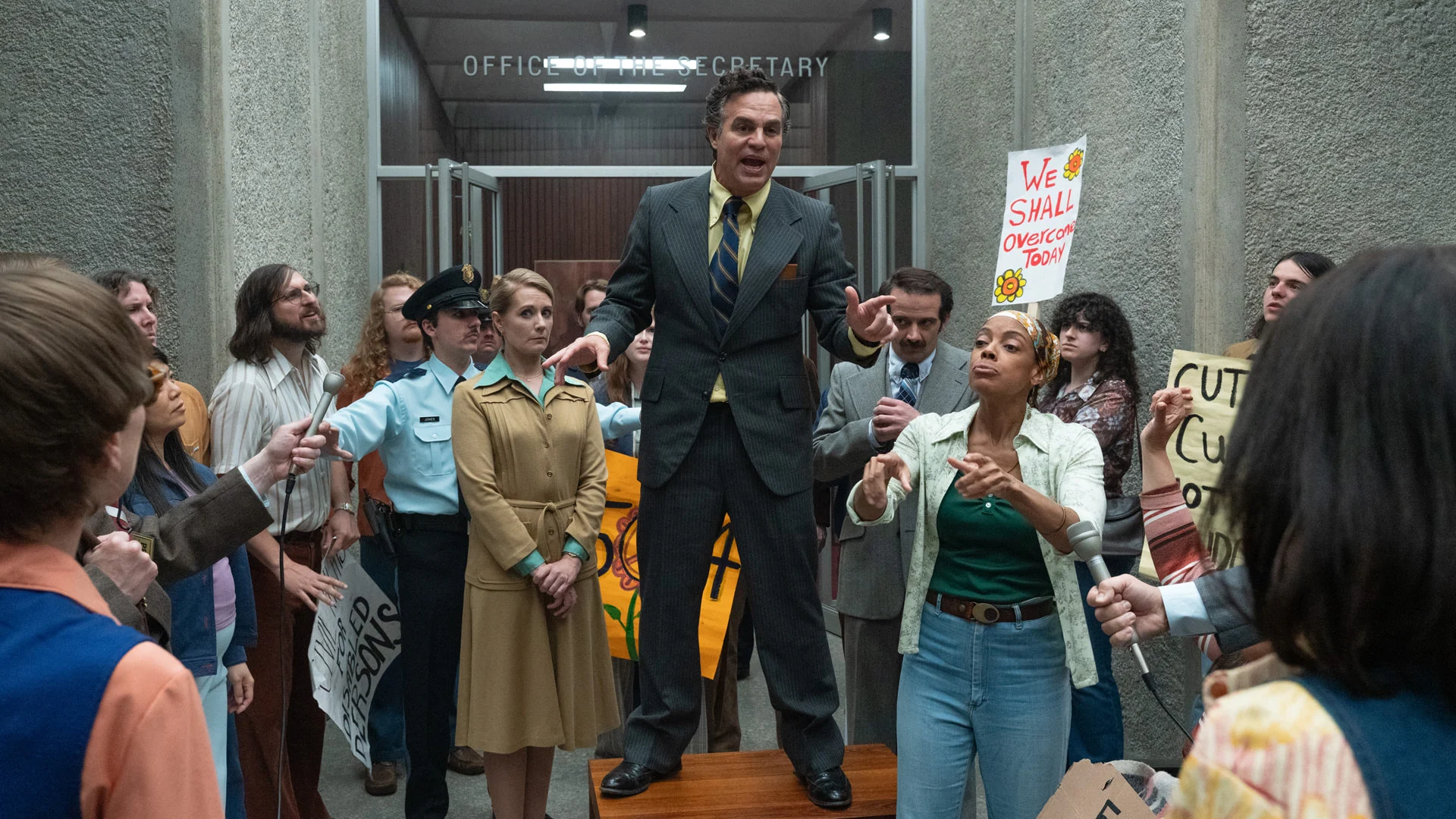
Biographical cinema often struggles to capture the unruly reality of grassroots activism, reducing complex political movements to tidy arcs and neat legislative victories. Too many historical dramas polish the friction of community organizing until it resembles a polite lecture rather than an exhausting fight for fundamental human dignity. In ‘Being Heumann’, director Siân Heder avoids those conventional pitfalls by anchoring the narrative in the chaotic realities of real people demanding systemic change.
Following her Oscar-winning drama ‘CODA’, Heder collaborates with co-writer Rebekah Taussig to adapt the 2020 memoir written by Judith Heumann and Kristen Joiner. Instead of tracing a cradle-to-grave chronicle of Heumann’s entire life, the film focuses on a defining political showdown that unfolded in 1977. The narrative frames the battle not as an individual journey, but as an ensemble study of collective endurance against bureaucratic indifference.
The central conflict erupts over Section 504 of the Rehabilitation Act of 1973, a civil rights provision that sat unenforced for four years. Newly appointed Secretary of Health, Education, and Welfare Joseph A. Califano Jr., played by Mark Ruffalo, stalls implementation over estimated costs. Refusing to let officials dilute the measure, activist Judy Heumann, played by Ruth Madeley, spearheads an occupation of San Francisco’s regional federal building.
The Siege of 50 Fulton Street and Section 504
What begins as an impulsive, spontaneous protest becomes a 26-day occupation of the federal facility at 50 Fulton Street. Over 100 disabled protestors navigate severed telephone wires and hostile administrators attempting to starve them out of the building. Survival becomes an act of communal ingenuity as deaf participants sign messages through windows, while the Black Panther Party delivers hot daily meals.
The film underscores how cross-movement solidarity proved vital to keeping the protest alive against government pressure. “When you think about people with disabilities in the 1970s throwing themselves out of their wheelchairs, pulling themselves up the steps of federal buildings and what they got done? Guerrilla tactics but they got the goods,” co-star Rob Delaney noted in an interview with Big Issue. This fierce resolve exposed an administration hoping to quietly disregard civil rights obligations.
The Washington Delegation and Califano’s Capitulation
To break the stalemate, Heumann and fellow activists travel across the country to Washington, D.C., riding inside an unheated box truck. Their presence on Capitol Hill strips the Carter administration of its progressive image and forces the public to confront federal negligence. Cornered by mounting scrutiny, Califano finally relents on April 28, 1977, signing the original, un-weakened Section 504 regulations into federal law.

The climax hinges on a tense telephone exchange between Califano and Judy that captures the central friction of the entire movement. While the cabinet secretary tries to frame his signature as personal generosity, Judy offers no apologies and refuses to perform institutional gratitude. The scene emphasizes that disabled citizens were never seeking charitable favors; they were claiming basic constitutional rights that had been wrongfully denied.
Authentic Representation and the Continuing Movement
Behind the scenes, the production reflected the radical accessibility and inclusion demonstrated during the historic protest itself. Director Siân Heder reflected on mounting such an ambitious set in an interview with The Hollywood Reporter, observing, “Wait, we have to learn how to do this in general, like this shouldn’t just be for this project, because taking care of your people on your crew… we’re human bodies and we’re trying to do a really hard thing in a limited amount of time.” That deliberate production ethos mirrors the movie’s refusal to compromise on authentic casting.
As the occupants celebrate inside the federal building, the closing sequence avoids treating the signing as an absolute finish line. The activists share one last evening in the space they occupied, recognizing that legal ink does not instantly dissolve entrenched societal prejudice. Califano faces political isolation in Washington, while the activists roll out into San Francisco to begin the arduous work of enforcing compliance.
Before the credits roll, archival photographs of the actual 1977 activists appear, highlighting the 13-year fight leading to the 1990 Americans with Disabilities Act. By pairing the historical figures with their on-screen counterparts, the film reminds viewers that accessibility remains an ongoing civil rights struggle. The conclusion of ‘Being Heumann’ honors a transformative historical standoff while confronting how much work remains ahead.
What did you think of the climactic standoff in ‘Being Heumann’, and how do you feel the film handled Judy Heumann’s legacy?