How Odysseus Really Outsmarts Poseidon in ‘The Odyssey’, and What Nolan’s Movie Might Do Differently



Homer’s ‘Odyssey‘ has survived thousands of years precisely because its central conflict never gets old, a mortal man matching wits against a furious sea god who refuses to let him go home. Now that Christopher Nolan’s big screen version is finally about to hit theaters, fans are asking a very specific question, does Odysseus actually beat Poseidon, and will any of that survive the translation to IMAX film.
The answer from the source material is more complicated than a simple victory. Odysseus does not defeat Poseidon in a conventional sense but rather uses cleverness and divine guidance to navigate his challenges. That distinction matters a lot once you start comparing the myth to what Nolan appears to be building on screen.
The Real Story Behind Odysseus and Poseidon’s Feud
The entire conflict starts with a single act of cruelty and pride. Odysseus and his men get Polyphemus drunk and gouge out his eye with a heated stake, then trick the blinded Cyclops’s neighbors into thinking he is merely sick before escaping tied beneath his sheep. It should have ended there, but Odysseus could not resist one final taunt.
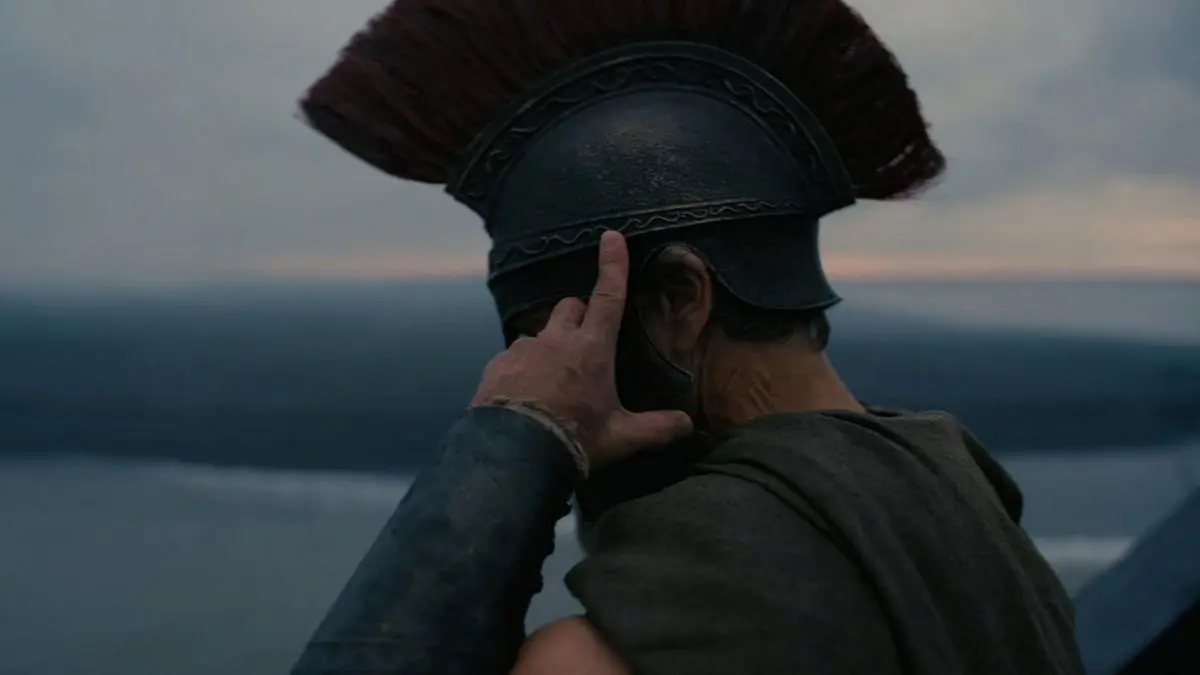
While making his escape, Odysseus reveals his real name to Polyphemus, who then prays to his father Poseidon to avenge the blinding. That single boast turns what could have been a clean escape into a decade long punishment. A single boast in the Cyclops episode turns escape into years of punishment at sea, and Poseidon’s anger begins the moment Odysseus blinds Polyphemus.
It is worth noting the feud is not purely personal for Poseidon. Beyond the injury to his son, Poseidon’s hatred is tied to larger divine politics, since Zeus had already shown favor toward Odysseus, and Poseidon reads that support as a challenge to his own authority. That layered motivation is exactly the kind of texture a filmmaker like Nolan tends to gravitate toward.
How Poseidon’s Wrath Nearly Destroys Odysseus
Poseidon spends most of the poem making Odysseus suffer rather than trying to kill him outright, which is arguably crueler. After seventeen days at sea on his raft from Calypso’s island, Odysseus spots land just as Poseidon returns from his own travels and grows furious, rousing a storm so powerful it breaks the raft to splinters. Odysseus barely survives, washing ashore exhausted after two additional days fighting the waves.
The turning point does not come from a physical showdown at all. Homesick and desperate, Odysseus is advised by Circe to travel to the underworld and consult the seer Tiresias about how he might eventually appease Poseidon. In Hades, Tiresias tells Odysseus exactly what he must do to placate the sea god.
The resolution, when it finally arrives, is almost anticlimactic by design. Odysseus eventually undertakes to placate Poseidon as Tiresias instructed, marching inland to a place where the locals had never seen an oar, and there he sacrifices to the god, who forgives him for blinding Polyphemus. There is no duel, no trick, no triumphant blow. There is only patience, humility, and ritual, which is a very different kind of ending than modern audiences might expect from an epic ‘Odyssey’ adaptation.
What We Know About Nolan’s ‘Odyssey’ Movie Adaptation
Nolan’s cast alone signals how seriously he is taking this material. Bill Irwin plays Polyphemus, the Cyclops and son of Poseidon, in a film that also features James Remar as Tiresias, the blind prophet of the underworld. Matt Damon leads as Odysseus alongside Tom Holland, Robert Pattinson, Anne Hathaway, Zendaya, Jon Bernthal, and Lupita Nyong’o.
Interestingly, Poseidon’s actual on screen presence still seems uncertain. Corey Hawkins’s role has not been publicly revealed, and some outlets have speculated he may play Hermes rather than Poseidon, the sea god originally rumored for him. That kind of ambiguity around casting suggests Nolan may not be treating Poseidon as a traditional, fully embodied character at all.
That theory tracks with everything else Nolan has hinted about his approach to the gods. Reports suggest divine intervention in the film will feel like weather, with Poseidon’s grudge showing up as a sea that will not stop trying to drown Odysseus rather than a literal deity confronting him directly. The trailer has already shown a massive figure in a cave believed to be Polyphemus, so Nolan is not avoiding the fantastical elements entirely, but much of the divine conflict is expected to register through natural forces rather than a god standing onscreen.
Will the Ending Change?
Given how quiet and internal the myth’s actual resolution is, it raises a real question about pacing for a $250 million tentpole. Nolan is said to have an estimated production budget of 250 million dollars for the film, making it the most expensive of his career, with production spanning Morocco, Greece, Italy, Sicily, Scotland, Iceland, and Ireland. A story built for spectacle on that scale does not obviously lend itself to a third act where the hero quietly walks inland with an oar to make peace offerings.
Structurally, though, Nolan has built his entire career on nonlinear storytelling, which might actually help him land Tiresias’s prophecy and the eventual appeasement in a way that still feels earned. The film’s nonlinear framework, opening in the middle of the story and weaving between timelines before building toward a bloody homecoming, reads like a natural fit for a director known for Dunkirk and Memento.
Whether Nolan keeps that quieter, more spiritual resolution or trades it for something more visually explosive, audiences will not have to wait long to find out. The film premiered in London on July 6 with a United States release set for July 17, and it will be available in IMAX 70 mm and other premium film formats.
With the movie landing in theaters within days, how do you think Nolan should handle Poseidon’s grudge against Odysseus, as a literal god demanding a final confrontation, or as something closer to the unforgiving sea itself.