‘The Iliad’ vs. ‘The Odyssey’: Here’s Everything You Need to Know Before Seeing Nolan’s Upcoming Masterpiece


Christopher Nolan has spent his entire career chasing gaps in cinematic culture, and this time he found one hiding in plain sight for nearly three thousand years. His new film adapts Homer’s Greek poem ‘The Odyssey‘ into an IMAX experience built for the biggest screens available. The confusion swirling around whether this is an ‘Iliad’ story or an ‘Odyssey’ story is understandable, since both epics share the same war, the same hero, and the same ancient poet.
But anyone expecting a Trojan War movie is going to be surprised. The film is a screen adaptation of Homer’s ancient Greek epic focused entirely on Odysseus’s long and perilous journey home after the Trojan War has already ended, tracking his run ins with mythical beings as he tries to reunite with his wife. That distinction matters more than it might seem, and it shapes everything about how this movie was built.
‘The Odyssey’ versus ‘The Iliad’ Explained
The two poems attributed to Homer tell very different stories, even though casual moviegoers often lump them together. The ‘Iliad’ covers the war itself, the siege of Troy, the rage of Achilles, and the brutal grind of a decade long conflict. ‘The Odyssey’ picks up after that war is over and follows one soldier’s chaotic, monster filled voyage back to his kingdom.
That’s the version Nolan chose to put on screen. His film follows Odysseus as he faces a dangerous voyage back to Ithaca, meeting creatures like the Cyclops Polyphemus, Sirens, and Circe along the way.
It’s a road trip movie dressed up as a mythological epic, not a battlefield saga, and that framing gives Nolan room to lean into fantasy and horror elements he hasn’t fully explored before.
Even the film’s marketing has leaned into that scale. Nolan’s first release since ‘Oppenheimer’ arrives as one of the most anticipated films of the year, carrying the weight of following up a movie that swept the Academy Awards. Fans hoping for a straightforward war epic are instead getting sea monsters, witches, and a slow motion descent into myth.
Cast and Characters Bringing Homer’s Epic to Life
Matt Damon anchors the film as its central figure. Damon stars as Odysseus, while Anne Hathaway plays his wife Penelope, and Tom Holland plays Odysseus’s son Telemachus. Rounding out the mythological side of the cast, Lupita Nyong’o co-stars as Helen of Troy while also playing Helen’s sister Clytemnestra, and Zendaya takes on the role of the Greek goddess Athena.
The supporting roster reads like a who’s who of modern Hollywood. The ensemble also includes Charlize Theron, Robert Pattinson, Jon Bernthal, Benny Safdie, Samantha Morton, and John Leguizamo, among others.
Robert Pattinson takes on the role of Antinous, one of Penelope’s most persistent suitors back in Ithaca, adding a layer of domestic tension to a story otherwise dominated by gods and monsters.
Even musician Travis Scott shows up in a mysterious capacity. Nolan explained that he cast Scott specifically to draw a connection between rap and oral poetry as analogous art forms, framing hip hop as a modern descendant of the storytelling tradition Homer represents. It’s a wild swing for a film this expensive, and it says a lot about how seriously Nolan is treating the poem’s roots in spoken performance rather than pure spectacle.
Release Date and IMAX Filming Details
Mark the calendar, because this one has a firm date attached. Nolan’s ‘The Odyssey’ hits theaters on July 17, 2026, with early showings beginning the afternoon of July 16. The film carries an R rating, runs two hours and fifty two minutes, and will have exclusive access to IMAX screens for its first three weeks in release.
The production itself pushed technical boundaries that even Nolan hadn’t attempted before. With an estimated budget of two hundred fifty million dollars, the film ranks among the most expensive of Nolan’s career and is the first ever shot entirely on IMAX’s 70 millimeter film cameras.
Filming spanned multiple continents over several months. Principal photography took place between February and August 2025 across Morocco, Greece, Italy, Scotland, Iceland, Western Sahara, and Malta, along with additional work at the Universal Studios lot in Los Angeles.
Nolan brought back key collaborators for the project as well. Composer Ludwig Göransson, known for his work on ‘The Mandalorian,’ ‘Oppenheimer,’ and ‘Sinners,’ scored the film, while cinematographer Hoyte van Hoytema, who has shot every Nolan movie since ‘Interstellar,’ returned behind the camera. That combination of longtime collaborators and unprecedented camera technology is a big part of why the film has been positioned as a genuine cinematic event rather than just another summer blockbuster.
Historical Accuracy Debate and Fan Reactions
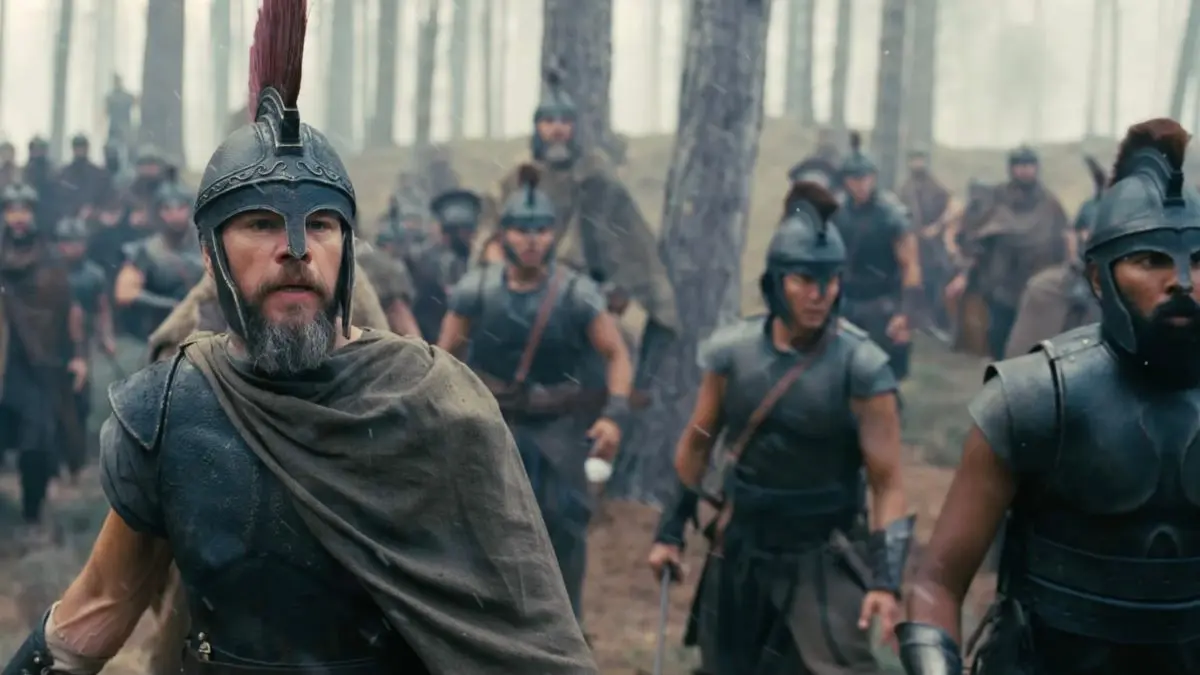
Not everything about the rollout has been smooth sailing. The costume and production designs, accents, dialogue, and casting choices sparked critical discussion and scrutiny regarding historical accuracy to the source material and the ancient Greek setting. Some of that criticism got specific and pointed. The armor and ship designs featured in trailers drew criticism from Greek publications, historians, and online commenters, as did the casting of non Greek actors in central roles, with some commentators calling the choices unrealistic and a misrepresentation of ancient Greek history.
One design choice in particular became a lightning rod online. Agamemnon’s armor was repeatedly compared to the Batsuit from Nolan’s own ‘The Dark Knight’ trilogy, with critics arguing it detracted from the immersion Nolan was clearly chasing. It’s a strange full circle moment for a director whose superhero work still shapes how audiences read his visual choices, even in a project set thousands of years before Gotham existed.
Early reactions from those who have already seen the film suggest the scale genuinely lands, even if opinions on the story choices vary. One Letterboxd review called the finished product a colossal achievement even by Nolan’s own standards, praising its commitment to capturing as much as possible in camera using the new IMAX technology. Critics have been more mixed, with Rotten Tomatoes noting that the film’s most remarkable achievement isn’t necessarily the drama or performances but the sound design carrying the weight of the experience.
With Nolan trading the Trojan battlefield for sirens, cyclopes, and a decade at sea, does swapping the ‘Iliad’ for ‘The Odyssey’ feel like the right call for his first post ‘Oppenheimer’ epic, or were you hoping for the war story instead?