‘How to Rob a Bank’ Ending Explained: The Truth Behind Ryan’s Final Heist

The heist subgenre has long thrived on sleek escapism, precise choreography, and the romantic thrill of outsmarting impenetrable vaults. Director David Leitch, renowned for orchestrating kinetic spectacles in ‘Bullet Train’ and ‘The Fall Guy’, takes an unconventional turn with his latest project. Rather than relying solely on glamorous thieves executing victimless jobs, the filmmaker infuses the familiar cat-and-mouse dynamic with raw economic frustration.
Audiences have grown accustomed to polished capers where charismatic antiheroes vanish into tropical paradises with duffel bags of untraceable currency. Yet the modern cinematic landscape has increasingly shifted toward stories reflecting widespread public anger against corporate greed and systemic inequality. That cultural friction forms the backbone of a story where criminal activity is no longer concealed in shadows, but thrust directly into the spotlight of social feeds.
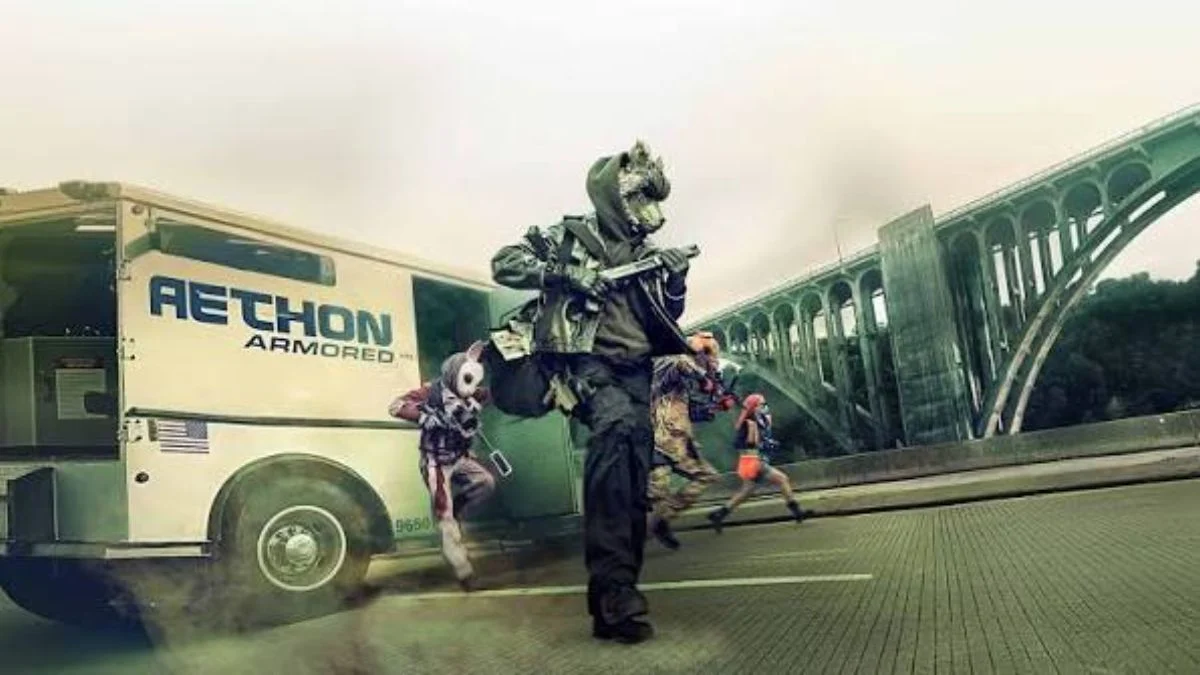
In ‘How to Rob a Bank‘, this tension erupts through the exploits of a masked Pittsburgh crew known to millions of online spectators as Who’s Hungry. Led by Nicholas Hoult’s enigmatic protagonist Ryan, the gang streams their armed robberies in real time while uploading slick step-by-step tutorials. By turning grand larceny into viral content, Ryan transforms armed robbery into an interactive crusade against predatory financial institutions.
The Tragic Motive Driving Who’s Hungry
Behind the energetic jump cuts and playful animal masks lies a heartbreaking backstory that fundamentally reframes the gang’s crusade. Years before forming the crew, Ryan and his college sweetheart Emi, played by Anna Sawai, took out an exploitative loan from a ruthless banking firm overseen by Christian Slater’s Walton. When the predatory bank aggressively demanded repayment, the couple could no longer finance life-saving medical care for their young son Ren, resulting in his tragic death.
Every member of the quartet carries their own scars from institutional neglect, including Pete Davidson’s Vince, an impoverished Afghanistan veteran unable to access proper healthcare. Vince risks everything to secure financial stability for his wife Skyler and their young daughter before his failing health deteriorates further.
Shedding light on the emotional stakes, screenwriter Mark Bianculli explained in an interview with The Upcoming that “I think you have to care about the people who want something, otherwise they’re just thieves.”
Meanwhile, the massive notoriety of the gang draws the crosshairs of Special Agent John West, a weary investigator portrayed by John C. Reilly. Lacking digital literacy, West cuts an off-the-books immunity deal with Reagan Gardner, a house-arrested software hacker played by Zoë Kravitz. Analyzing how the thieves blend armed robbery with viral agitation, The Guardian observed that the masked criminals act as both bank robbers and online activists who inspire their digital followers to replicate their actions.
Walton’s Confrontation and Vince’s Tragic Sacrifice
The film’s chaotic climax centers on an ambitious, multi-front assault against Walton’s primary corporate repository in downtown Pittsburgh. While tech guru Hugo breaches the internal mainframe to siphon hundreds of millions of dollars, Ryan corners Walton in his executive office. Holding the corrupt banker at gunpoint, Ryan utters the devastating truth that Walton’s bank killed his child, yet he chooses to spare the executive’s life rather than become a killer.

As the heist concludes, the team scatters across the metropolitan core under heavy pursuit from local authorities and federal agents. Cornered during an intense highway perimeter stop, Vince realizes his capture is imminent and that prison would end his remaining days in misery. After placing one final emotional phone call to his young daughter, Vince draws an empty firearm on the surrounding officers, tragically choosing to go out on his own terms.
Ryan’s Capture and the Final Prison Twist
Recognizing that federal surveillance has compromised his vehicle, Ryan refuses to let Emi share in his impending capture. He forces Emi to flee into a bustling crowd of sympathetic supporters wearing identical animal masks before continuing as a diversion. West eventually intercepts the decoy vehicle, deliberately ramming Ryan’s car and taking the rebellious leader into federal custody.
Despite Ryan’s arrest, the mission achieves total victory because Hugo successfully redistributes the stolen hundreds of millions across Pittsburgh. Substantial funds are quietly wired to Vince’s widow, while massive sums are funneled into grassroots charities and community aid networks. This leaves West and the Department of Justice trapped in a public relations nightmare, unable to repossess the funds without sparking immense civil outrage.
Setting Up the Future of the Movement
The closing sequence relocates to the maximum-security penitentiary where Ryan sits isolated in a recreation area. Suddenly, the internal television monitors flick to life, broadcasting a familiar encrypted signal from Who’s Hungry as building alarms begin blaring. Ryan looks up and flashes a knowing smile, indicating that Hugo and Emi have orchestrated a prison breach to break him out.
By refusing to frame Ryan as a traditional victor or a defeated criminal, ‘How to Rob a Bank’ leaves its central conflict deliberately unresolved. The movie illustrates that even if authorities apprehend an individual figurehead, an underlying social revolution powered by millions of online supporters cannot be so easily handcuffed. This calculated cliffhanger sets up an intriguing premise for a potential sequel, where the battle shifts from street-level banks to the entire judicial system.
Let us know your thoughts in the comments below on whether Ryan will successfully escape prison in a sequel or if his viral movement has already achieved its ultimate purpose.