Prime Video’s New AI Tool Wants to Fix One of Streaming’s Most Annoying Dubbing Problems, and It Will Start with ‘Maxton Hall’



Anyone who’s watched a dubbed show knows the feeling: dialogue in one language pouring out while an actor’s mouth clearly continues forming words in another. That mismatch has long been one of streaming’s quiet annoyances, a small but persistent barrier between viewers and full immersion in international content.
Streaming platforms have spent years trying to make foreign-language hits feel more accessible to global audiences, layering subtitles and traditional dubbing over increasingly popular international series. Prime Video has been particularly aggressive in this space, having already experimented with AI-assisted dubbing across a dozen licensed titles in English and Latin American Spanish back in March 2025.
Now the streamer is taking that experimentation a step further. Amazon’s Prime Video is promising to make English-language dubs look more natural by using AI to sync up the way actors’ mouths move on screen, with the new feature debuting first on ‘Maxton Hall,’ the German-language romance that stands as Prime Video’s most-watched international original series to date.
According to Prime Video, the system combines AI and visual effects technology to adjust actors’ lip movements so they line up more naturally with translated, human-performed dialogue. Rather than relying purely on synthetic voice generation, the feature works alongside professionally dubbed audio, using visual manipulation to close the gap between what viewers hear and what they see on screen.
Raf Soltanovich, vice president of technology at Prime Video and Amazon MGM Studios, explained the thinking behind the rollout in a statement shared through Amazon’s own newsroom. He said the company is constantly innovating with new tools that enhance the viewing experience for its customers, framing the lip-sync feature as part of that broader effort to make global content feel more seamless and immersive.
The choice to debut this feature on ‘Maxton Hall’ makes sense given the show’s outsized success on the platform. The series became the most successful International Original in Prime Video’s history at the time of its first season release, reaching the number one spot on Prime Video’s charts in more than 120 countries and territories during its opening week alone.
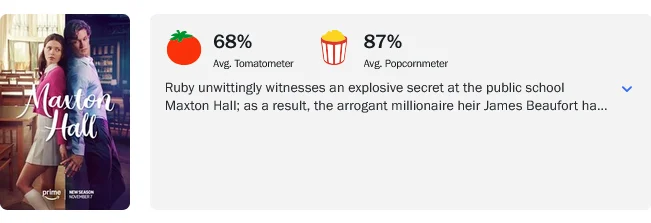
Lip-sync dubs are now available starting today on ‘Maxton Hall’ Seasons 1 and 2 globally in English, and the feature will also be baked into the show’s third and final season when it premieres on Prime Video on December 9. That final season, based on the 2018 novel ‘Save Me’ by Mona Kasten, will consist of six episodes and roll out across more than 240 countries and regions.
Prime Video hasn’t disclosed specifics about which AI tools power the new lip-sync system, keeping details of the underlying technology largely under wraps. That opacity mirrors the company’s broader approach to its AI dubbing initiatives, which have consistently emphasized human oversight rather than fully automated processes.
That earlier AI-aided dubbing pilot, which covered titles like ‘El Cid: La Leyenda,’ ‘Mi Mamá Lora,’ and ‘Long Lost,’ was described as a hybrid process where localization professionals worked alongside AI tools while retaining ultimate quality-control responsibilities. The new lip-sync feature appears to represent another layer built on top of that same localization philosophy.
With Prime Video confirming plans to expand the technology to additional titles down the line, this rollout on ‘Maxton Hall’ likely represents just the beginning of a broader shift in how the platform handles dubbed content going forward. Given how much international programming has driven engagement across major streamers in recent years, tools like this could meaningfully change how comfortable global audiences feel diving into shows made outside their native language.
Would you use AI lip-sync dubbing if it made foreign shows feel more natural?
Have something to add? Let us know in the comments.