Rhaenyra’s Season 3 Finale Turn Has Fans Screaming ‘Daenerys Deja Vu’ All Over Again


‘House of the Dragon‘ just gave us its most unsettling episode yet, and the internet immediately went to the same place. Queen Rhaenyra Targaryen’s cold, calculated choices in the Season 3 finale have fans and critics drawing a straight line to Daenerys Targaryen’s infamous heel turn in ‘Game of Thrones’, and honestly, it is hard to unsee once you notice it.
The comparisons are not exactly new, but they have never felt this loaded. With showrunner Ryan Condal and star Emma D’Arcy now weighing in directly on the connection, the parallels between these two Targaryen queens are no longer just fan theory territory. They are officially part of the show’s own narrative DNA.
Rhaenyra and Daenerys Targaryen Share More Than Just a Surname
The blood tie between these two characters is not some loose fan headcanon. Princess Rhaenyra and Daenerys are distant relatives, living roughly 200 years and about eight generations apart, according to the Targaryen family tree laid out in George R.R. Martin’s source material.
That distance in time has not stopped fans from noticing the echoes. Both women ride dragons, with Daenerys famously bonded to Drogon while Rhaenyra began riding her dragon Syrax at just seven years old. Fans online have even pointed out how similarly both actresses play the adoring, almost worshipful way their characters look at their dragons.
Beyond the visual symmetry, the emotional throughline is just as strong. Both characters grow up believing they are destined to become the first queen to sit the Iron Throne, and both have older brothers who die before they can claim it. It is the kind of scaffolding that makes the later comparisons between their reigns feel inevitable rather than forced.
Power and the Iron Throne Corrupt Rhaenyra in Ways Daenerys Would Recognize
Showrunner Ryan Condal did not shy away from the elephant in the room when addressing the finale’s darkest moments. Condal acknowledged that fans will naturally compare Rhaenyra’s Season 3 arc to Daenerys’s controversial heel turn in the ‘Game of Thrones’ series finale.
He was also careful to draw a clear boundary between the two arcs. Daenerys only reached the Iron Throne at the very end, after she had already destroyed the city, while Rhaenyra’s story is about actually holding the throne and being slowly altered by the experience of trying to keep it.
Still, Condal was clear that the thematic bones underneath both stories are the same. He explained that the parallels tie back into the greater themes of the ‘A Song of Ice and Fire’ universe, namely pride, power, and how far power can corrupt someone. He noted that the Iron Throne can turn already corrupted people into full villains, while it can simply destroy gentler characters, the way it did King Viserys.
That corruption played out in brutal fashion this season. Rhaenyra ordered the execution of the High Septon and had a captive Helaena force fed during Season 3, choices that read as a direct callback to the kind of ruthlessness that defined Daenerys’s final chapter.
Emma D’Arcy Breaks Down Rhaenyra’s Authoritarian Turn Scene By Scene
Emma D’Arcy has been remarkably candid about how deliberate this darker version of Rhaenyra really is. D’Arcy explained that Rhaenyra’s tyrannical journey this season tracks closely with how her empathy mechanism is affected by the events of the series, and that Jace’s death and the grief that follows fundamentally disrupts that empathy.
For D’Arcy, the goal was never to make Rhaenyra’s descent feel abstract or purely symbolic. The actor said they wanted the journey to feel legible, adding that if audiences want to be better at protecting democracy, they have to be smarter about understanding the behavior of dictatorial leaders, and this arc was a chance to make that kind of behavior understood.
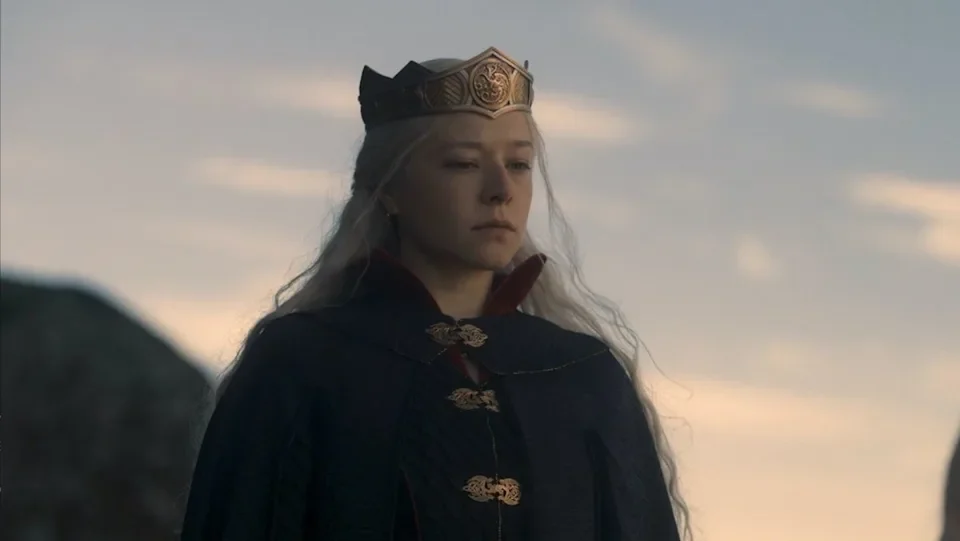
D’Arcy leaned into the acting challenge of playing that shift rather than just labeling it. From a performance standpoint, D’Arcy found it more playable to think about empathy and how that internal mechanism gets damaged over time, rather than only thinking about Rhaenyra’s relationship with authoritarianism as a concept.
The finale’s most devastating moment, Helaena’s death, only deepens that isolation. D’Arcy said that Helaena’s death likely condemns Rhaenyra to be alone in her pursuit of power, especially given how impassable her relationship with Alicent is likely to become. D’Arcy described Helaena as far more than just another casualty of the Targaryen war, calling her the moral center of the entire series.
Fans Are Not the Only Ones Spotting Character Echoes Across the Franchise
The Daenerys and Rhaenyra parallel is not the only side by side comparison fueling conversation right now. ‘House of the Dragon’ fans have also drawn comparisons between Lady Olenna Tyrell from ‘Game of Thrones’ and Princess Rhaenys Targaryen, with both characters praised for their sharp wit, strategic minds, and commanding presence in a male dominated world.
That kind of cross generational character mirroring seems baked into how this franchise operates. Fans have noted that Rhaenys carries herself in a manner strikingly similar to how Olenna, known as the Queen of Thorns, moved through ‘Game of Thrones’ with cunning and decisive authority.
With Season 4 already confirmed as the final chapter, Ryan Condal has said he will soon return to writing the show’s last season, revealing that the key events of Seasons 3 and 4 were mapped out together from the start. That means whatever final form Rhaenyra’s arc takes, it was always designed with Daenerys’s shadow looming over it.
Whether Rhaenyra ends up as a tragic echo of Daenerys or carves out a distinct legacy of her own, one thing is certain, her choices in this finale have permanently changed how fans watch her fight for the Iron Throne. Do you think Rhaenyra is doomed to repeat Daenerys’s fall, or is her path to the throne different enough to end in something other than ruin?