Soldier Boy Just Called Homelander an ‘Asexual Weirdo’ in ‘The Boys’ — Here’s What That Actually Means


The final season of ‘The Boys’ keeps delivering jaw-dropping moments, and Season 5 Episode 5 gave fans one of the most unexpectedly tender lines of the entire series. Amid a blood-soaked Hollywood mansion and a very chaotic ‘Supernatural’ reunion, Soldier Boy said something about his son that sent viewers straight to the internet with one burning question: is Homelander actually asexual?
The short answer is that it’s complicated. But understanding why requires looking at who Homelander is at his psychological core, what the show has actually depicted across five seasons, and how the source material tells a very different story from the Prime Video adaptation. This is not as simple as slapping a label on the most dangerous man in America and calling it a day.
What Soldier Boy Actually Meant by ‘Asexual Weirdo’
In Season 5 Episode 5, while Homelander was unconscious after being gassed by Malchemical, Mr. Marathon and Malchemical tried to convince Soldier Boy to end Homelander once and for all. Soldier Boy’s response to the plea was to declare, “He is a fcking asexual weirdo, but as much as it pains me to say this, he’s my fcking asexual weirdo. Nobody f*cks my son, but me.”
Soldier Boy considered the description for a moment, agreeing that Homelander is an “asexual weirdo,” but ultimately refused to harm him, because Homelander is still his son. The line is played more for dark comedy and a twisted expression of paternal loyalty than as any kind of formal character declaration about Homelander’s orientation.
TV Tropes categorized the moment as a “Hypocritical Heartwarming” beat, noting that while Soldier Boy does agree that Homelander is an asexual weirdo, he is his asexual weirdo. In context, Soldier Boy appears to be using the word loosely, possibly referring to Homelander’s cold, transactional, and deeply narcissistic approach to human connection rather than making a clinical statement about his sexual orientation.
Homelander’s Relationships and the Power Dynamic Behind Them
Throughout the series, Homelander has engaged in several sexual and romantic entanglements, all of which are filtered almost entirely through his obsessive need for control and validation. Antony Starr, who plays Homelander, has described the character as “the neediest, emotionally weakest character on the show,” adding that Homelander has “always been ostracized and disconnected from not only humanity but even other supes.”
In Season 2, Homelander and Stormfront began a semi-romantic but mostly sexual relationship, with Homelander delighted by her willingness to kill and her ruthlessness, the two engaging in violent, superpowered sadomasochistic encounters. His relationship with Madelyn Stillwell before that was equally loaded with psychological weight, rooted in an unsettling maternal dynamic as much as any genuine attraction.
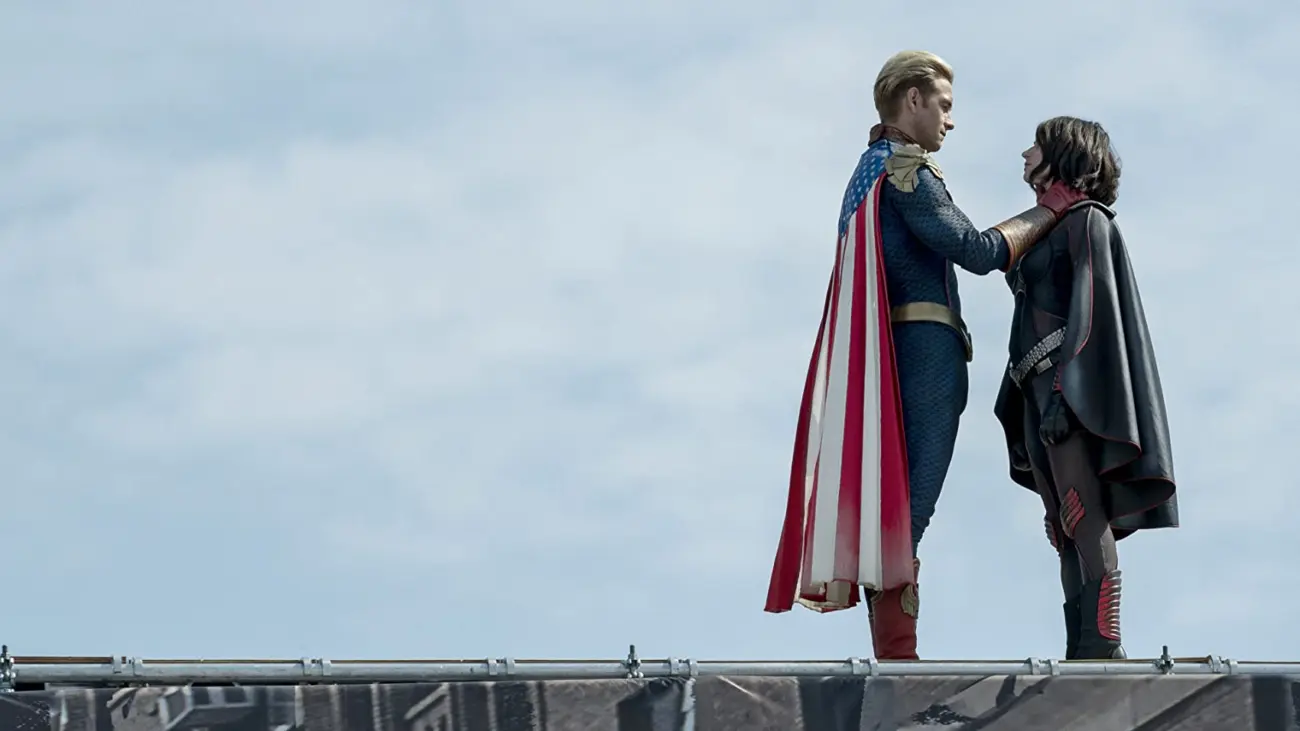
Homelander’s murderous tendencies stem from a lack of affection, having grown up alone in a lab with no mother figure, and this is held up as the dividing factor between him and his good-natured son Ryan, who has grown up with a mother. The point is that for Homelander, intimacy is never really about desire in any conventional sense. It’s always about dominance, approval, or filling the void left by a childhood spent as a laboratory experiment.
Throughout the entire live-action series, Homelander has been portrayed as a straight character, with all of his romantic interests being female, and no hints have been given that his orientation could be otherwise. Whether or not that amounts to a genuinely asexual experience is a reading fans can debate, but the show has never framed him that way through its own storytelling tools.
How ‘The Boys’ Comics Tell a Very Different Story
The source material, the comic series by Garth Ennis and Darick Robertson, paints Homelander’s sexuality in far more morally complex and explicit terms. In the comics, Homelander coerced Soldier Boy into a sexual encounter, with the story being that the comics’ version of Soldier Boy was a gullible and easily manipulated person who wanted to please Homelander and was afraid of him. Homelander told him to engage with him as a kind of test to join The Seven, though it was really just a means of humiliation and control.
In the comics, Homelander is generally attracted to females, but he reveals a secret attraction to men in later issues, having promised Soldier Boy a spot in The Seven in exchange for sexual relations with him. These encounters are consistently framed by writers as expressions of Homelander’s cruelty and power hunger rather than genuine attraction, making it difficult to pin down any authentic sexual identity beneath the violence.
Series creator Eric Kripke has been fairly liberal with his characterization of the maniacal superhero when compared with the comic book origins, and the TV show’s Homelander is too sociopathic to enjoy anything close to what people might call a real relationship. The creative decision to strip away any queer dimension from the live-action Homelander was noted by some outlets as a rare case where erasing a character’s canon bisexuality was arguably the more responsible creative choice, given the violent and predatory context in which those acts occur in the source material.
What Homelander’s Sexuality Really Reveals About the Character
The more useful lens for understanding Homelander’s relationship with intimacy might not be any label on the conventional spectrum, but rather the lens of what drives him. The thing about Homelander is that he is someone who craves power in the form of adoration, feeling powerful whenever people either love or fear him, and his relationships with others reflect this need for control above all else.
Antony Starr has said in interviews that Homelander is often controlled by the women in his life, including Stillwell, Stormfront, and Becca, and that his relationships are tangled up with narcissistic psychology and deeply unresolved emotional needs. Whether Soldier Boy’s “asexual weirdo” quip was a deliberate piece of characterization planted by the writers or just a throwaway insult born of Soldier Boy’s own generational bluntness is something fans will continue to debate as the final episodes roll out.
What the moment does confirm is that Homelander’s relationship with connection, desire, and love remains one of the most psychologically fascinating and disturbing threads in all of ‘The Boys’. No single label captures it cleanly, and that ambiguity is precisely what makes him so terrifying to watch.