


Trump Targets Hollywood With Low-Interest Bonds and Fresh Tariff Threats


President Trump is again taking aim at how and where movies are made. In a new interview with the California Post published Monday, January 26, he said he wants to punish film productions that leave the United States while offering a new incentive to keep cameras rolling at home.
The President repeated his plan to place heavy tariffs on movies filmed overseas. At the same time, he floated a new idea to help studios that stay domestic. He suggested using federal low-interest bonds as a way to make filming in the U.S. more appealing.
Trump did not explain how the bonds would work or who would qualify for them. Still, he said his goal is simple. I want to bring the movie business back to Los Angeles in particular, he told the California Post.
This bond idea would be a big shift from what Hollywood usually supports. Producers and unions have mostly pushed for tax credits and rebates. Over the past year, they have pointed to programs in places like Canada and the U.K., where tax incentives have helped pull major productions away from California.
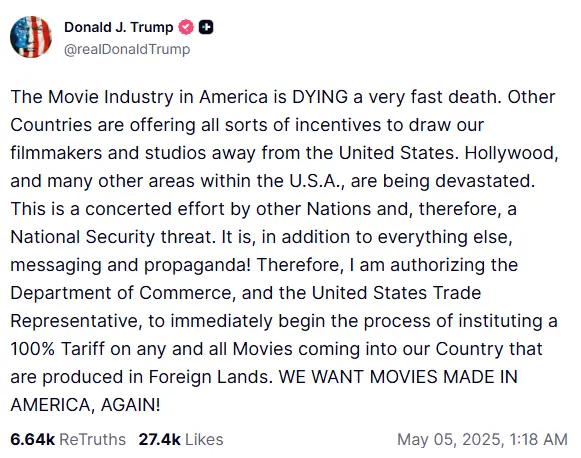
Trump’s comments brought back memories of earlier warnings that rattled the industry. In May 2025, he posted on Truth Social that he was considering a 100 percent tariff on movies made outside the U.S. At the time, he wrote that the American film industry was dying a very fast death because productions were moving abroad. While the message caused concern at first, many industry insiders later brushed it off. One producer recently described the renewed threats as just hot air again.
The President’s interest in Hollywood policy grew after working with actor Jon Voight, who was named a special ambassador to Hollywood early in Trump’s term. Voight teamed up with producers Steven Paul and Scott Karol to put together a broad plan that included federal incentives and deductions. Trump echoed that effort during the interview, saying, And so I’m going to put tariffs on, and we’re going to be doing bonds, some bonds, some low-interest bonds, for the movie industry. We’ll bring it back.
The timing of the proposal matters. Competition for film production has intensified. California Governor Gavin Newsom recently expanded the state’s film and TV tax credit to $750 million. At the federal level, Democratic lawmakers such as Senator Adam Schiff have been pushing for incentives tied to American labor.
So far, the Motion Picture Association has not commented on the bond idea. Labor unions have been more direct, signaling they would rather see tax deductions than loans, even low-interest ones.
Whether Trump’s bond proposal gains traction remains unclear. For now, it adds another layer to an ongoing debate about how the U.S. can compete with countries that have made filmmaking cheaper and easier. The question facing the industry is whether loans can really do that job, or if tax-based incentives are still the only approach that works.
What do you think about this situation? Let us know in the comments.

