Why Cookie Clicker, 2048 and Wordle Outlive Blockbusters

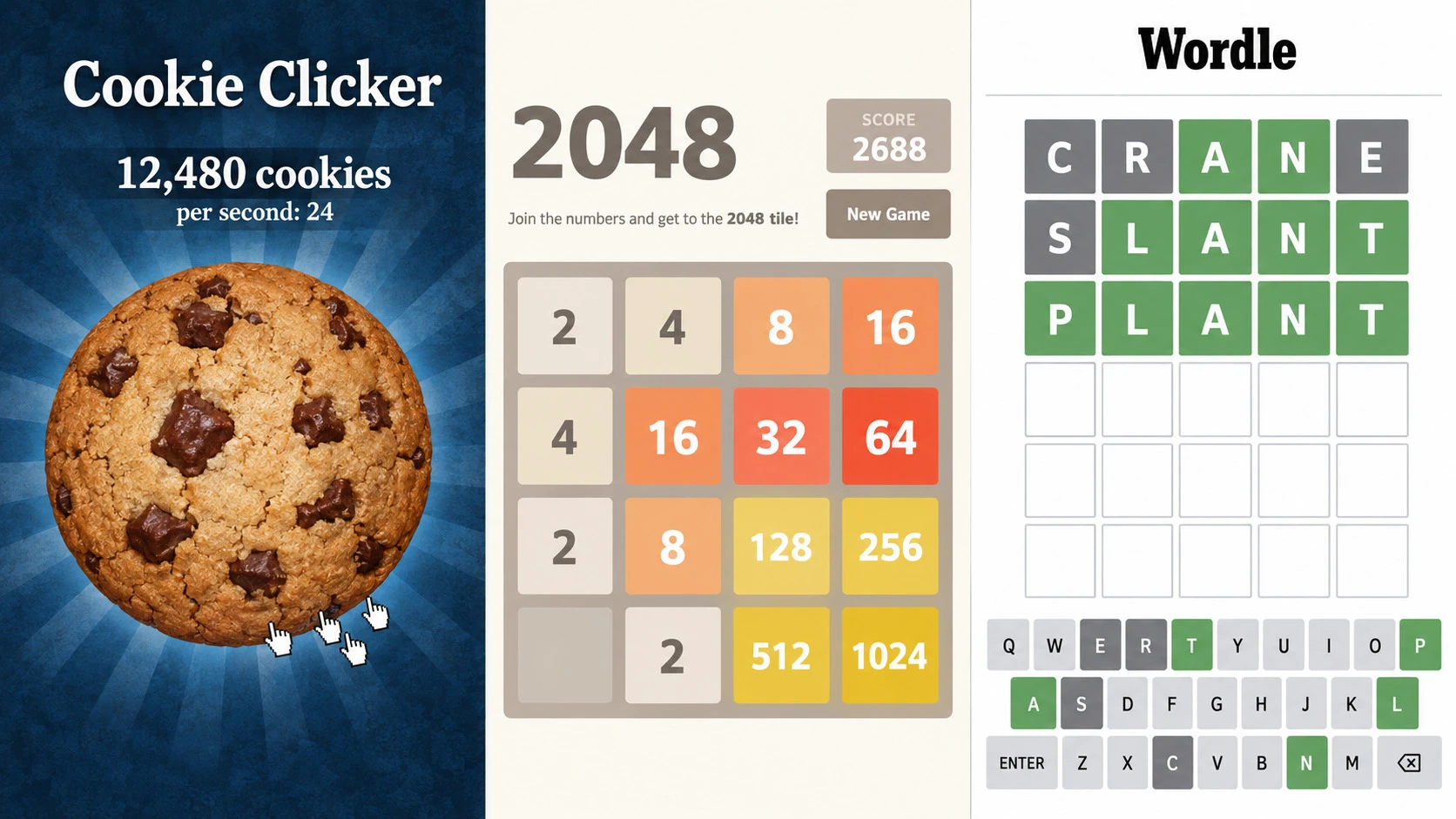

Every year the games industry ships a handful of titles that cost more than a mid-sized movie, and every year a few of them are gone within months. Meanwhile, a game about clicking a cookie, a game about sliding numbered tiles, and a game about guessing a five-letter word are still opened by millions of people a day. None of the three took more than a weekend to build, none of them had a marketing budget, and none of them has changed much since launch. That is not a coincidence. Put the three side by side and they say something fairly precise about what actually keeps people coming back to a game, and it is not the thing big publishers spend their money on.
Cookie Clicker: one night in 2013
Julien Thiennot, who publishes as Orteil, put Cookie Clicker online in August 2013 after building the first version in a single evening as a joke. You click a cookie, you get a cookie, you spend cookies on grandmas and farms that make more cookies. There is no ending and no way to lose. The joke spread through forums within days, and Thiennot found himself maintaining what had become, almost by accident, the defining example of a new genre. Nearly every idle and incremental game since, from mobile tycoon apps to the clicker games that fill browser portals, owes something to that first evening’s work.
What is striking is how little the game needed to change. Thiennot has kept updating it for more than a decade, adding minigames, seasonal events and a prestige system, but the core loop is the one from 2013. A paid Steam version arrived in 2021 with cloud saves and achievements, and the free browser version kept running alongside it. Both are still active. The Steam release did not replace the original; it simply gave people who had been playing for years a way to pay for something they already loved.
2048: a weekend project that went viral
In March 2014, a 19-year-old Italian developer named Gabriele Cirulli built 2048 over a weekend, riffing on an earlier game called 1024, which itself borrowed from Threes, a paid mobile game released a month earlier. Cirulli released his code under an open license, put it on a single web page, and did not expect much. Within a week it had drawn roughly four million visitors. He never monetized it. When Threes’ creators published a long, frustrated account of watching their carefully designed game get out-competed by clones, 2048 was the clone they meant, and Cirulli acknowledged as much. The design argument was real, and it changed nothing about which game people actually played.
Because the source was open, 2048 spread into thousands of clones and apps, including the mobile versions that topped app store charts while Cirulli’s original earned nothing. The original is still online exactly as it was, and the game has become a fixture on browser portals such as Rocket Games, where it sits next to Cookie Clicker and hundreds of other titles that load in a tab with nothing to install. Twelve years on, four arrow keys and a four-by-four grid are still enough.
Wordle: built for one person
Josh Wardle made Wordle for his partner, who loved word puzzles, and opened it to the public in October 2021. On November 1 it had 90 daily players. By early January 2022 it had 300,000, and by the end of that month The New York Times had bought it for a figure the paper described as in the low seven figures. One puzzle a day, six guesses, and a grid of colored squares you could paste anywhere without spoiling the answer.
The purchase changed the address and almost nothing else. The Times kept the game free, kept the one-a-day rule, and resisted the obvious temptation to add more. It later said Wordle had brought tens of millions of new users to its games section, which is a remarkable return on a game with a six-by-five grid. The clones followed, as they always do: Heardle for songs, Quordle for four words at once, and enough direct copies that the Times eventually sent takedown notices to hundreds of them. None of that dented the original, because the original was never competing on features. It was competing on habit.
What the three have in common
Look past the genres and the same design shows up three times.
None of them needs installing. You open a tab and you are playing, which matters more than developers like to admit. Every download screen, launcher, account prompt and patch loses a share of the people who were curious a second ago, and a game that lives in a browser tab loses none of them. This is also why all three survived the shift to phones without a native app: the browser was already there.
Each one can be understood in about ten seconds. Cookie Clicker has one button. 2048 has four arrow keys. Wordle explains itself through its own color feedback after the first guess. There is no tutorial because nothing needs one, and there is no onboarding because there is nothing to board.
Each has a single number that always moves. Cookies per second, the biggest tile on the board, the day’s streak. The player never has to decide what to do next, only whether to keep going, and the answer to that question is almost always yes for at least one more turn. Big games spend enormous effort building quest logs and objective markers to answer a question these three never have to ask.
And each one is easy to talk about. Cookie Clicker’s absurd upgrade names, 2048’s screenshots of a hard-won tile, Wordle’s spoiler-free grid of squares: all of them travel through chat and social feeds without any marketing budget. Wordle’s share grid may be the single most effective piece of viral design of the decade, and it was added almost as an afterthought, at the request of players.
There is one more thing they share, which is less flattering to the industry. None of the three was designed to make money. Thiennot built a joke, Cirulli built a weekend exercise, Wardle built a gift. Two of the three eventually earned their creators something, one through Steam and one through a newspaper, but the money came years after the audience, not before it. Nothing in the games was ever shaped around a purchase.
The counterexamples
Sony’s Concord launched in August 2024 after years of development and a budget reported in the hundreds of millions of dollars. It was taken offline after 11 days, refunds were issued, and the studio was closed by October. It was a competent game with a large team, a launcher, a price tag and a marketing campaign. It simply did not give anyone a reason to open it twice.
A few months earlier, Warner Bros. had released Suicide Squad: Kill the Justice League, a live-service shooter built on a beloved DC property by the studio behind the Batman: Arkham games. Warner Bros. Discovery later told investors the game had cost the company around 200 million dollars in the quarter of its release. It was not a bad game so much as a game nobody had asked for, wrapped in systems designed to keep players paying rather than playing. A cookie that has been clicked several trillion times managed the second part without ever attempting the first.
None of this means big games are a mistake. It means that scale is not what makes people return. Concord and Suicide Squad had everything except the thing Cookie Clicker has, which is a reason to open the tab again tomorrow.
Where they live now
Part of the reason these games outlast bigger ones is that they never left the browser. The originals are all still online at their creators’ sites, the portals carry Cookie Clicker and 2048 alongside everything else, and Wordle stays with The New York Times, one puzzle a day, as it was designed. Nobody has to remember where they installed them, because they were never installed.
Blockbusters compete on scale. These three compete on friction, and friction is a fight the browser has been winning for a long time.