Why Superhero Team-Up Scenes Are Difficult to Stage


A combination of two or more superheroes’ abilities usually looks effortless in a media franchise, but in reality, they are one of the hardest actions to plan. The involvement of several characters’ unique traits, the necessity to differentiate their moves, outfits, fighting style, graphical representation, and importance in the scene may create an overwhelming number of details to keep track of.
However, when the characters depicted in the production have an established origin and appearance, a seemingly simple decision to include them all in one media piece may require additional effort. Every character included in the scene has to have a purpose, be recognizable even at a superficial glance, and demand sufficient screen time to introduce their role and personal narrative.
Therefore, the creation of a successful multi-hero scene requires the additional input of writers, directors, operators, editors, production designers, sound mixers, costume makers, and visual effects designers.
Every Hero Needs a Clear Role
The first problem is thinking of that each character is doing in a scene. If there are several heroes fighting against the same monster, it becomes boring. The action should be exciting only if all characters are involved, each of which is performing their task, which is necessary for victory.
For example, while one superhero is fighting the villain, the other saves people or disables the weapon that the villain wants to use. It is vital to give characters different abilities, which they will use to achieve the same goal. This difference allows emphasizing the skills of each hero so that all of them are useful and have their roles.
If one superhero is much stronger, he arrives at the battle site first, but the others are smarter, more agile, and tech-savvy so that they can hack the weapon and turn it off before it is activated. The audience should feel defeated because they could not think of a way to win, not because the characters are in the same place at the same time.
Different Power Levels Create Story Problems
Superhero teams are rarely comprised of characters possessing equal skills, which poses a problem for a writer or director already at the start of the production.
A nearly unstoppable force and a well-trained, but still human, character are not likely to act in the same manner against one particular incident. And if the strongest person on the team can solve all problems single-handedly, the others might as well not be there in the first place.
Writers and directors have to create multiple setbacks or complications within one particular media piece to compensate for the lack of skills among the heroes, enabling each of them to utilize their personal skill set and achieve some degree of acclaim.
After all, competent team-up episodes or films focus on the differences between their protagonists rather than attempt to erase them, thus making the said differences the driving force of the narrative.
The Audience Needs to Understand the Geography
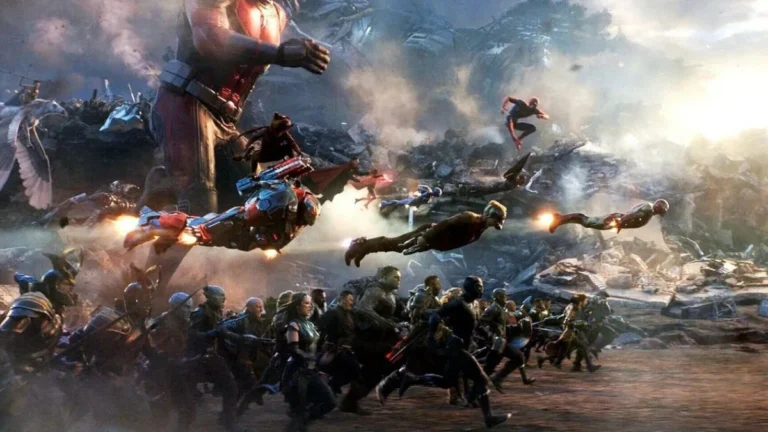
Spatial clarity is significantly compromised in the case of multiple superheroes fighting. The viewers need to know where the characters are, where the action is taking place, and what is going on around the combatants. Without that information, even an impressive spectacle of a fight may confuse the audience.
The first shots in a large fight sequence may be long shots, which enable the viewers to grasp the context of the action. Then, after the initial moment, the camera may get closer to the combatants to follow the detailed developments without losing the general context.
Furthermore, some long shots may be used to split the environment into zones. For example, one superhero is fighting on the roof, while another is defending himself on the street. This way, the action is given more room to breathe and does not turn into a chaotic mix of unrelated events.
Each Character Needs a Distinct Fighting Style
Team-up scenes are more effective when the audience can recognize a character through movement as easily as through costume. A speed-based hero should not be battling in the same way as a power-based hero. Technology, magic, weaponry, and unarmed combat all influence a character’s fighting style. It is up to a choreographer to create multiple fighting styles and find ways to combine them
The key is to create moves that are connected, so that a hero who can fly and one who cannot both look like valid combatants. The difference in style can aid characters, provided that a choreographer plans for moves that complement each other. Each character’s style can help them stand out and can make scenes more lively by being easy to identify.
The Camera Cannot Show Everything at Once
One of the biggest challenges when making a team-up scene is figuring out where the audience should focus their attention. There might be multiple heroes doing important actions, but the camera cannot follow every single one of them, so the directors should establish a hierarchy of actions so that it will be clear to the audience what is going on.
Perhaps the main action will be in the foreground, while the other heroes will continue to fight in the background, or the camera will follow one of the heroes and then shift its attention to the others.
Long panning shots might be employed to create a sense of cohesion between the various fighters. Behind every successful superhero project is careful pre-production planning, World Production Service helps teams coordinate the creative and technical elements needed before filming starts.
The camera should establish a feeling of unity between the heroes by circling the fight, not just showcasing the technical proficiencies of the filmmakers.
Visual Effects Need to Feel Consistent
Superhero team-ups often combine several different effects within the same sequence. One character may be flying while another uses energy-based powers, and someone else may be interacting with a digital creature or collapsing environment. These effects can look individually impressive, but they still need to feel as though they exist under the same physical rules.
Lighting is especially important because energy, explosions, and other effects should influence nearby actors and surfaces. If you are looking for visual effects support for large-scale action scenes, World Production Service can help coordinate VFX requirements to ensure digital elements blend naturally with the filmed environment. If an effect produces bright light but nothing around it responds, the image can feel disconnected.
Scale and physical reaction also need consistency. A powerful impact should affect the environment appropriately, while characters should respond to forces in ways that match what the audience is seeing. The more superheroes present, the more complicated these interactions become.
Costumes Can Restrict the Action
While superhero costumes are indeed spectacular, they can also be downright unusable. Various armor pieces, helmets, capes, masks, boots, stiff fabrics or rigid accessories can impede movement or prove challenging to the camera.
A particular problem occurs when two or more superheroes are involved since each one’s costume can restrict the movements of the other. The stunt, costume, camera, and special effects departments should collaborate to ensure that the costume is neither too restrictive nor incompatible with the desired camera angles and not overpowering the actors’ performances.
Sometimes, the shot has to be adjusted because a double, either an actual stuntman or computer-generated, is used when the original actor cannot perform a specific action. As such, the practical aspect of a superhero costume is undeniably important.
Group Dialogue Can Be as Difficult as the Action
Not every superhero power event scene is about battling. Just having several of the primary characters in the conversation is equally hard to write and realize. Each participant should have the same character while not leaving the impression that everyone is waiting for his turn to speak.
Well-written ensemble dialogues usually have interaction rather than equal time for all participants. For instance, one actor can object to the proposed plan, another one can joke, and the third one can keep focusing on the current issue.
This way, some characters have more activity than others, which is fine as long as the story does not slow down. The example above shows how the author can build the conversation around the issue rather than the characters.
It would make the text less compelling if every hero uttered a quote just because they are present in the scene. This factor is essential in writing dialogue because characters should discuss something, argue, plan, strategize, and negotiate rather than having a conversation just for the sake of representation.
Screen Time Needs to Feel Balanced
Team-up movies typically feature characters who have their own fandoms, which puts pressure on the writers to give everyone a satisfying moment in the spotlight. That does not necessarily mean that all heroes need equal screen time.
A well-placed moment that showcases a heroine’s unique qualities can be more satisfying than a drawn-out set-piece, and one hero can have a tactical moment, another can have a tearful reunion with their ally, and a third can get a moment to show off their flashy powers.
It allows the cast to feel balanced when the runtime clearly favors one or two protagonists, but it requires that each hero gets something worthy of their own story that the others don’t have. It’s not about how much screen time they have, but what they do with it.
Sound Helps Separate Complex Action
Sound design becomes particularly useful when several heroes are acting at once. Distinctive sounds associated with powers, weapons, technology, or movement can help audiences understand what is happening even when the visual information becomes complicated.
A character may be heard before entering the frame, while the sound of a familiar weapon or ability can tell viewers what is happening elsewhere in the scene. Music can also help organize the sequence. Themes associated with individual heroes may appear briefly before blending into a larger musical idea as the team begins working together.
These audio cues provide clarity without requiring additional dialogue or visual explanation.
Editing Has to Preserve the Flow
Editing determines if the complex team-up action is energetic or confusing. If it is poorly done, the geography can be disorienting; the longer that a film dwells in one point of view, the more challenging it can be to follow the action elsewhere at the same time.
The best edits are often those that feature one hero linking the action to the next, such as throwing an object for another hero to catch. Or one gets out of the way, creating an opening for a teammate to perform the next task.
This makes the action appear to flow from one hero to the next, suggesting in a well-edited fight scene that the characters are a coordinated team, working with one another, not just a series of unrelated characters appearing in turns.
Teamwork Needs to Be Visible
A superhero team-up should eventually evolve into a well-oiled unit of more than just a few heroes fighting on the same ground. The spectators need to see the characters collaborate. They may combine two powers, protect each other, set up their teammates for success, or adapt their strategies once they’ve seen their allies’ skills.
This can also be a process, as a group of misfits grows into a more competent whole, learning to fight in a way that showcases their joint strength, making it apparent without any exposition.
Such an evolution in the character’s fighting style can be used as a progression in the plot if it’s done in service of the storytelling.
Emotional Focus Still Matters
Large-scale battle sequences tend to be emotionally detached due to the staggering amount of characters, effects, and overall goings-on.
The audience needs to be able to relate to something or someone; one shot of the fear in a character’s eyes, exhaustion in their stance, determination on their face, and/or uncertainty in their gait, and you can instantly connect the audience to the conflict at hand, reminding them of the stakes.
While large-scale events tend to contain dozens, if not hundreds, of people involved in the conflict at once, they rarely have a direct impact on the story or stakes of the conflict. However, one or two protagonists can be used as the emotional core that ties everything back together, to remind audiences what it’s all about.
The Best Team-Up Scenes Hide the Planning
The best superhero movie team-up scenes are those that make it feel spontaneous, despite every movement being meticulously planned.
Actors, stuntmen, cameramen, VFX, editors, costume designers, production designers, and sound designers all have to perform their part as if the scene was rehearsed to perfection, while making it look as if it was not.
That is when the scene becomes satisfying. It displays a certain level of competence, which makes the audience focus on how the various heroes tackle the situation together, using their respective powers in a manner that makes sense and in a way that is easily identifiable by the viewer.
A good fight scene showcases a mixture of different skills, without overshadowing one another, making the location and power levels of every character involved clear, without making it feel like a war between egos and not a coordinated effort.
That is the challenge of a team-up episode. It is not the presence of multiple superheroes on-screen that is satisfying. It is the combination of them all working in tandem, utilizing each other’s strengths, compensating for each other’s weaknesses, and presenting a coherent effort that satisfies beyond the spectacle of the characters themselves.