‘An Enemy Within’ Ending Explained: The Real Killer Was Never Outside the Estate



Most thrillers spend their entire runtime making you fear whoever is lurking in the dark outside. ‘An Enemy Within’ ends exactly the way its title promises: with nearly everybody discovering the real danger was already sitting inside the room long before the sniper arrived outside. That cruel irony is precisely what makes this wedding-night pressure cooker worth staying with until its bitter final moments.
Written and directed by John Michael Kennedy, the film stars William Moseley, Patrick Baladi, Tristan Gemmill, Kim Spearman, and Alexander Lincoln, and had its UK feature premiere at the British Urban Film Festival before arriving on digital and on-demand in the United States on May 15. It is Kennedy’s debut narrative feature, and it announces a filmmaker with a genuine understanding of how to make a room feel like a coffin.
The Wedding Night Setup and the Ultimatum That Sets Everything Burning
The premise is deceptively clean: Caleb is marrying into wealth, power, and a dark legacy. During the reception at a Victorian hotel, he receives a chilling message from a satellite phone slipped into his pocket: kill your father-in-law before midnight, or your bride dies. The caller is The Wolf, a legendary assassin with a sniper’s aim and a vendetta.
A lesser thriller would simply turn this into a cat-and-mouse action story. Instead, ‘An Enemy Within’ traps viewers inside one sprawling estate and lets paranoia slowly poison every conversation until everyone starts revealing exactly who they are under pressure. The guests continue dancing in the reception hall completely unaware, which makes the horror feel even more suffocating for both Caleb and the audience watching him unravel.
Caleb already feels emotionally trapped between two powerful families. Julia’s family controls wealth and influence, while Caleb’s own father William quietly distrusts the arrangement from the start. The uncomfortable atmosphere only worsens once Robert offers Caleb control of the family business, effectively bypassing his own children and setting off resentment that barely stays contained.
The Wolf Assassin and the Vendetta Hiding Behind the Sniper Scope
As the night unfolds, secrets erupt of corporate corruption, massacres, and betrayals within the family. Guests continue dancing, unaware, while Caleb navigates a maze of moral compromises, armed standoffs, and shifting loyalties. The Wolf is not simply a hired gun. The figure carries personal history tied directly to Robert Foresight’s past, and as that history surfaces, the thriller’s moral landscape shifts completely.
At its core, ‘An Enemy Within’ is not about innocence corrupted. It is about people who have already compromised themselves emotionally, morally, or psychologically long before the first gun is ever raised. Kennedy’s screenplay thrives on the understanding that every character sees themselves as justified. Nobody believes they are the villain of the story.
The turning point arrives once Robert’s health deteriorates and suspicions begin spreading around the room about who hired The Wolf in the first place. The film cleverly shifts focus away from simple mystery mechanics and instead turns every family member into a suspect. That pivot transforms what began as a contained thriller into something much uglier and far more interesting.
Caleb Wingate’s Arc and the Price of Wilful Blindness
One of the film’s smartest creative decisions is its casting of William Moseley as Caleb. Kennedy cleverly weaponizes audience familiarity with Moseley’s inherently earnest screen persona, still associated by many viewers with the noble innocence of Peter Pevensie from ‘The Chronicles of Narnia’, to create immediate subconscious trust.
Caleb initially appears to be the emotional center of the film: fresh-faced, sympathetic, and trapped inside a nightmare orchestrated by wealthier, uglier forces around him.
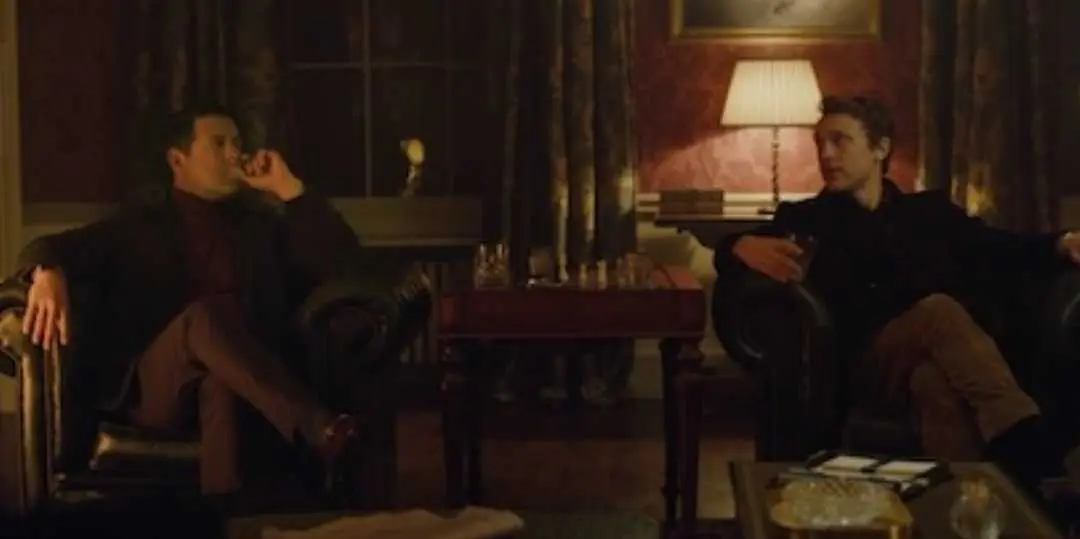
As the story unfolds, viewers slowly realize Caleb is not entirely pure either. He may not be openly cruel like others around him, but he has spent years ignoring uncomfortable truths because doing so benefited him socially and financially. That becomes one of the film’s biggest themes: survival through self-deception.
Moseley delivers an excellent performance balancing emotional sincerity with growing unease as Caleb’s carefully constructed reality begins fracturing around him. Even as the character’s situation grows increasingly dangerous, Moseley never overplays panic or hysteria, grounding Caleb in a nervous restraint that quietly keeps audiences emotionally tethered to him.
The Ending Unpacked: Exposure, Ruin, and No Clean Exits
What begins as a stylish wedding-night thriller slowly mutates into something far nastier — a study of wealthy people rotting emotionally behind expensive walls while pretending morality still exists somewhere between the champagne glasses and loaded rifles.
By the final act it becomes less about survival and more about exposure. Nobody escapes untouched. Some lose power, some lose illusions, and some discover they were never the heroes they imagined themselves to be in the first place.
Caleb survives physically, but psychologically he is shattered by what he learns about both families and himself. The empire the Foresight family spent decades constructing does not survive the night intact either. The ending refuses to deliver the cathartic rescue audiences conditioned on mainstream thrillers might expect.
The twists work because they feel inevitable rather than arbitrary. Kennedy carefully structures the narrative so that power constantly shifts hands within the room. That emotional honesty gives the conclusion a weight that lingers. It is the kind of ending that rewards audiences who have been paying attention rather than simply waiting for the action set pieces.
Kennedy’s Direction and the Critical Conversation Around His Debut
For a debut narrative feature produced under the limitations of an independent budget, Kennedy displays an impressively assured visual voice and a sophisticated understanding of thriller mechanics, ensemble blocking, and thematic construction.
One standout sequence, in which bloodied family members armed with rifles descend into the brightly lit wedding reception area after spending much of the film trapped inside the darkened study, perfectly captures Kennedy’s understanding of visual tonal contrast.
Cinematographer Lorenzo Levrini gives the estate a suffocating Gothic texture filled with shadows, dark wood interiors and sickly lighting that slowly grows more oppressive as the night continues. The sound design also deserves enormous credit, with subtle ticking clock motifs quietly reminding audiences that midnight is approaching even during calmer scenes.
Critical opinion has been divided but genuinely engaged with what Kennedy is attempting. One reviewer noted that while there is a decent idea for a night of horror in the screenplay, the film largely takes place inside a single room and occasionally resembles a filmed play rather than a conventional cinematic thriller.
By contrast, Behind The Lens Online praised the film as having “something deliciously venomous” pulsing through it, calling it a tightly coiled debut that balances dark humor, suspense, emotional dysfunction, and escalating violence without collapsing into self-parody.
The film’s tagline promises that the wedding was just the beginning, and in the best possible reading of ‘An Enemy Within’, that is exactly right: what starts as a premise becomes a portrait, and what starts as a thriller becomes something closer to a reckoning. If you have made it through the final act and are still untangling who deserved what fate inside that estate, share your verdict below — because this is the kind of ending that splits rooms almost as cleanly as The Wolf splits loyalties.