If ‘Ladies First’ Flipped Your World, These Films Will Keep the Script Reversed

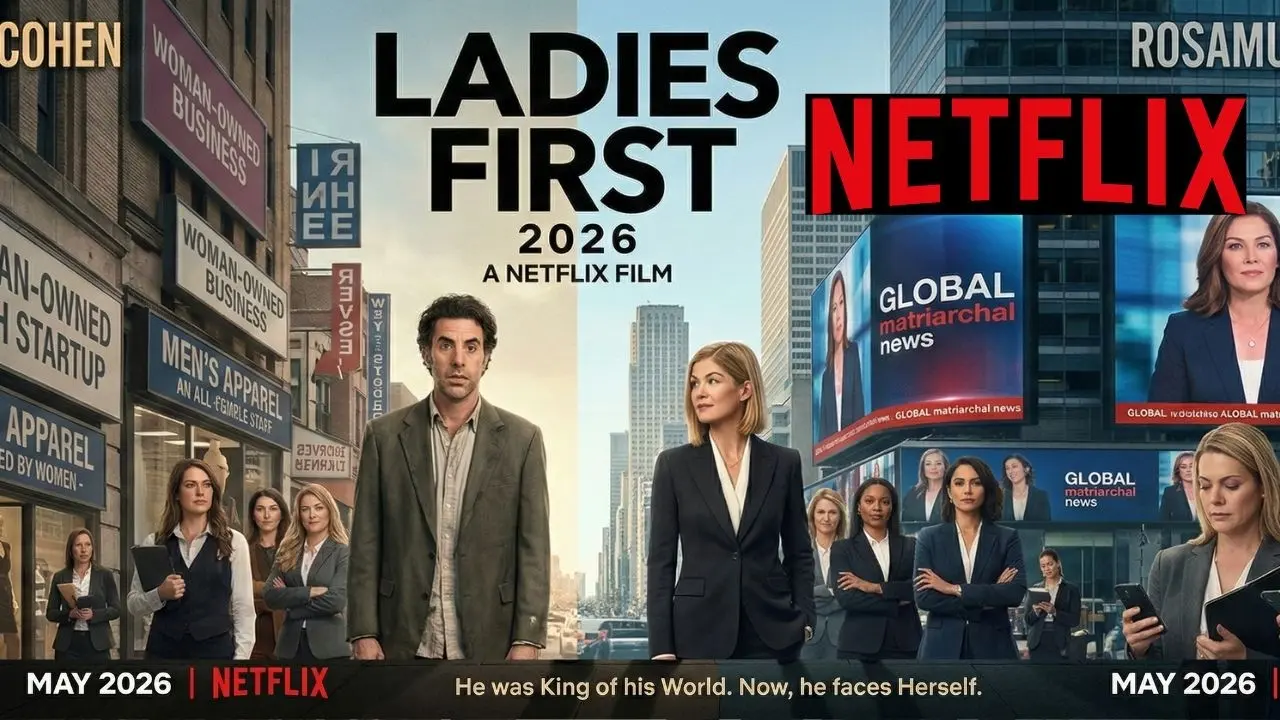

Netflix’s newest comedy ‘Ladies First’ dropped on May 22, and it has already sparked the kind of conversation that tends to outlast any individual film’s critical reception. The film follows Damien Sachs, a man who seemingly has it all, money, power, and a never-ending stream of casual flings, until he wakes up in his worst nightmare: a parallel world dominated by women. Directed by Thea Sharrock and led by Sacha Baron Cohen and Rosamund Pike, it is loosely inspired by the 2018 French film ‘I Am Not an Easy Man’ by Éléonore Pourriat.
The gender-swap satirical comedy genre has a long and surprisingly rich history on screen, and ‘Ladies First’ is really just the latest chapter in it. If you burned through the film and found yourself hungry for more of that same pointed, playful energy, these are the titles that belong on your watchlist next.
The French Original That Started It All: ‘I Am Not an Easy Man’
Before ‘Ladies First’ ever went into production, there was a sharper, scrappier French film that laid the blueprint. ‘I Am Not an Easy Man’ stars Vincent Elbaz as a chauvinist who ends up in a parallel universe where stereotypical gender roles are reversed, and the film was released on Netflix in April 2018. Remarkably, it holds the distinction of being the first French-language film ever commissioned by Netflix.
The film follows Damien, a man highly familiar with the benefits of living in a patriarchal society, who, soon after a bump to the head, finds himself waking in what seems to be an alternate universe dominated by women. The premise is nearly identical to ‘Ladies First’, though the French version leans harder into its absurdist comedy and sharper social teeth.
The film has an absurdist comedy and a genuine commitment to its premise, with relatively sharp messaging that warrants a closer look. For viewers who felt ‘Ladies First’ pulled its punches in places, the original is well worth tracking down for comparison.
The Classic That Made Gender-Swap Comedy Mainstream
If there is one film that truly legitimized the battle-of-the-sexes fantasy premise as a Hollywood mainstay, it is Nancy Meyers’ ‘What Women Want.’ The film earned mixed reviews from critics but was a box office success, with a North American domestic gross of $182 million and a worldwide gross of $374 million against a budget of $70 million. That is the kind of number that tells you the audience responded to something real.
Nick Marshall, a Chicago advertising executive and alpha male, is a chauvinist skilled at selling to men and seducing women, who finds his world turned upside down by a supernatural ability to hear women’s thoughts. The DNA is unmistakable when you stack it against ‘Ladies First’: same arrogant ad executive archetype, same workplace power dynamics, same comedic reckoning.
The first film that comes to mind as a comparison for ‘Ladies First’ is this Nancy Meyers rom-com starring Mel Gibson in his leading man days. Decades apart and still telling essentially the same story about entitled men needing a jolt to understand how the other half lives, which says something worth sitting with.
The Gender-Reversed Remake That Brought It Into the Modern Era
Hollywood rarely stops at one bite of the apple, and ‘What Women Want’ eventually spawned its own response film. ‘What Men Want’ is an update of ‘What Women Want’ that is minus Mel Gibson and flip-reversed for the Me Too generation, with the protagonist being power-dressing sports agent Ali Davis, played by the magnetic Taraji P. Henson, who gains the ability to read the minds of men after a supernatural encounter.
The story follows a successful sports agent who gains a newfound ability and chooses to harness her powers in the boardroom as well as the bedroom, navigating a male-dominated world with a sharp satirical lens. The film’s genius is in flipping the perspective entirely, putting a woman at the center of the kind of supernatural-fix story that was previously reserved for men learning their lesson.
The tone here is brasher and more contemporary than the Mel Gibson version, and it lands closer to the vibe of ‘Ladies First’ in its willingness to lean into workplace comedy and the absurdity of power dynamics done broadly for laughs.
‘Barbie’ and the Mainstream Moment for Matriarchy Satire
No conversation about gender-swap satire in recent years is complete without addressing ‘Barbie.’ The film depicts a world where men are shown in leisurely roles, a stark contrast to the real world, and the real world presents Ken with a dose of patriarchy, leading him to plot a coup to establish a male-dominated society back in Barbieland. Sound familiar?
Barbieland is an inverted patriarchy, depicting a society in which women hold positions of power and are defined by their careers, whilst the existence of men is defined by their relation to women. Greta Gerwig’s film essentially operates on the same satirical logic as ‘Ladies First’, though with far more visual spectacle and a considerably larger cultural footprint behind it.
The plot of ‘Ladies First’ sounds similar to that of ‘Barbie’, except that Ken’s plot is reversed, with the film running solely on satire and showing what it is like when women run the world. Watching both back-to-back makes for a genuinely illuminating double feature on how Hollywood keeps circling this idea from different angles without quite knowing what to do with it.
The Satirical Thread Connecting Them All
What unites ‘I Am Not an Easy Man,’ ‘What Women Want,’ ‘What Men Want,’ ‘Barbie,’ and now ‘Ladies First’ is something deeper than a shared premise. Each film uses fantasy or alternate reality as a comedic mirror, putting privileged characters in positions where the rules no longer protect them and seeing how long it takes for genuine empathy to arrive.
Cohen may play the main character in ‘Ladies First’ but Rosamund Pike is the actor who owns it, proving for the umpteenth time she has more star power and talent than half the industry, comfortable in a position of power and fascinating even when her character is morally questionable. That dynamic, of the ostensible lead being upstaged by the woman in the room, is itself a meta-joke the genre keeps telling.
The most interesting read on ‘Ladies First’ is a metatextual one, where Cohen’s most famous creation, the cheerfully chauvinistic Borat, gets emotionally vivisected by Pike’s calculating character.
The genre has found a way to comment on itself, and on the culture that keeps demanding it be remade. Whether ‘Ladies First’ earns its place in that lineage or coasts on the formula is a debate worth having, and it would be fascinating to know which of these films you think nailed the premise best.