‘The Testaments’ Show vs. Book: Here Are All the Major Changes


Hulu’s ‘The Testaments’ arrived on April 8, 2026, and readers of Margaret Atwood’s beloved 2019 novel were quick to notice that something felt different. The spinoff series, which serves as a direct sequel to ‘The Handmaid’s Tale,’ draws heavily from Atwood’s source material but reshapes it in ways that go far beyond cosmetic adjustments.
For anyone who devoured the novel expecting a faithful page-to-screen transfer, the show offers something more complicated and, in many ways, more surprising. While the source material continues the dystopian world established in ‘The Handmaid’s Tale,’ the showrunners have adapted timelines, character arcs, and plot details to suit the television format and to expand the story in new directions. Here is a breakdown of the most significant changes made so far.
The Testaments Timeline Shift That Changed Everything
The single most consequential departure from Atwood’s novel is the time jump, and it sets off a chain reaction that affects nearly every other element of the adaptation. The novel unfolds 15 years after the events of ‘The Handmaid’s Tale,’ whereas the show takes place just 4 years after the series finale of the Emmy Award-winning program.
Therefore, June Osborne, played by Elisabeth Moss, and the Handmaids’ uprising in Boston remains relatively fresh, and the consequences of these events would still be apparent and experienced in ‘The Testaments.’ This was clearly a deliberate creative decision by showrunner Bruce Miller to maintain continuity with a show that only wrapped in 2025.
The TV adaptation had long overtaken where the original story had ended, which means some changes to ‘The Testaments’ were necessary. The Hulu series concluded in 2025, having extended its story well beyond the scope of Atwood’s first book. That narrative overhang created creative constraints that ripple through every major decision in the adaptation.
Daisy’s Identity Is Completely Different in the Show
Perhaps the most dramatic change from the book involves the character of Daisy, played by Lucy Halliday. In Atwood’s novel, Daisy’s secret identity is one of its most powerful reveals. In ‘The Testaments’ book, it’s eventually revealed that Daisy is actually the daughter of June and Nick. That version of Daisy has a similar backstory and broad function in the narrative to the TV one, but there’s an age gap of several years between her and Agnes.
The show diverges from this revelation due to a shorter time jump of four years after the original series finale, rather than the 15 years in the book, meaning Daisy is not portrayed as Holly in the TV version. The math simply does not work. Bruce Miller explained this choice to The Hollywood Reporter, noting that “Holly would only be four or five. So in our story, because of the timeline, baby Holly, as far as we know, is safe growing up in Toronto… for now.”
In the Hulu version, The Hollywood Reporter reported that Daisy is a Toronto teen turned undercover Mayday agent at a Gilead girls finishing school, and she’s the character who brought Elisabeth Moss’s June Osborne back into the franchise, as June is Daisy’s handler. That relationship simply does not exist in Atwood’s novel in the same way.
Character Ages and the Ripple Effect on Agnes
The compressed timeline also reshapes who Agnes is within the story. Agnes is depicted as 14 or 15 in the TV show, while in the novel, she begins around 13 or 14 and reaches her early 20s by the story’s conclusion. In the series, Daisy appears to be roughly the same age as Agnes, whereas in the book, as sisters, she is considerably younger.
In the book, Agnes is about 10 years older than Daisy. This makes sense because Agnes was already a child when Gilead took her. Daisy, as Nicole, was born later and sent to Canada as a baby. The TV show collapsed that age gap almost entirely, placing both young women in the same school setting under Aunt Lydia’s watch.
Chase Infiniti, who plays Agnes, described her character as someone who is just starting to see the truth about her world, saying “She is really learning that her life is not all that she was prepped for and expecting.” That framing as a teenager discovering disillusionment is quite different from the older, more politically aware Agnes of the novel.
Commander Judd and Aunt Lydia Get Reinvented
Two of the novel’s most important figures have been substantially reimagined for the screen. In Atwood’s ‘The Testaments’ book, Judd is described as a high-ranking Gilead commander who repeatedly marries child brides in his advanced age. On the show, Judd was aged down and portrayed by actor Charlie Carrick. That choice softens one of the novel’s most unsettling dynamics, even if the character remains menacing in other respects.
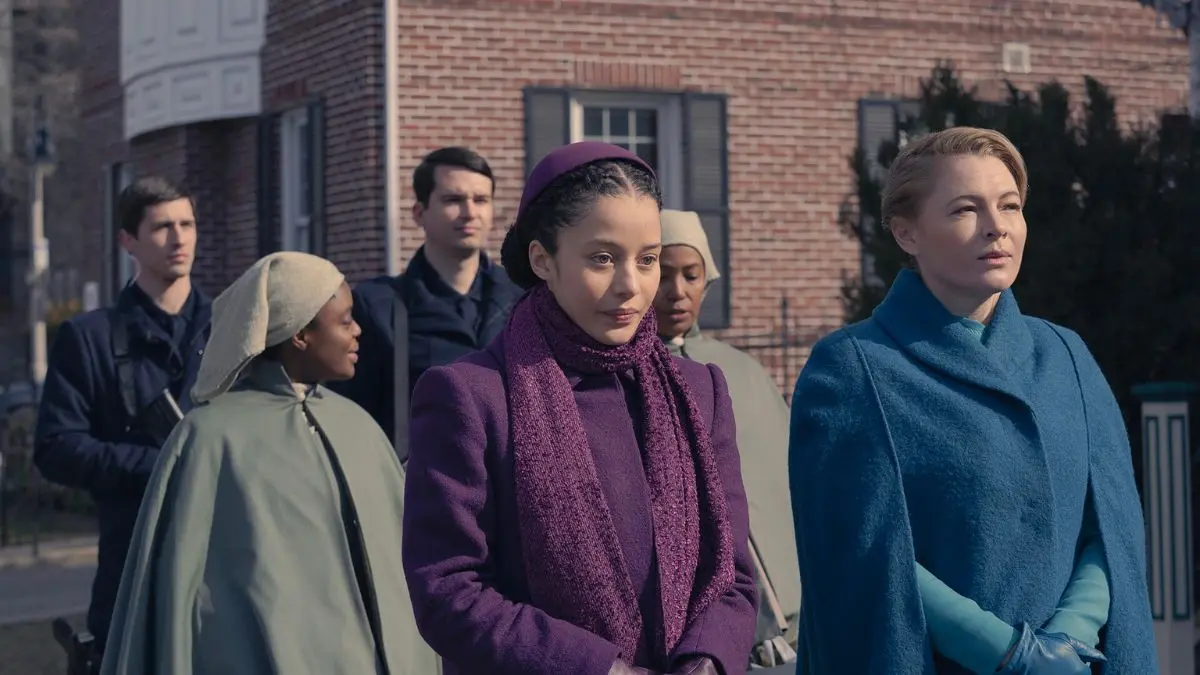
Ann Dowd teased before ‘The Testaments’ premiered that Lydia would be a school teacher in the TV world, while the book revealed she was a family court judge. That backstory shift fundamentally changes the texture of Lydia’s pre-Gilead self, even if her ruthless pragmatism within the regime stays consistent across both versions.
The reintegration of Aunt Lydia, who was very publicly on June’s side by the end of ‘The Handmaid’s Tale,’ into Gilead’s leadership is especially hard to believe, as one review noted, pointing to the tension created by adapting Atwood’s version of the character onto a figure who had already been developed across six seasons of television in a diverging direction.
What Stays True to Atwood’s Vision
Despite all the changes, the show has not abandoned the architecture of the novel. Creator Bruce Miller confirmed that ‘The Testaments’ debut season will cover that first section of Atwood’s novel. Since ‘The Handmaid’s Tale’ ran for six seasons based on one book, ‘The Testaments’ will likely take liberties as well if it finds success on Hulu.
The book is told in three perspectives, covering Daisy, Agnes, and Aunt Lydia, a central figure in ‘The Handmaid’s Tale.’ The show maintains that same structural approach, even as it reconfigures what each perspective contains. The core mission of Agnes and Daisy working together to undermine Gilead from within also remains intact.
Atwood herself, speaking about the novel at an event in 2019, said “Although I could not continue with the story of Offred, I could continue with three other people concerned in these events and tell the story of the beginning of the end, because we know from ‘The Handmaid’s Tale’ that Gilead vanishes.” That thematic destination, the collapse of Gilead seen through the eyes of the next generation, is where both the book and the show are ultimately headed, even if they are taking very different roads to get there.
Whether you are a devoted reader of the novel or a newcomer encountering Gilead for the first time through the screen, the question worth debating is whether Bruce Miller’s changes serve the spirit of Atwood’s story or quietly undermine its most daring choices, so share your take on the biggest book-to-show departure in ‘The Testaments’ below.