‘Enola Holmes 3’ Review – A Malta Set Mystery That Trades Some Of Its Spark For Sentiment



Millie Bobby Brown has carried this franchise on her shoulders since 2020, turning Sherlock Holmes’ overlooked younger sister into one of Netflix’s most dependable recurring characters. Two films in, the formula had settled into something comfortable, blending Victorian mystery with coming-of-age drama and a healthy dose of fourth-wall-breaking charm.
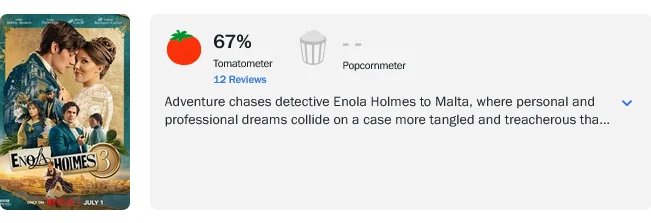
This third outing shakes that formula up in a meaningful way, swapping director Harry Bradbeer for Philip Barantini and relocating the action from foggy London streets to the sun-soaked island of Malta. Enola is preparing to marry Lord Tewkesbury, and just as the wedding festivities begin, her brother Sherlock goes missing, pulling her back into detective mode while she wrestles with what marriage might mean for her independence.
Watching it unfold, I found myself genuinely torn in a way the previous two films never made me feel. There is a version of this movie that fully commits to its darker, grittier instincts, and there is another version still clinging to the breezy, mystery-of-the-week energy that made the earlier entries so easy to enjoy, and the finished film seems to be arguing with itself about which one it wants to be.
Brown remains the reason this franchise works at all, and her performance here still carries flashes of the wit and warmth that made Enola such an appealing lead in the first place. That said, there is a noticeable dip in her energy this time around, as though the character herself has grown a little tired of proving what she is capable of, and it left me wondering whether three films in a row might simply be starting to show some wear.
Henry Cavill’s Sherlock gets sidelined for a significant chunk of the runtime given the kidnapping premise, which makes narrative sense but also robs the film of one of its most enjoyable dynamics, the sibling banter that gave the earlier movies so much of their charm. When he finally reenters the story, his screentime feels rationed rather than earned, and I found myself missing the easy chemistry between Brown and Cavill that had become one of the series’ most reliable pleasures.
The Malta setting itself is a genuine highlight, and Barantini clearly relishes the chance to shoot somewhere with more texture and grit than the London backlots of the earlier films. A subplot involving a local Maltese man with legitimate grievances against British interference gives the movie some of its most interesting thematic material, even if the film never quite trusts that thread enough to let it fully breathe.
Where the movie stumbles hardest is in its central mystery, which unfolds with surprisingly little tension for a franchise built entirely around detective work. I found myself piecing together the culprit well before Enola did, and the reveal, when it finally arrives, lands with more of a shrug than the satisfying click a good whodunit should deliver.
Helena Bonham Carter remains a delight in her limited screentime as Eudoria, injecting chaos and warmth in equal measure whenever she appears, and Louis Partridge continues to make Tewkesbury more endearing than the character probably deserves on paper. It is these smaller character beats, rather than the central mystery, that end up carrying the emotional weight of the film.
By the time the credits rolled, I was left with genuine appreciation for what this franchise has built over three films, even as this particular chapter left me wanting more from its plotting and pacing. It is still an enjoyable watch anchored by a likable cast and a gorgeous new setting, but the spark that made the earlier films feel effortless has noticeably dimmed here. I am landing on 7 out of 10 for this one, a solid but clearly transitional entry that coasts more on goodwill than on the sharp storytelling that built this franchise in the first place.
Do you agree with where I landed on ‘Enola Holmes 3’, or did this Malta-set mystery work better for you? Let me know your own take in the comments.