The Odyssey Just Reopened One of Greek Mythology’s Darkest Family Secrets, Agamemon’s Murder of His Own Daughter


Christopher Nolan’s ‘The Odyssey‘ has finally arrived, and one brutal flashback is already dominating conversation online. Buried within the sprawling adaptation is a gut punch of a scene showing Agamemnon carrying his own child to her death, a moment that TV Tropes describes as a shot of the king holding a small child while his wife screams in horror nearby.
That single image has sent casual viewers scrambling to understand the mythology behind it. Here is what actually happened to Iphigenia in ancient Greek tradition, and how Nolan chose to translate that horror onto the screen.
The Agamemnon Sacrifice at the Heart of the Myth
According to the traditional account dramatized in the 1977 film ‘Iphigenia,’ Agamemnon assembled a massive Greek fleet at Aulis to sail for Troy and reclaim his brother Menelaus’s wife, Helen. The goddess Artemis, angered by an offense committed by Agamemnon’s father King Atreus, punished the fleet by sending storms that made it impossible for the ships to sail.
The prophet Calchas revealed that only one act would lift Artemis’s curse, according to the same source. Agamemnon would have to sacrifice his own firstborn daughter, Iphigenia, to atone for the crime and finally earn the winds needed to reach Troy.
What makes the myth especially cruel is the deception involved. Agamemnon supposedly wrote to Clytemnestra requesting that Iphigenia be sent to Aulis under the pretense of marrying the great warrior Achilles, only for her arrival to become a countdown to her own death. Even as Iphigenia spoke joyfully of her wedding, the film depicts her father already speaking in the language of her sacrifice.
This version of the story comes primarily from Euripides’s play ‘Iphigenia at Aulis,’ and it has shaped nearly every screen adaptation since. It is the ambition and pride of a king, not the will of the gods alone, that ultimately dooms his daughter in this telling of events.
How Nolan’s ‘Odyssey’ Adaptation Handles Iphigenia
Nolan’s approach is deliberately brief but unmistakably brutal. The film shows Agamemnon sacrificing his own daughter to secure favorable winds, a moment Penelope describes onscreen as monstrous, according to details from the film itself.
Rather than dramatizing the full ordeal the way ‘Iphigenia’ did decades earlier, Nolan uses the sacrifice as a single devastating flashback, a shot of Agamemnon carrying a small child while his wife screams, used both to establish his monstrous nature and to fuel Odysseus’s fear that his own son Telemachus could meet a similar fate if he refuses to go to war.
Notably, this detail is never mentioned in either of Homer’s original epics. It comes from the wider mythological cycle and was first explicitly tied to Clytemnestra’s motive for revenge by the playwright Aeschylus, and Nolan’s film follows that same tradition rather than Homer’s silence on the matter.
Lupita Nyong’o takes on the dual role of both Helen of Troy and Clytemnestra in the film, and it is widely believed the screaming woman glimpsed in trailer footage is Clytemnestra desperately trying to reach her daughter before the sacrifice occurs, based on the context surrounding the scene.
Clytemnestra’s Revenge as the Emotional Engine of the Story
In mythology, Clytemnestra never forgives her husband. She believes her daughter to be dead and ultimately kills Agamemnon herself upon his return from Troy, an act of vengeance for the murder of their child, as recounted in descriptions of the original Euripides source material.
Nolan’s film preserves that same emotional throughline. Clytemnestra is shown murdering Agamemnon after the war, a brutal and undignified killing at the hands of his own wife, and Helen is shown gloating over his fate, insisting he deserved it for using her disappearance as a flimsy excuse to wage a war of conquest, according to details from the film.
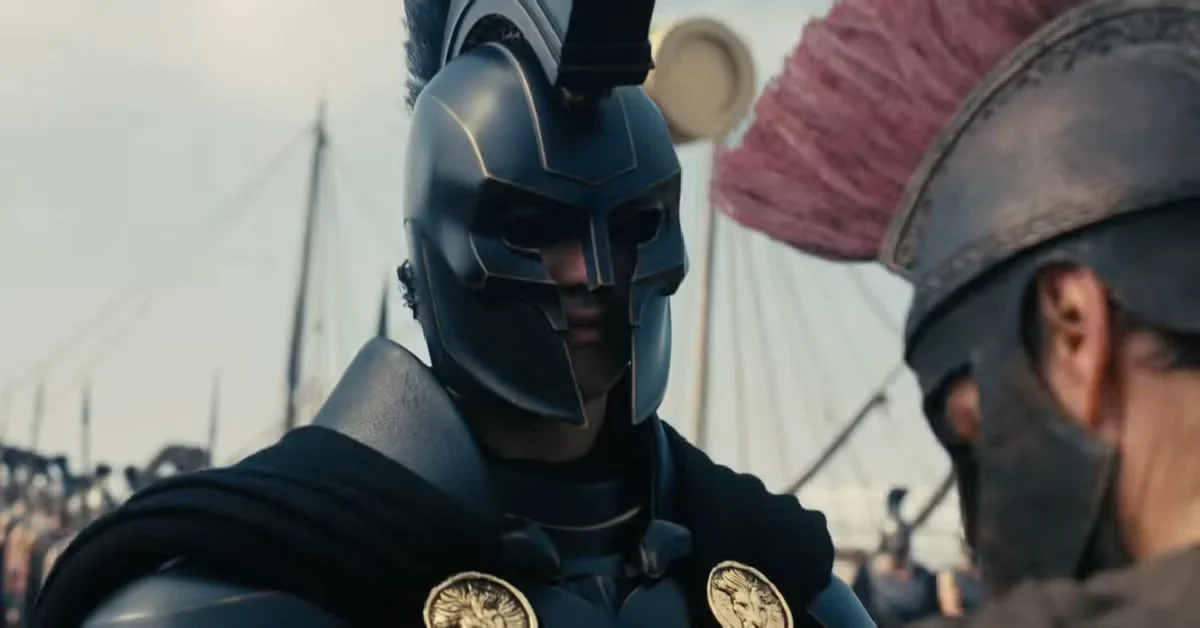
The cycle of violence does not end there in either version. Their son Orestes eventually avenges his father by killing his own mother, a twist confirmed within the film when Menelaus reveals to Odysseus that Orestes killed Clytemnestra in Agamemnon’s name.
It’s a family tragedy that spans three generations, and Nolan’s decision to keep that entire arc intact, even in a film centered on Odysseus’s journey home, signals how seriously he treated the darker corners of the source material rather than sanding them down for a modern audience.
Casting Choices Bringing the Agamemnon Myth to Life
Benny Safdie plays Agamemnon in the film, marking his second collaboration with Nolan after portraying Edward Teller in ‘Oppenheimer,’ according to details from the film’s production. Safdie is primarily known as a filmmaker alongside his brother Josh, having co-directed ‘Uncut Gems’ and ‘Good Time’ before stepping into ‘The Smashing Machine’ as a solo director in 2025.
Nyong’o’s double casting as both Helen and Clytemnestra adds a layer of tragic irony to the story, since in the mythology the two women are sisters, and Helen’s abduction is technically what set the entire chain of events, including Iphigenia’s death, into motion in the first place.
The film’s ensemble also includes Anne Hathaway as Penelope, Tom Holland as Telemachus, Jon Bernthal as Menelaus, Charlize Theron as Calypso and Zendaya as Athena, rounding out a cast built to carry both the intimate family tragedy of the Agamemnon line and the sweeping adventure of Odysseus’s decade-long voyage home.
Given how much weight Nolan places on a single flashback most audiences won’t have expected walking into a Matt Damon adventure epic, it says a lot about how faithfully the darker threads of Greek mythology survived the trip to the big screen. Do you think ‘The Odyssey’ handled Agamemnon’s fate and Iphigenia’s sacrifice with the gravity the myth deserves, or should Nolan have given that storyline even more room to breathe?