How Comic Book Movies Create a Sense of Scale on Screen


Films from comics should be grander than life. The heroes and villains can fly, knock down buildings, jump around in space, battle monsters of colossal size, and withstand natural catastrophes, which cannot occur in real life. However, reaching the required degree of grandeur is much more difficult than simply increasing everything.
The scale will depend on the way the film director combines such elements of filmmaking as cinematography, production design, location, sound, special effects, lighting, editing, and the characters’ point of view. If all of these aspects are used in the right way, even an ordinary scene may turn out to be extremely grand. If they are not, a sequence that includes spectacular destruction could turn out to be unexpectedly small.
The best comic book movies know that scale is not merely about magnitude. Scale is about allowing the viewer to grasp how big, how dangerous, how far away, or how scary something is for the characters themselves.
Scale Begins With a Point of Comparison
It is a size comparison against some other object that helps audiences see the size of objects. The building looks enormous only when a person stands near it, whereas a huge monster is more menacing with cars, streets, or humans on screen as a reference point. Such comparisons are used in filmmaking all the time.
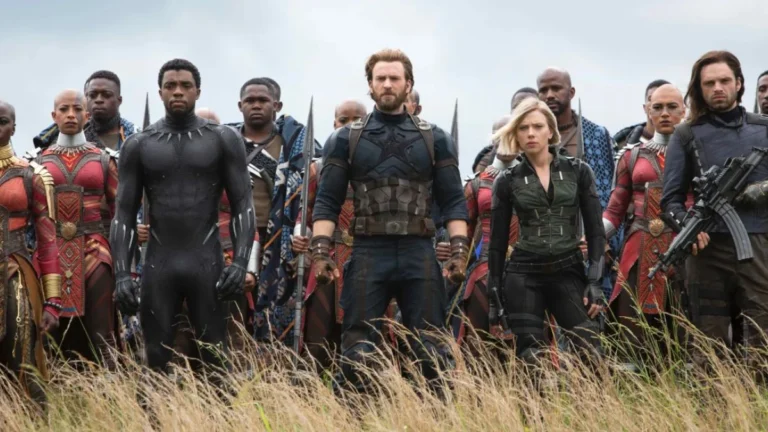
When the superhero stands alone in front of a huge object, the size comparison is immediately obvious. A shot that reveals how small the human figure is in relation to the huge surroundings may serve the same purpose without any visual effects. This aspect is particularly significant for comic book films since so many settings and characters are larger than life.
The digital city, spaceship, or monster may be huge in technical terms, but it may be hard to understand its size if there is nothing recognizable that could help the audience. This is why good visual storytelling needs to give the audience something to see.
Wide Shots Establish the World
One of the easiest ways to create scale is to show the environment. By using wide shots, the viewer can see where the characters are in relation to other environmental objects such as buildings, nature, crowds, vehicles, and many more. This method allows the viewer to understand the location and geography before the action starts taking place.
It is especially useful when there is a need for a larger scale, such as in superhero movies. In this case, using a wide establishing shot will allow viewers to see the starting point of the superhero, the direction of the target or threat, and the distance between them. This will enable a faster and easier workflow with close-ups and a good wide-angle setup.
Otherwise, scenes with massive scale and wide-angle views will seem impressive but will confuse the viewer’s mind about the actual arrangement.
Camera Placement Changes How Big Something Feels
Where the camera is positioned can greatly affect how big or small something appears in a photo. Low angles can create the illusion of greater size, as the camera looks up, and the audience looks up within a scene at what’s on the screen.
Towering figures and structures look even more imposing when viewed from below. On the other hand, high angles make things look smaller, as if you’re looking down on them within the environment.
Movie directors often use these different perspectives during comic book movie filming. This way, a superhero can first appear heroic and larger than life, then be shown as tiny and vulnerable when up against a bigger foe or natural disaster.
Camera angles can create an emotional impact as well as a visual one by illustrating the relationship between the environment and the characters within it.
Real Locations Make Digital Scale More Convincing
Visual effects can create worlds of an incomparable scale, but real-world environments often form the foundation of a digital environment.
A real street, building, mountain, bridge, or shoreline has inherent detail that defines its scale. Location selection is a crucial stage in production planning, influencing everything from visual style to storytelling. With location scouting support, World Production Service helps teams identify spaces that match the creative direction of their projects.
An extended environment, rendered digitally, will include these familiar elements as reference points, allowing audiences to experience an image that they can relate to.
A digitally rendered spacecraft above a real-world cityscape appears massive, as the audience can relate to the scale of the buildings beneath the vessel. Such principles can be applied to other exponentially scaled projects, such as depicting collapsing structures, large-scale fauna, and otherworldly environments.
The relative scale of a computer-rendered image can influence the apparent size and scale of its objects, making them more accessible and relatable to an audience.
Production Design Builds Scale From the Ground Up
Production design is also essential in bringing comic book worlds to life on the screen. Filmmakers can use scale to create an impression of vastness without constructing every element. Practical construction can be used sparingly, and the rest created with visual effects.
A huge futuristic building can have some practical elements, such as a set for a character to enter, a corridor, a control room, or a platform at the front of the set, while the rest is created with computer graphics.
Sets create a tangible environment that the characters can explore, but visual effects can help to make it impossibly huge. Furthermore, production designers can help to convey scale through replication.
Massive buildings made of glass and steel can be suggested by sets that have long horizontal rows of windows, columns, lights, doors, or other elements required to make the construction fully present in the scene.
Visual Effects Need Physical Rules
While modern visual effects could make something as big as the filmmakers want, bigger does not always mean more convincing. Digital environments require consistency in physical laws.
If an enormous object speeds by too quickly in proportion to its apparent size, it could make the object look wispy and less dense. If objects tumble without resistance, or buildings crush themselves with no resistance, an audience would be forgiven for thinking that the world being presented to them is all just a facade. Motion is vitally important. Objects on a bigger scale tend to have more mass and therefore need to move slower for the sake of believability.
A huge spaceship drifting slowly into the scene can feel more massive than one that rockets by at a fast pace simply for the fact that the slow-moving vessel makes you feel as if you are floating with it. It’s the same with creatures, machines, and large-scale explosions. Audiences need to see the relationships between scale and motion to feel as though they are seeing something realistic, something that could exist in our world.
Without a physical reference to a property such as mass, digital spectacles can feel like cartoons, less grounded and heavy than something that was made with practical effects.
Sound Can Make an Image Feel Much Larger
Scale is not created by visuals only. Sound has a powerful effect on the perceived scale of something. A huge object flying towards the camera could be announced by a low-frequency sound effect before it is actually seen. Deep impacts, vibrations, distant explosions, and responses to the environment could also help to create scale not visible in the picture.
Moreover, sound designers use reflections and distances. Therefore, an explosion that occurs far away from the camera cannot be heard the same way as an explosion close to the camera. Moreover, the use of silence can also be effective if the scale of the event needs to be emphasized. If the sound is lowered before the powerful effect occurs, the viewer will feel a much deeper impact from it.
Comic movies using sound effects make the most effective moments much more powerful than less attractive films, where everything is noisy.
Crowds Show the Human Scale of an Event
Large-scale superhero events would be more understandable with ordinary people in them. Crowds provide a useful reference point. A superhero, with an empty digital city around them, is an impressive sight but an emotionally detached one.
An emphasis on crowds running around or watching the battle gives the audience something to relate to, providing a useful reference point for the scale of the fight. As a bonus, that added emotional weight adds to the drama of the scene, raising the stakes. A collapsing building being tossed aside has more emotional impact if the people nearby are shown to be in danger too. A large-scale battle isn’t just an amazing spectacle; it’s a threat to the world around the heroes.
The most effective superhero movies use crowds as plot devices. The audience doesn’t need to care about every random person caught in the middle of the fight. We only need to see a few reactions to what is happening to understand how massive the event is by seeing it through everyday eyes.
Editing Controls How Audiences Experience Size
Fast editing can generate excitement, but scale requires time to absorb. If each shot is only a fraction of a second, the audience can comprehend a sense of something large occurring, but might not be given sufficient time to grasp the scope of the action taking place.
Larger shots can allow for massive environments to feel more grandiose, as it allows the audience to see and experience the environment. A filmmaker can linger on the vastness of the landscape while the character traverses it or slowly introduce a new large object into the scene instead of immediately moving to another shot. This lets the audience experience the expanse and appreciate the scale of the objects and environment.
The editing can then quicken once the geography is established. The most effective action sequences often intercut between shots that showcase the scale of the environments and the more personal scale of characters and their effect on the landscape.
Lighting Helps Separate Different Levels of Depth
Large environments can be made to look flat by having everything lit the same way. Cinematographers and VFX artists utilize lighting in order to craft a three-dimensional look by separating the foreground, middleground, and background.
Atmospheric haze, shadows, highlights, reflections, and contrast allow one to distinguish between objects closer to the camera and objects further away. This is especially useful in virtual reality or computer-generated images.
A city that stretches on for miles would not have the same level of contrast and detail in the far distance as it would on the buildings closest to the viewer; one would need to simulate the appearance of atmosphere thinning out as it stretches on into the distance, and the loss of fine detail with it to make the world feel expansive. Lighting can also be used to draw attention to a specific part of an image.
A tiny figure surrounded by an immense and dark area could be emphasized as the point of focus while still appearing swallowed up by the surroundings at the same time.
Landscapes Naturally Create Epic Scale
Comic Book Movies Frequently Utilize Mountains, Deserts, Coastlines, Forests Essay Comic book movies frequently utilize mountains, deserts, coastlines, forests, and other large-scale natural environments because they communicate scale to an audience without needing much additional explanation.
Having the superhero at the edge of a mountain or walking along a huge desert immediately places the character as a tiny part of a much larger world.
If you are planning to capture large environments from a broader perspective, aerial filming through World Production Service can help reveal the true scale of landscapes, architecture, and cinematic locations.
Natural locations also include the complexity of depth that would be very hard to fully recreate in a different medium. The use of distant mountains, changes in the heavens, the haziness of atmosphere, and variation in ground textures provide the audience with vital visual cues to judge how far things are
After that, visual effects can build on those environments to make the landscape feel even bigger. A mountain range might double as the location for an entire alien civilization, or a coastline could be digitally altered without losing the natural feel of the original location. Using natural landscapes as a base for larger-scale video effects allows the illusion of real-world environments to bleed into the fantastical depictions of comic books.
Small Moments Make Large Moments Feel Bigger
Constant spectacle can, in fact, diminish the sense of scale. When there is always some sequence of explosions on a grand scale, creatures of huge proportions, and collapsing buildings, eventually, one gets used to all this visual spectacularity.
Smaller sequences offer contrast. For instance, a small conversation in the room gives the sense of human scale before going into much bigger places. Walking down a regular street helps emphasize later flying above the city.
It is possible to manipulate audience perceptions with the help of changes in scale. Everything big looks even more spectacular after experiencing something smaller. This principle resembles sound design when silence can amplify a loud effect. Similarly, visual spectacle requires contrast.
Character Perspective Gives Scale Emotional Meaning
The most effective use of scale usually comes from the emotional context of the environment to the character. A vast spaceship is more impressive when our protagonist feels overwhelmed by it. A colossal city turns more impressive when the character is desperately searching for a particular person within it. Without emotional context, the scale falls flat.
Comic book movies are best when the audience is experiencing the kind of events that only occur when the character is reacting appropriately. Even superheroes are frequently outnumbered, and when they aren’t, the emotional connection to the environment helps them understand their role in it.
The audience is not thinking about the scale in terms of size, but rather the implications it should have on the character in which they are experiencing the story.
True Scale Comes From Combining Every Element
Creating a sense of scale in comic book movies is not simply a matter of visual effects. It is about cinematography, production design, locations, lighting, sound editing, movement, and characters’ point of view.
The sense of scale is created through the use of wide shots to show the geography of the location, production design, and visual effects. Moreover, using real locations helps to make the comparison with familiar things in order to show the size of objects.
Sound effects are also essential to create an appropriate sense of scale. Most importantly, it is vital to make the audience relate to the world through a character’s perspective. A colossal creature, a giant spaceship, or a huge city requires appropriate comparisons to make it clear how big it is in the context of the film.
The characters should be tiny in front of these objects in order to emphasize their size. That is why the best comic book movies use visual effects and cinematography to make the audience feel the scale of the world.