Denzel Washington’s Neo-Noir Masterpiece ‘Devil in a Blue Dress’ Is Available to Stream on YouTube


The mid-1990s witnessed an ambitious resurgence of post-war crime stories, as filmmakers sought to recapture the moody allure of mid-century urban mystery. Classical detective cinema had long romanticized cynical private investigators stalking fog-shrouded alleys, yet mainstream studios rarely explored the diverse social fabric that genuinely defined postwar urban centers. When TriStar Pictures released ‘Devil in a Blue Dress’ in September 1995, the production presented a radical reinvention of that familiar cinematic landscape.
Rather than recycling tired Hollywood clichés, the cinematic adaptation turned to the richly textured literary world of author Walter Mosley. Mosley’s investigative fiction stood apart from pulp predecessors by embedding personal economic survival into the heart of hard-boiled storytelling. This narrative foundation offered Hollywood a unique canvas to explore systemic tension, societal neglect, and institutional corruption through an authentic historical lens.
At the center of this gripping mystery is Ezekiel “Easy” Rawlins, an unemployed World War II veteran struggling to keep up with his mortgage in segregated 1948 Los Angeles. Desperate to maintain ownership of his beloved home, Rawlins agrees to search for Daphne Monet, a mysterious socialite who vanished into the city’s vibrant jazz district. Director Carl Franklin embraced this layered dynamic, noting that “this film is really social realism married to film noir,” in an essay for The Criterion Collection.
Subverting the Classical Noir Detective Formula
Unlike Philip Marlowe or Sam Spade, Rawlins does not operate out of a dingy commercial office with a bottle of rye tucked into a desk drawer. He is an ordinary homeowner whose primary motivation is protecting his small slice of the postwar American dream. As he accepts a lucrative fee from the predatory private operative DeWitt Albright, Rawlins finds himself thrust into a lethal web involving City Hall candidates, ruthless fixers, and brutal law enforcement officers.
The investigation quickly reveals that Monet’s disappearance is inextricably tied to a high-stakes political scandal and racial boundary crossing. Rawlins must rely on street-level intuition and code-switching to navigate both elite white corridors of power and the protective camaraderie of Central Avenue nightlife. The deeper he probes into the conspiracy, the more he realizes that truth in mid-century California carries a devastating personal cost.
Rawlins’ gradual entanglement illustrates how economic desperation forces working-class people into dangerous compromises. Franklin observed this moral erosion when analyzing the protagonist’s survival tactics, explaining that “the more money he gets, the more compromised he’s becoming,” as the filmmaker told The Film Stage. This delicate thematic balance elevates ‘Devil in a Blue Dress’ far above ordinary genre exercises.
The Dynamic Chemistry Between Denzel Washington and Don Cheadle
Denzel Washington delivers one of the most restrained and charismatic performances of his celebrated career as Rawlins. He grounds the protagonist with quiet dignity, conveying genuine fear and intellectual agility rather than invincible bravado. Washington allows audiences to experience the daily indignities faced by Black veterans returning from overseas service into an unforgiving civilian hierarchy.
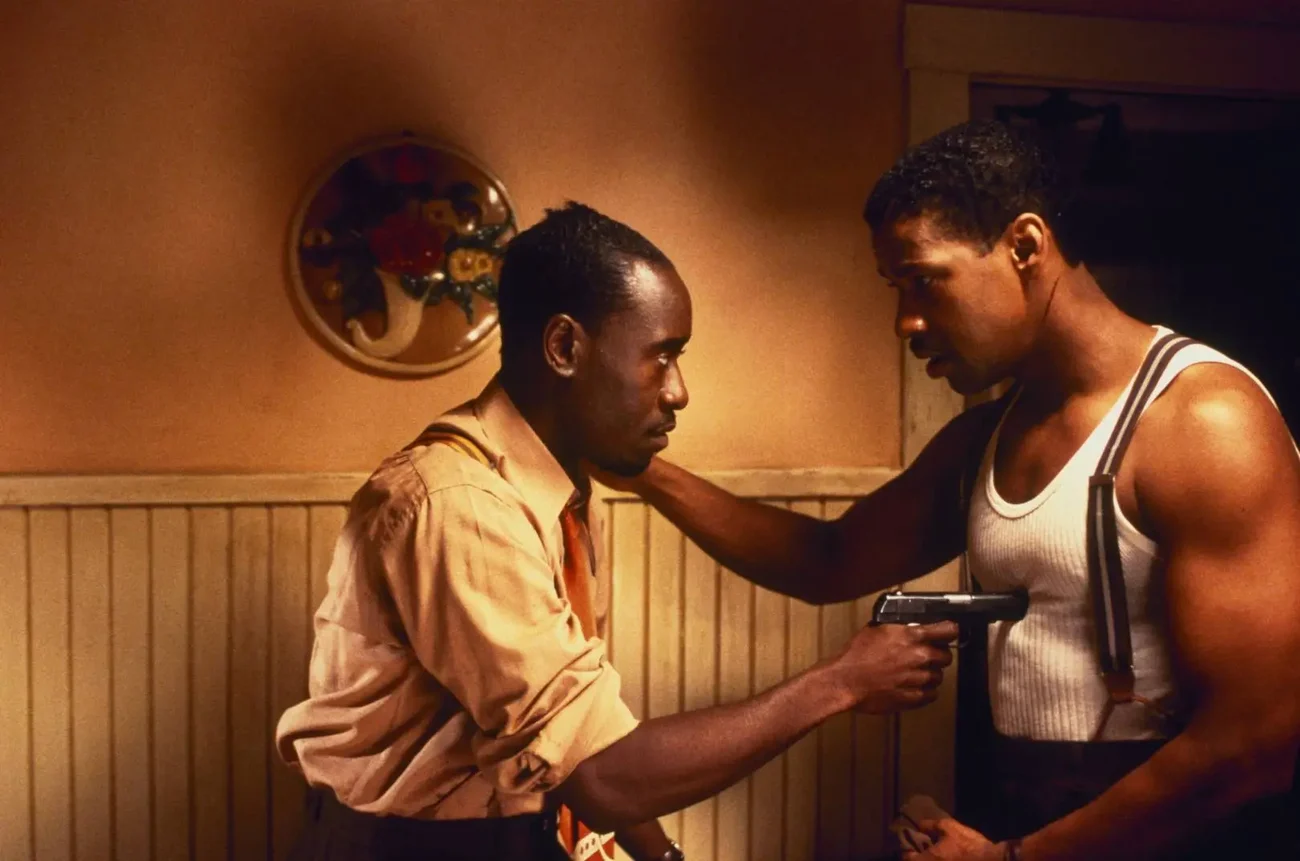
The dynamic shifts into overdrive with the arrival of Raymond “Mouse” Alexander, played by Don Cheadle in a transformative, scene-stealing turn. Mouse functions as Rawlins’ trigger-happy childhood friend from Houston, arriving in Los Angeles with violent instincts that contrast sharply with Rawlins’ cautious morality. Cheadle’s electric energy injects dangerous tension and pitch-black comedic relief into the unfolding peril.
The creative spark between the two actors proved undeniable from the moment they performed their initial rehearsals together. Franklin recognized the rare chemistry immediately, recalling that “when he worked with Denzel, it was just the perfect fit, the two of them,” in an interview with Roger Ebert. Their contrasting approaches create a riveting dynamic that remains a benchmark of mid-nineties screen partnerships.
A Lasting Legacy Beyond Initial Box Office Struggles
Despite universal praise from film critics upon arrival, ‘Devil in a Blue Dress’ struggled to find its footing at the domestic box office. The period thriller earned approximately $22 million against a matching $22 million production budget, facing intense competition and opening during a frenzied national news cycle. Because the theatrical returns were muted, studio executives abandoned plans to develop Mosley’s ongoing book series into an extensive cinematic franchise.
Over the subsequent three decades, the movie has undergone a profound and thoroughly deserved cultural reappraisal. Film historians frequently cite Tak Fujimoto’s warm, shadow-drenched cinematography and Elmer Bernstein’s lush musical score as masterclasses in atmospheric world-building. Prestigious boutique restorations have introduced newer generations of cinephiles to its unmatched craftsmanship and evocative historical setting.
Today, ‘Devil in a Blue Dress’ endures as a vital landmark that proved how private-eye mysteries could challenge societal power structures while delivering timeless entertainment. Washington and Franklin created a sophisticated vision of historical fiction that feels as vibrant and urgent today as it did during its initial premiere.
Where does ‘Devil in a Blue Dress’ rank among your favorite Denzel Washington crime thrillers, and would you like to see Easy Rawlins return to the screen?