Every Major Alamo Movie Ranked and Revisited


Few battles in American history have captured the Hollywood imagination quite like the 1836 siege at the Alamo, and fewer still have been retold on film as persistently, as passionately, or as controversially. The story of a small, outgunned garrison holding a crumbling Texas mission against an overwhelming Mexican army has proven irresistible to filmmakers for well over a century. It has everything cinema loves: doomed heroes, legendary names, a ticking clock, and an ending everyone already knows.
As True West Magazine has noted, the Alamo presents a genuinely difficult storytelling challenge for filmmakers. The heroes are trapped in a fort for nearly two weeks without much happening beyond long debates on patriotism, and then they are all killed in a finale the audience has been expecting since the opening frame. That inherent dramatic limitation has not stopped Hollywood from trying, again and again, to crack the story wide open. The results have ranged from silent-era curiosities to big-budget disasters, with a handful of genuine gems scattered in between.
The Silent Era and Hollywood’s Early Obsession With the Alamo
Depending on the source, somewhere between a dozen and twenty films have been produced over the past century about the Texas Revolution. The earliest significant entry is a 1915 production that set the template for nearly everything that followed.
‘The Martyrs of the Alamo,’ which had its premiere in New York in October of 1915, depicted 250 Americans under Colonel Travis, including Davy Crockett and James Bowie, facing down thousands of Mexican soldiers under General Santa Anna. It was a broad, myth-building exercise more interested in heroic iconography than historical nuance, but it established the visual language that Alamo films would trade on for decades.
A 1926 six-reel silent film directed by Anthony Xydias marked the first time Davy Crockett was moved to center stage in an Alamo production, a creative decision that would become standard practice for virtually every version that followed. By the time the sound era arrived, the Alamo had already calcified into a particular kind of national myth, one that Hollywood was both reflecting and actively constructing.
The 1950s proved especially productive for Alamo-themed productions, with Hollywood delivering ‘The Man from the Alamo’ in 1953 and Disney’s enormously popular ‘Davy Crockett’ in 1955, featuring native Texan Fess Parker in the title role, alongside the television series ‘The Adventures of Jim Bowie.’ The Disney production in particular set off a nationwide craze for coonskin caps and frontier mythology that primed audiences for what was coming next.
John Wayne’s Passion Project and Its Complicated Legacy
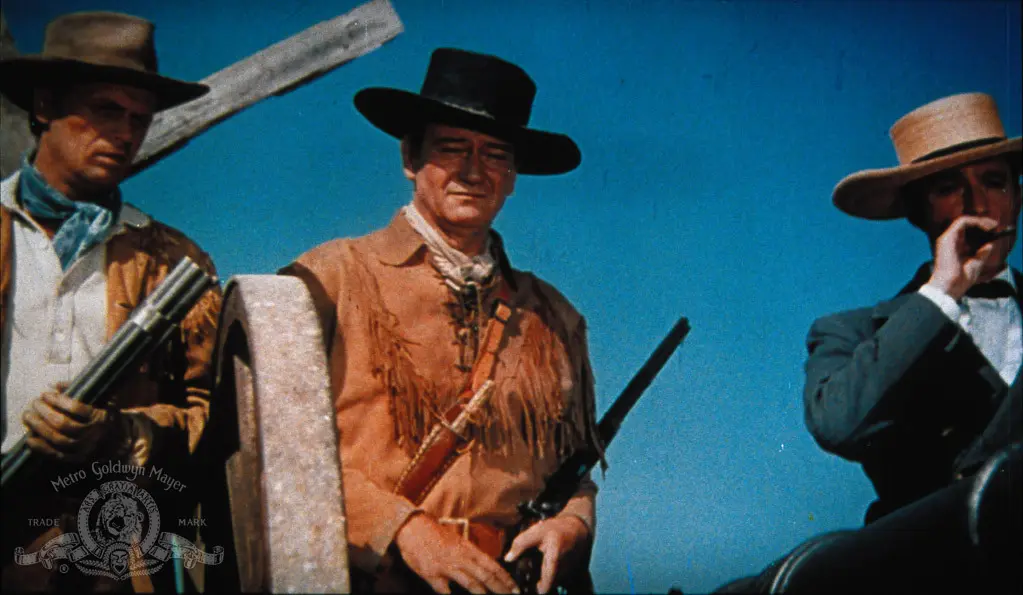
John Wayne had been nursing his dream of making ‘The Alamo’ for over fifteen years, and he threw himself into developing the project after completing ‘The Quiet Man’ in 1952. The road to production was notoriously rocky. Wayne had worked on an Alamo script as early as 1945 for Republic Pictures before eventually falling out with studio head Herbert Yates, who went on to produce his own version, ‘The Last Command,’ in 1955.
United Artists agreed to back the project only if Wayne himself starred, feeling the $12 million budget was too large a risk without the Duke in front of the camera. Wayne originally planned to direct and produce without starring, but investors forced his hand. For the film’s location, he decided on Brackettville, Texas, and began building the sets in 1958, assembling a cast and crew that eventually numbered 342 people, along with 1,600 leased horses and a catering staff of 45 people.
Wayne reportedly invested over $1.5 million of his own money into the production, with the film ultimately grossing just under $8 million against its $12 million budget, making it one of the biggest financial disappointments of his career.
Reviews were mixed, with critics at the time admiring the sheer scale of the production but pointing to its length, historical inaccuracies, and self-indulgent speeches as major weaknesses. The film currently sits at 52% on Rotten Tomatoes. Strangely, the film was also banned entirely in Mexico upon release.
The 2004 Remake and the Performance That Deserved Better
When director John Lee Hancock brought the story back to theaters four decades later, the results were both more nuanced and far more punishing at the box office. The 2004 version of ‘The Alamo,’ produced by Ron Howard and Mark Johnson, starred Dennis Quaid as Sam Houston, Billy Bob Thornton as Davy Crockett, Jason Patric as Jim Bowie, and Patrick Wilson as William Travis, with a budget of $107 million that earned back only $25.8 million worldwide. By any measure, it was a catastrophic financial failure.
The film currently holds a 29% score on Rotten Tomatoes, with critics calling it too conventional and uninvolving to be memorable. Yet the critical consensus masks what many film lovers and historians consider a genuinely valuable piece of work.
Unlike Wayne’s version, which essentially turned Crockett into an extension of Wayne’s own screen persona, John Lee Hancock’s film introduced Crockett as a man fully conscious of his mythical status, aware that his fame was nothing more than legend, and swept up in a revolution that left him no choice but to meet people’s impossible expectations.
Roger Ebert, pushing against the tide of negative reviews, gave the film three and a half stars and wrote that the advance buzz was negative and that was precisely why the film turned out to be a good movie, singling out Thornton’s Davy Crockett as surprisingly the most three-dimensional hero of the piece, carried by one of Thornton’s best-ever performances. The critical rediscovery of this film has only accelerated in recent years, helped along by Thornton’s renewed stardom.
Historical Accuracy Versus Hollywood Myth
Scholars have long pointed out that Wayne’s version in particular is riddled with inaccuracies, noting that the final battle actually lasted less than an hour in the pre-dawn darkness of March 6, 1836, and that current scholarly consensus holds that the historical Crockett may have attempted to surrender at the end of the assault before being executed. Wayne’s film presents a very different version of these events, one built around heroic sacrifice rather than historical complexity.
The 2004 film is considered by many Alamo enthusiasts to be probably the most historically accurate screen depiction yet produced. It took conscious steps to humanize figures on both sides of the battle, presenting Santa Anna’s forces with more dignity than previous versions had allowed.
Production involved 101 days of filming, during which the entire city of San Antonio de Behar and the Alamo itself were reconstructed across 50 acres in Texas, with no sound stage shooting whatsoever.
The tension between myth and accuracy has defined every version of this story. One IMAX film released in 1988 and screened exclusively at a single theater behind the Alamo shrine in San Antonio has been described as the only film that genuinely cared about depicting the battle correctly. That it required a special-venue format to exist at all says something telling about what mainstream audiences have traditionally wanted from the Alamo on screen.
Why Hollywood Keeps Coming Back to the Alamo
Wayne himself described the Alamo story as the greatest piece of folklore ever brought down through history, and observed that folklore had always been the most successful medium for motion pictures. That insight, made over half a century ago, still holds up as an explanation for Hollywood’s persistent return to this particular well.
Wayne wanted his version to express the view that Texas’s struggle for independence was not only one of the most heroic moments in American history but also a metaphor for America itself, hoping to show the world the kind of spirit and will for freedom that he believed still defined the American character. Whether that reading resonates or feels like revisionist nationalism depends largely on who is watching and when.
The story of the Alamo has been told in at least a dozen significant screen versions, and there is little reason to believe Hollywood is finished with it. Every generation seems to need its own interpretation of those thirteen days in San Antonio, its own reckoning with what those men chose and what it cost them.
If you have grown up with one version of this story, whether that’s Wayne’s thunderous patriotism or Thornton’s quiet, aching dignity, which depiction of the Battle of the Alamo has hit closest to home for you?