Netflix Reveals the Movies Behind ‘La Bola Negra’


Every great film has a hidden family tree. Directors rarely build a vision from nothing, and the movies they carry in their heads often shape everything from tone to framing. For one of the year’s most talked-about awards contenders, that family tree has now been made public.
‘La Bola Negra‘ is the sweeping Spanish-language drama from Javier Calvo and Javier Ambrossi, known as Los Javis. It won them a shared Best Director prize at Cannes with Paweł Pawlikowski for ‘Fatherland’, and it has been building awards buzz ever since. Netflix is treating it as the crown jewel of its 2026 slate, giving it a 47-day theatrical window, the longest in the streamer’s history.
Now Netflix has revealed the movies that inspired it. The list includes ‘Come and See’ (1985) by Elem Klimov, ‘Apocalypse Now’ (1979) by Francis Ford Coppola, ‘Ivan’s Childhood’ (1962) by Andrei Tarkovsky and ‘Damnation’ (1988) by Béla Tarr. It also names ‘Beau Travail’ (1999) by Claire Denis, ‘Incendies’ (2010) by Denis Villeneuve, ‘The Favourite’ (2018) by Yorgos Lanthimos and ‘The White Ribbon’ (2009) by Michael Haneke.
⬇️ The films that inspired La Bola Negra ⬇️ -Come and See (1985), directed by Elem Klimov -Apocalypse Now (1979), directed by Francis Ford Coppola -Ivan’s Childhood (1962), directed by Andrei Tarkovsky -Damnation (1988), directed by Béla Tarr -Beau Travail (1999), directed by Claire Denis -Incendies (2010), directed by Denis Villeneuve -The Favourite (2018), directed by Yorgos Lanthimos -The White Ribbon (2009), directed by Michael Haneke
— Netflix Tudum (@NetflixTudum) October 19, 2026
The eight titles span more than five decades and several countries, from Soviet-era war cinema to contemporary European arthouse. It’s not the kind of reference list you’d expect for a film about queer love and Spanish history. That’s part of what makes the film feel so unusual.
The Advocate noted that the film’s brutality and sometimes bitter tone come from the directors’ cinematic diet, pointing to Haneke, Tarkovsky’s ‘Ivan’s Childhood’ and Klimov’s historical anti-war epic ‘Come and See’. One of the directors has described the film as ‘Portrait of a Lady on Fire’ filtered through ‘Apocalypse Now’, which neatly captures the mix of tenderness and harshness. The goal, they said, was to show reality in a hard way while keeping a gentle view of the world through the character Sebastián.
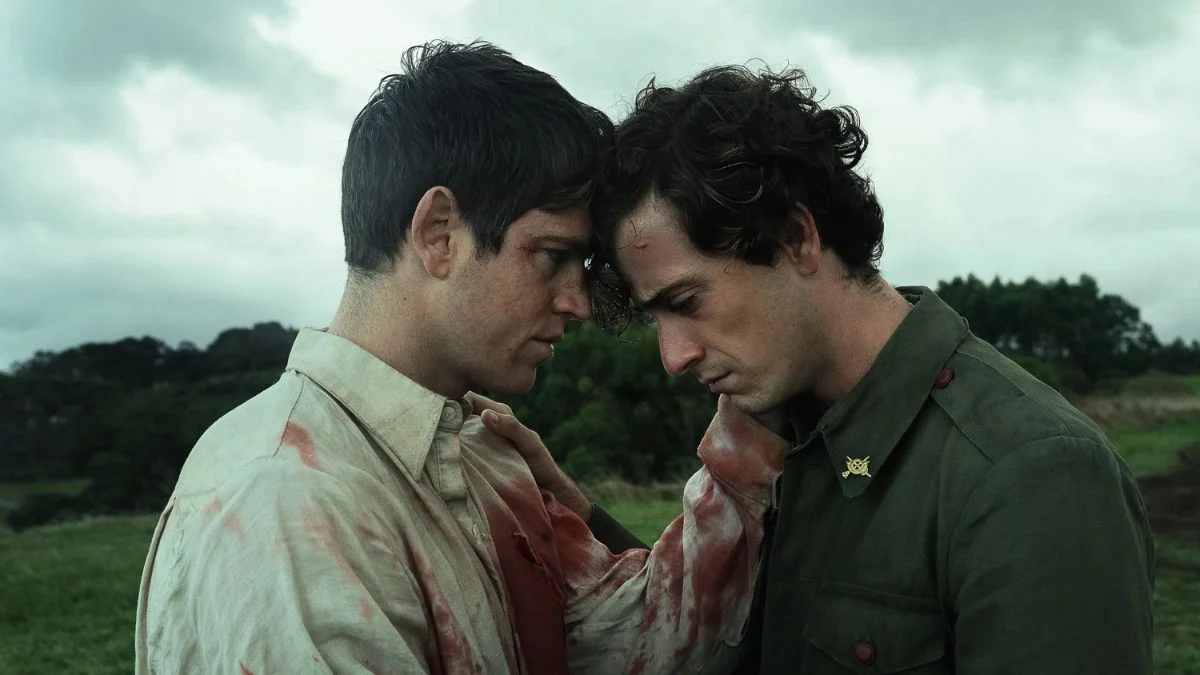
The story follows three gay men across three eras: 1932, 1937 and 2017. In the earliest timeline, a young man is blackballed from a social club because of his sexuality, which gives the film its title. The film is built from four surviving pages of Federico García Lorca’s last play, which he was working on in the summer of 1936, the year he was assassinated.
The three timelines connect through desire, pain and inheritance, running 2 hours and 39 minutes. Guitarricadelafuente makes his acting debut as Sebastián, alongside Miguel Bernardeau, Carlos González, Milo Quifes, Lola Dueñas and Julio Torres. Penélope Cruz and Glenn Close lead the supporting ensemble, and the film is executive produced by Pedro Almodóvar.

The release strategy is as notable as the creative lineage. The film opened in New York and Los Angeles on October 16, with a wider expansion to follow before it arrives on Netflix on December 2. Netflix reportedly paid between $4 million and $5 million for it after a bidding war at Cannes.
That window marks a significant step for a studio that has often been criticized for treating theaters as an afterthought. Variety noted that Netflix is giving the film an unprecedented show of confidence. The directors have said they made it for the screen, in contrast to a movie you can simply rewatch on a streaming service.
Critics have been strongly supportive. RogerEbert.com called it one of the most moving films of 2026, praising the way it turns an unfinished Lorca work into a generations-spanning study of war, sexuality and buried love. Little White Lies described it as a head-spinning, era-spanning ode to political liberty.
The awards conversation is already active. Variety has framed it as a potential first Best Picture Oscar for Netflix, and Kalshi traders give it a 19% chance of winning Best Picture, second only to ‘The Odyssey’ at 47%. Cannes audiences also gave it a lengthy standing ovation, reported at more than 15 minutes.
LA BOLA NEGRA tells the story of three generations of men whose lives are intimately connected through desire, pain, and love. Starring Spanish music sensation Guitarricadelafuente, Miguel Bernardeau, Carlos González, Milo Quifes, Lola Dueñas, Julio Torres, Penélope Cruz and Glenn Close. From Cannes-winning directors Javier Calvo and Javier Ambrossi (“Los Javis”). In theaters October 16.
— Netflix (@netflix) September 1, 2026
Publishing the influences does more than satisfy curiosity. It frames the film as part of a long tradition of serious filmmaking rather than a niche project, and it invites viewers to watch it alongside some of cinema’s most acclaimed titles. For awards voters, that context can help position it as an ambitious, auteur-driven work.
It also says something about the directors. Los Javis came up through television and musical theater, and this list shows they’ve been studying filmmakers who push boundaries. The result is a film that sets queer love against the scale of epic war cinema.
For cinephiles, the list doubles as a viewing guide. Watching these eight films before or after ‘La Bola Negra’ offers a way to trace the threads that run through it. Whether you start with ‘Come and See’ or ‘The Favourite’, the connections may change how you see it.
Which Film Most Excites You About the Influences Behind La Bola Negra?
Have something to add? Let us know in the comments!