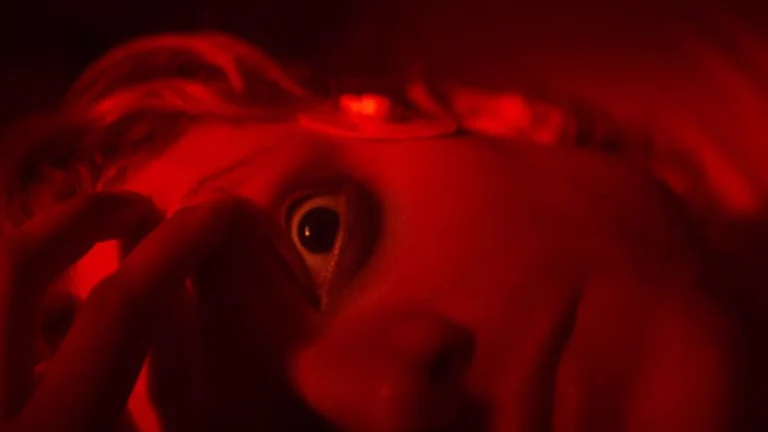
‘Red Rooms’ Recap and Ending Explained: What Kelly-Anne’s Chilling Obsession Really Means



Pascal Plante’s ‘Red Rooms’ has become one of the most talked about psychological thrillers to emerge from Canada in years, and its unsettling final act is still sending viewers straight to online forums for answers. The film follows Kelly-Anne, a successful model who becomes fixated on the trial of accused serial killer Ludovic Chevalier, and its ambiguous conclusion has left audiences questioning exactly what kind of person she really is.
The 2023 film, originally titled ‘Les Chambres Rouges’ in French, has slowly built a cult following since its festival debut, and its slow arrival on digital platforms has introduced it to an entirely new wave of viewers. With its unsettling subject matter and a performance that critics have compared to some of cinema’s most iconic antiheroines, it is easy to see why people are still dissecting every frame months and years after its original release.
‘Red Rooms’ Plot Recap Before the Ending
‘Red Rooms’ centers on the high-profile case of serial killer Ludovic Chevalier, whose trial has just begun as the film opens, and Kelly-Anne is obsessed with every detail of it. The film follows Kelly-Anne, an obsessive voyeur following the case of Chevalier, who is accused of killing three little girls and, worse, torturing them beforehand and creating snuff films to sell on the dark web.
During the opening statements, prosecutor Maitre Chedid reveals that Ludovic allegedly recorded the murders of three innocent girls only to sell the footage on the dark web. As reality blurs with her own morbid fantasies, Kelly-Anne goes down a dark path to seek the final piece of the puzzle, the missing video of a murdered thirteen year old girl named Camille, to whom she bears a disturbing resemblance.
Two of the three tapes tied to the murders had already been retrieved, and one of them led directly to Chevalier’s arrest, but the third and most horrifying tape, the one showing what happened to Camille, remains missing for most of the film. Outside the courtroom, Kelly-Anne encounters a woman named Clementine who insists to the media that Chevalier is innocent and that the evidence against him has been fabricated or planted to protect the real killer.
The Real Meaning Behind Kelly-Anne and Clementine’s Bond in ‘Red Rooms’
Clementine attends the trial firmly believing Chevalier is innocent, even going so far as to call him a victim of the system, though she still expresses sympathy for the families of the three girls. The film uses her character to explore a very specific corner of true crime culture, the kind of fandom that forms around accused killers rather than their victims.

An unlikely friendship develops between Clementine and Kelly-Anne throughout the film, and the two eventually bond over the case while eating pizza inside Kelly-Anne’s upscale apartment. It is a strange, almost domestic moment that sits uneasily against everything else happening around it, and that contrast is very much the point.
Kelly-Anne is so dedicated to following the trial that she sleeps on the street outside the courthouse the night before proceedings just to guarantee herself a good seat in the public gallery. That level of devotion, paired with her private searches through the darkest corners of the internet, is what makes her far more unsettling than Clementine ever becomes.
What Happens to Kelly-Anne in the ‘Red Rooms’ Ending?
The trial itself unfolds over roughly two months, and ‘Red Rooms’ eventually ends with Ludovic pleading guilty while Clementine is left regretful of the belief she once held in his innocence. In the film’s climax, Kelly-Anne uses Bitcoin to bid on the third tape in a disturbing online auction, and it becomes hard not to question exactly what her real motives were all along.
Ultimately, she leaves a flash drive containing that final tape for Camille’s mother, suggesting that beneath her disturbing obsession there was some attempt at delivering closure to a grieving parent. Even so, the film never fully explains why Kelly-Anne went to such extreme lengths in the first place, and that unresolved question is exactly what has kept fans debating online.
Kelly-Anne’s own fate is left deliberately ambiguous by the time the credits roll, and Plante never spells out whether her actions were driven by empathy, obsession, or something far darker. What is clear is that the ending leaves her isolated, haunted by everything she has learned and by the lengths she went to in order to learn it.
Why ‘Red Rooms’ Cast and Critics Praise Its Disturbing Themes
‘Red Rooms’ stars Juliette Gariépy as Kelly-Anne, alongside Laurie Babin as Clementine, Elisabeth Locas as Camille’s mother Francine, and Maxwell McCabe-Lokos as accused killer Ludovic Chevalier. Critics have been overwhelmingly positive, with the film earning a Metacritic score of 81 out of 100 based on 15 reviews, a rating the site classifies as universal acclaim.
On Rotten Tomatoes, ninety six percent of seventy eight critics gave the film a positive review, with critical consensus praising Gariépy’s superb portrayal of self destructive obsession and calling the film a haunting and timely trip down a particularly morbid rabbit hole. That acclaim followed the film all the way to the festival circuit.
At the 2023 Fantasia Film Festival, ‘Red Rooms’ won Best Film, Best Screenplay, and Best Score, while Gariépy took home the award for Best Performance. The film also earned a nomination for the Crystal Globe Competition at the Karlovy Vary Film Festival, where it originally premiered in July of 2023.
Between its festival wins, its critical acclaim, and an ending that refuses to hand audiences any easy answers, ‘Red Rooms’ has cemented itself as one of the defining psychological thrillers of its era, and it is hard not to walk away from Kelly-Anne’s story wondering what you would have done in her place, so what do you think really drove her to the courthouse steps in the first place?