5 Things About ‘Dune Part 2’ That Made Zero Sense and 5 Things About It That Made Perfect Sense



‘Dune Part 2’ packs a huge portion of Frank Herbert’s world into a tight runtime, jumping from desert raids to imperial politics and ancient prophecies without slowing down. The story covers Paul Atreides as he moves from refugee to Fremen leader while the Imperium and House Harkonnen try to crush a rebellion that grows stronger with every spice raid. The film leans on real concepts from the books such as the Great Convention, Bene Gesserit conditioning, the Guild monopoly on interstellar travel, and the Fremen way of life built around water discipline and survival in the open sand.
Because it adapts dense lore into set pieces and fast transitions, some moments feel unexplained while others are grounded by the universe’s rules. The items below focus on what the movie presents on screen and the established mechanics behind those scenes, so each point lays out what the film shows and the in-world information that explains it or makes it hard to reconcile.
Zero Sense: The campaign timeline across Arrakis

The film shows Paul and the Fremen moving from local raids to near total dominance in what appears to be a short span of time. The montage structure covers multiple operations that disable spice production, unsettle Harkonnen control, and build a legend around Paul without placing clear markers that separate seasons or years. Viewers only see the escalation and the results, not a dated sequence of events that tracks how long it takes to unite scattered sietches.
Arrakis is a planet sized theater with northern and southern Fremen communities that have different customs and levels of openness to outsiders. Coordinating sietches, sharing weapons, and setting common tactics would require long rides between rock outcroppings and safe routes that avoid patrols and sandtrout rich zones. The film condenses that logistics picture into a few meetings and battles, which leaves the scope and duration of the campaign unclear on screen.
Perfect Sense: Paul surviving the Water of Life

The Water of Life is a poisonous exhalation from a drowned sandworm that only Bene Gesserit Reverend Mothers can transmute safely through spice amplified metabolic control. The movie shows that a male drinking it would normally die, yet Paul survives and awakens with expanded senses and ancestral memory. This aligns with the Bene Gesserit breeding program that seeks a figure able to bridge genetic memory in lines that previously required female conversion rituals.
The transformation shown after the ordeal matches known effects of spice saturation and prana bindu mastery. Heightened awareness, new access to genetic memory, and predictive capability are standard outcomes for a successful Reverend Mother, and in Paul’s case the change arrives with a wider field of prescience. The film uses that framework to explain why the ritual is deadly in general but survivable for someone engineered for that threshold.
Zero Sense: The Emperor personally arriving in a live war zone
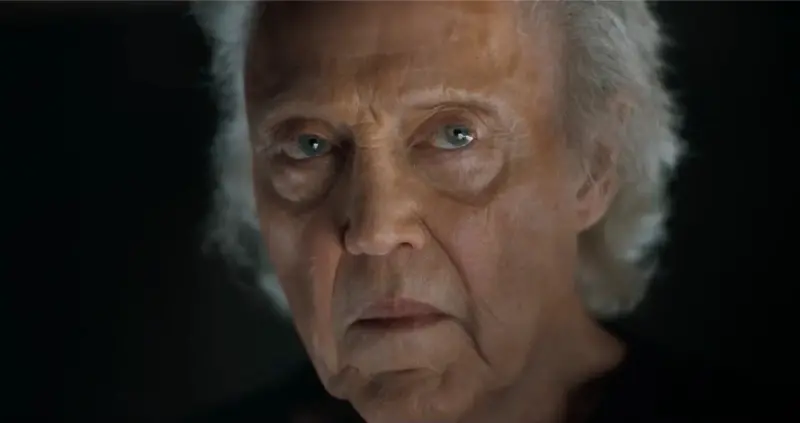
The climax places the Emperor and his court on Arrakis while Fremen forces remain active and Harkonnen command shows signs of instability. Imperial rulers typically avoid direct exposure to planetary level risks and rely on Sardaukar or vassal houses to project power while they remain aboard secure transports. The decision to stand on the surface during an ongoing insurgency is a high value target scenario that the film does not contextualize with additional precautions.
Spacing procedures and Guild transport norms allow safe arrival in orbit, but planetary security depends on ground control of shields, artillery, and skies cleared of hostile fliers. The movie gives minimal detail about layered security perimeters or evacuation corridors that would justify bringing the imperial household down to a fortress surrounded by hostile desert. Without those elements described, the visit appears to neglect standard imperial risk management.
Perfect Sense: The legal challenge that forces a duel
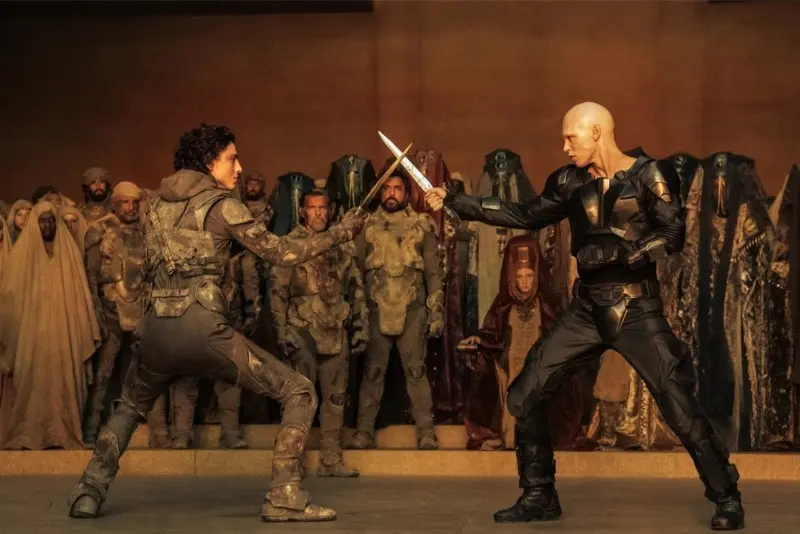
Paul invokes ancient forms that allow a formal challenge recognized by the Great Houses. Feudal law in the Imperium treats kanly as a sanctioned framework for vendetta and trial by combat, and those forms carry binding force when invoked properly in front of peers. The movie shows Paul calling for adjudication in a way that limits options to refuse without losing face and legitimacy.
Because the challenge occurs in the presence of the Emperor, a Bene Gesserit Reverend Mother, and representatives of major powers, the outcome becomes a matter of recognized law and custom. The duel’s acceptance ensures that victory translates into political authority over Arrakis and control of spice production. The film correctly ties battlefield momentum to a legal pivot that transforms military advantage into imperial leverage.
Zero Sense: Worm response times at the breached Shield Wall
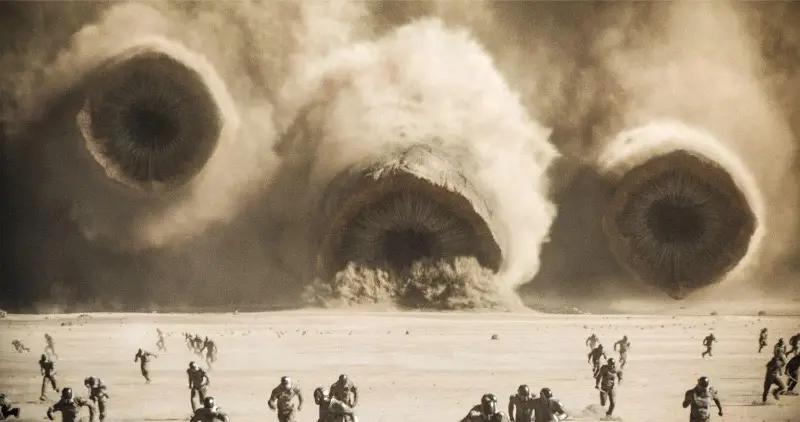
The assault sequence breaches a rock barrier that protects an imperial stronghold, after which worms pour into terrain that was previously safe. Fremen practices show that worms are drawn by rhythmic disturbances on sand and avoid bare rock and shield noise fields that agitate them. The film compresses the time between the breach, the influx of loose sand, and the arrival of multiple massive worms without detailing how far the nearest makers were or how quickly they could traverse that distance.
Worm travel requires continuous desert and typically follows thumpers or large scale vibrations that outcompete background noise from wind and foot traffic. Once sand floods through a break, a new route forms, but a realistic arrival would still depend on distance, prior thumper placement, and signal strength. The sequence presents the cause and effect clearly but leaves the travel interval and signal mechanics unstated.
Perfect Sense: Using atomics on a barrier without breaking the Great Convention
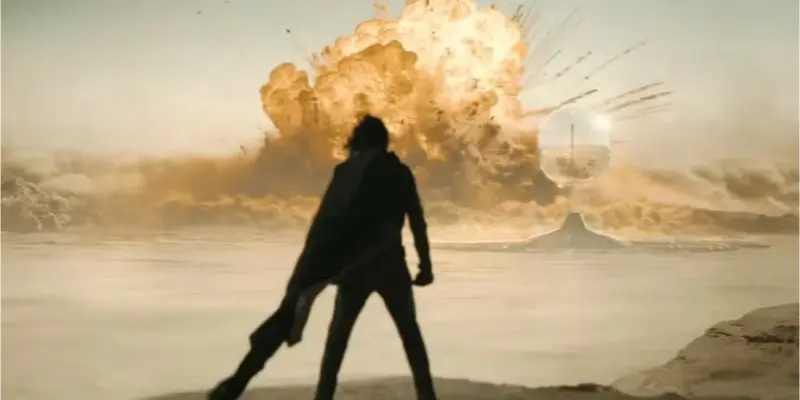
The Great Convention forbids the use of atomics against human targets and cities. The film depicts the detonation against a geological barrier that opens a path rather than a strike meant to vaporize personnel. This follows the letter of the law that distinguishes between using family atomics as engineering charges and deploying them as weapons of mass murder.
Historically, Great Houses maintain limited stockpiles for deterrence and emergencies. Applying a device to reshape terrain creates a military advantage while avoiding an explicit breach that would trigger universal retaliation. The movie presents a textbook example of exploiting a legal boundary that the Imperium recognizes, which is why other powers react to the strategic outcome rather than launching a punitive crusade over a convention violation.
Zero Sense: The political cost of Paul’s marriage against Fremen expectations
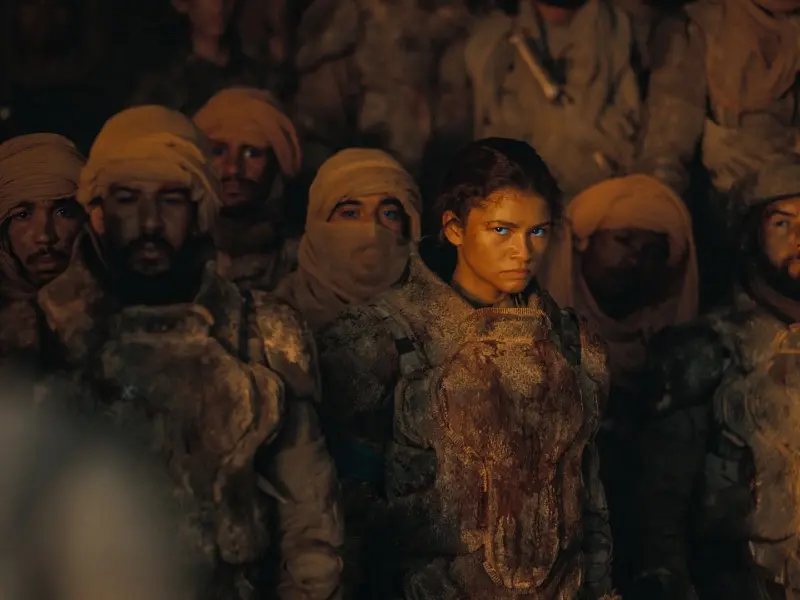
The ending shows Paul choosing a political marriage that secures imperial authority, while his bond with Chani fractures in public view. Among Fremen, legitimacy flows from demonstrated leadership, water sharing, and alignment with sietch customs that include recognition of chosen partners. The film does not address how Fremen leadership councils would reconcile a public slight against a known partner with continued unity after the victory.
In Atreides tradition, a political consort can coexist with a beloved concubine through acknowledged status and clear assurances for children and inheritance. Fremen norms are different and place value on communal acceptance and signs that a leader lives by desert commitments. The movie leaves those governance steps unspoken, such as formal oaths before naibs or water restitution, which makes the immediate political stability of the new regime difficult to evaluate from what is shown.
Perfect Sense: Jessica’s pregnancy and the preborn awareness of Alia

Jessica undergoes the Reverend Mother ritual while pregnant, which exposes the unborn child to the transmutation and grants access to ancestral memory from the start of life. The Bene Gesserit identify such children as preborn and warn of risks that arise from an adult consciousness without a natural developmental arc. The film represents this through Jessica’s internal communications that signal the presence of a highly aware fetus.
The outcome aligns with established Bene Gesserit science. Contact with the Water of Life during gestation imprints the child with stabilized spice saturation and a deep well of genetic memory. That state explains unusual perception and influence associated with the child long before birth, which the movie visualizes as clear guidance that shapes Jessica’s decisions.
Zero Sense: Sardaukar performance against desert trained Fremen

Sardaukar are elite troops conditioned on a prison planet with survival standards that produce exceptional soldiers. The movie shows them losing ground in the open desert even when they deploy in numbers with air support. The depiction does not pause to outline how their equipment and training differ from what is needed to fight in deep sand against opponents who control terrain and logistics.
Fremen doctrine uses sandwalk movement, shield discipline to avoid worm attraction, and ambush tactics around spice operations that force offworld troops into unfamiliar patterns. Gear that excels on rock and in urban sieges underperforms when thumpers, worm sign, and dehydration become central threats. The film implies these mismatches through outcomes but does not inventory the tactical disadvantages that explain repeated Sardaukar failures.
Perfect Sense: Feyd Rautha’s arena trial and Giedi Prime’s environment
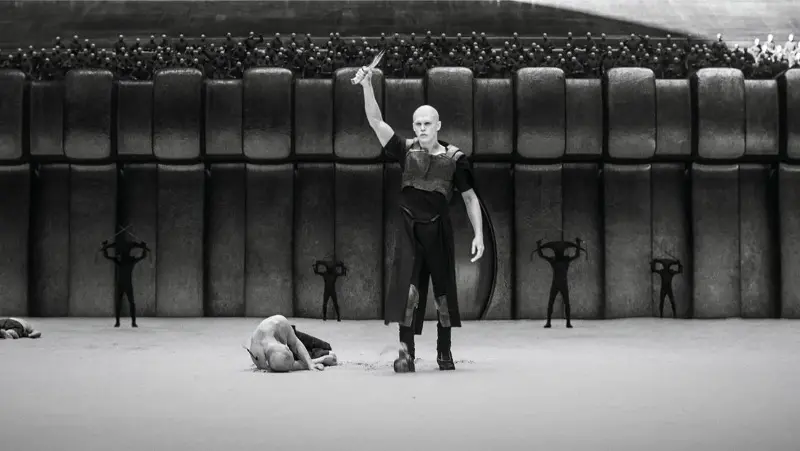
Feyd Rautha’s staged combats establish his lethality and the Harkonnen method of cultivating rulers through spectacle and fear. The sequence on Giedi Prime presents a hostile industrial world with environmental conditions that shape Harkonnen culture. The stark visual palette signals a spectrum shift in local light that changes how surfaces and skin appear, which underscores the alien feel of the planet without contradicting known planetary diversity in the Imperium.
Public duels on a house world serve multiple functions. They train a successor, bind retainers through displays of dominance, and project an image of control to subjects and rivals. The movie uses these practices to certify Feyd as a legitimate champion within Harkonnen law, which supports his later role in a formal duel recognized by imperial observers.
Share the one moment in ‘Dune Part 2’ that you think needs the most explaining in the comments.