A24’s ‘Mother Mary’ Ending Explained: What the Red Spirit Really Means and Why It Changes Everything


David Lowery’s latest film arrives as one of the more divisive and genuinely haunting releases A24 has put out in recent memory. ‘Mother Mary’ is a psychological drama thriller written and directed by Lowery, starring Anne Hathaway alongside Michaela Coel in a film that blends drama, music, and supernatural thriller elements into a single unsettling experience. For viewers who walked out of the theater trying to piece together what they just witnessed, you are absolutely not alone.
Long-buried wounds rise to the surface when iconic pop star Mother Mary reunites with her estranged best friend and former costume designer Sam Anselm on the eve of her comeback performance. That simple premise, however, barely scratches the surface of what ‘Mother Mary’ is actually doing beneath all the halos, red fabric, and fractured identity politics at its core.
A Pop Star in Crisis and a Long-Overdue Reunion
The film opens with Sam Anselm speaking bitterly to an unseen listener, laying bare a sentiment that they deserve neither love nor hate. It then shifts to a dazzling scene with pop icon Mother Mary, who performs her song “Burial” to a chorus of devoted fans, as she plans a bold comeback after a troubling onstage fall that had rumors swirling about a possible suicide attempt.
The tone is immediately off-balance in the best possible way, pulling the audience into a world where celebrity grandeur and personal devastation exist side by side.
Mary abruptly ends her tour after an emotional crisis and seeks out her old friend Sam, who first helped create her public diva persona, with their reunion forcing long-buried wounds of betrayal and resentment to the surface. The film treats this as the emotional core of everything that follows, with every supernatural twist eventually looping back to this broken bond between two women who defined each other.
Old resentments are laid bare as a vengeful Sam forces Mary to confront the end of their close creative partnership, and despite launching Mary’s career together, Sam was denied credit and cut out of her inner circle entirely. The film all but says that the pair were in a more intense relationship, with their dynamic carrying all the hallmarks of a broken-up couple, and Sam’s discovery that Mary was moving on to another designer is played like a breakup, with both blaming the other for their relationship not continuing.
The Red Spirit Symbolism in ‘Mother Mary’
The red spirit didn’t have any distinct physical features except that she was red, described in the film as “not like a color but red like a feeling.” Sam was in awe as she watched the red spirit gloriously transform into luminous red fabric, and when Sam opened the door, the spirit left, taking with it the pain in her mouth, the knot in her stomach, and the hole in her heart. It is one of the film’s most quietly devastating images, grief made tangible and then released.
Mary’s entire persona is built on religious imagery, with all of her costumes featuring halos, the first of which was made of nails. Most of her songs have spiritual undertones, including one titled “Holy Spirit,” and someone in the film compares a Mother Mary concert to a religious experience, like going to church but in a good way.
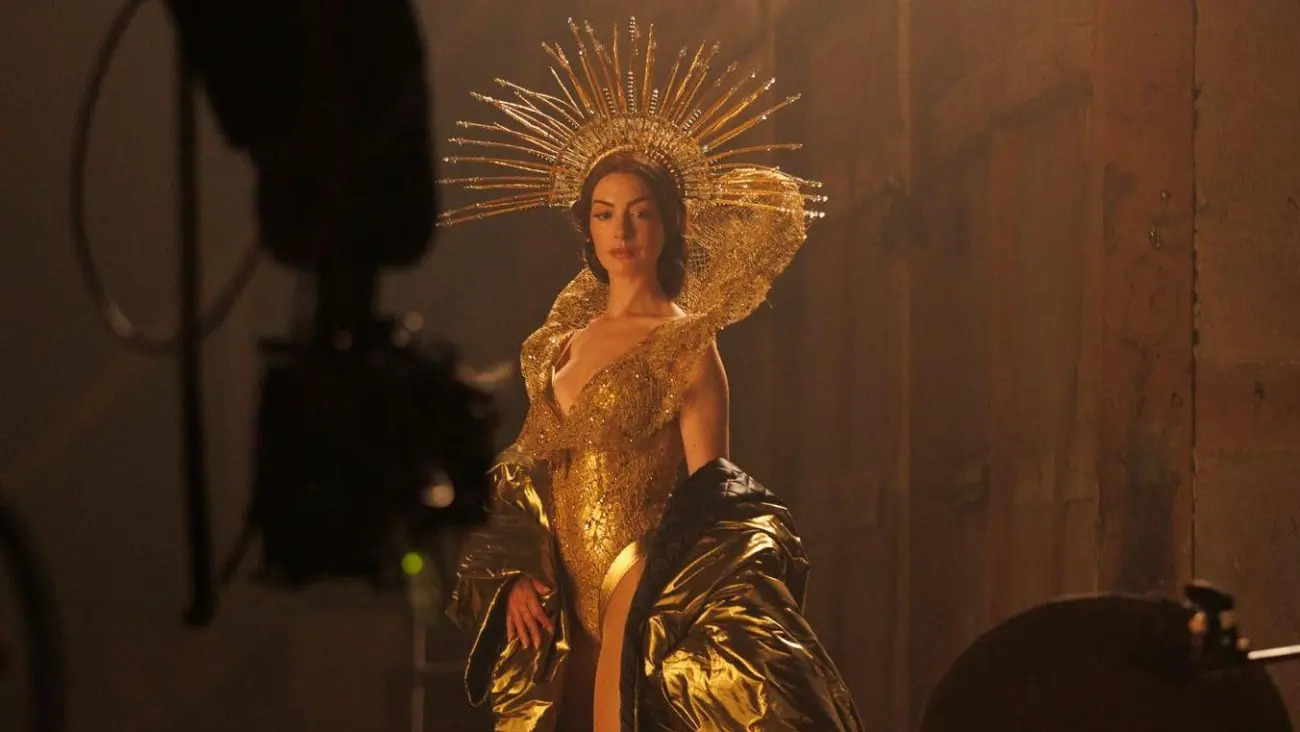
The supernatural thread and the pop-star iconography are never accidental, and Lowery leans hard into that collision between the sacred and the manufactured.
The red spirit first appears to Sam, then later manifests during one of Mary’s performances, where it overtakes her body and causes her to fall from a high platform. In the earlier scenes she is pursued by the spirit while she runs away from it, but by the end she fights the spirit because she no longer wishes to escape, choosing to face her challenges rather than continue running from them.
What Really Happened During the Onstage Fall
It is disclosed that during a previous performance, Mary got a bit lost after seeing the red entity and stepped back and fell from a raised platform, ending up suspended by her costume above the audience. The incident raises questions about whether it was an accident or a deliberate act, and the film does not provide a clear answer, leaving it open to interpretation. This ambiguity is entirely intentional, and it haunts every subsequent scene between the two women.
Mary reveals that she saw the same ghost after a séance with her team where Imogen, a fan possessed by a mysterious spirit, cut open Mary’s hand. That night, the red ghost appeared to Mary and attempted to enter her wound, but she escaped.
Exhausted by her demanding tour, she was confronted by the ghost during a concert and severely injured, falling as the spirit inhabited her. The distinction matters because it positions the fall not as clean despair but as something more complicated, a surrender to forces both internal and external.
The film emphasizes the very real dark side of fame, since from the outside her fans must have envied her life and looked up to her, but Mary was a mere human being who often felt overwhelmed, lonely, and depressed. Her fans idolized her, almost as if she couldn’t possibly make any mistakes even if she wanted to, but that day after Mary fell from the stage, the conversation around her shifted.
The Ending of ‘Mother Mary’ and What It Actually Means
Sam leads a reluctant Mary in a ritual to exorcise the spirit, using her dressmaking tools and invoking their past collaborations. Taking Sam’s shears, Mary slices open her own chest and Sam pulls out the ghost, turning the spirit of their mutual trauma into harmless fabric.
Mary apologizes for having wronged Sam and her team rushes her to the show, while Sam is inspired to craft the red fabric into a dress. It is a genuinely strange and visually arresting sequence that somehow lands emotionally precisely because it refuses to be literal.
Mary sheds her clothes and her headgear before taking to the stage, symbolizing her rebirth as an artist who refuses to be anyone but herself, representing a fresh start in both her personal and professional life.
The film uses its final act to examine identity, fame, and artistic ownership through a surreal experience that combines real life and performance elements, and by accepting both her public persona and her private identity, Mary enters a new stage because she now knows the impact her public existence has on her life.
‘Mother Mary’ comes from a director with an eclectic filmography that can’t be easily defined, sitting much closer in spirit to his esoteric work like ‘A Ghost Story’ and the twisted medievalness of ‘The Green Knight’ rather than his more accessible Disney projects. The film is not interested in easy conclusions, and the ending reflects that.
The ending reveals a fundamental conflict between the creator and their creation, with Sam as the builder of Mary’s legend and Mary as the price she must pay to maintain it, showing that artistic teamwork and their subsequent disputes continue to develop long after the curtain falls.
Whether you found ‘Mother Mary’ to be a mesmerizing piece of surrealist pop cinema or a frustrating exercise in deliberate opacity, it is hard to deny the film has left people talking, so what did the red spirit mean to you the moment Sam finally pulled it free?