China’s First Fully AI Feature Film Bombs Months After a ‘Worse Than AI’ Cartoon Became a Surprise Hit

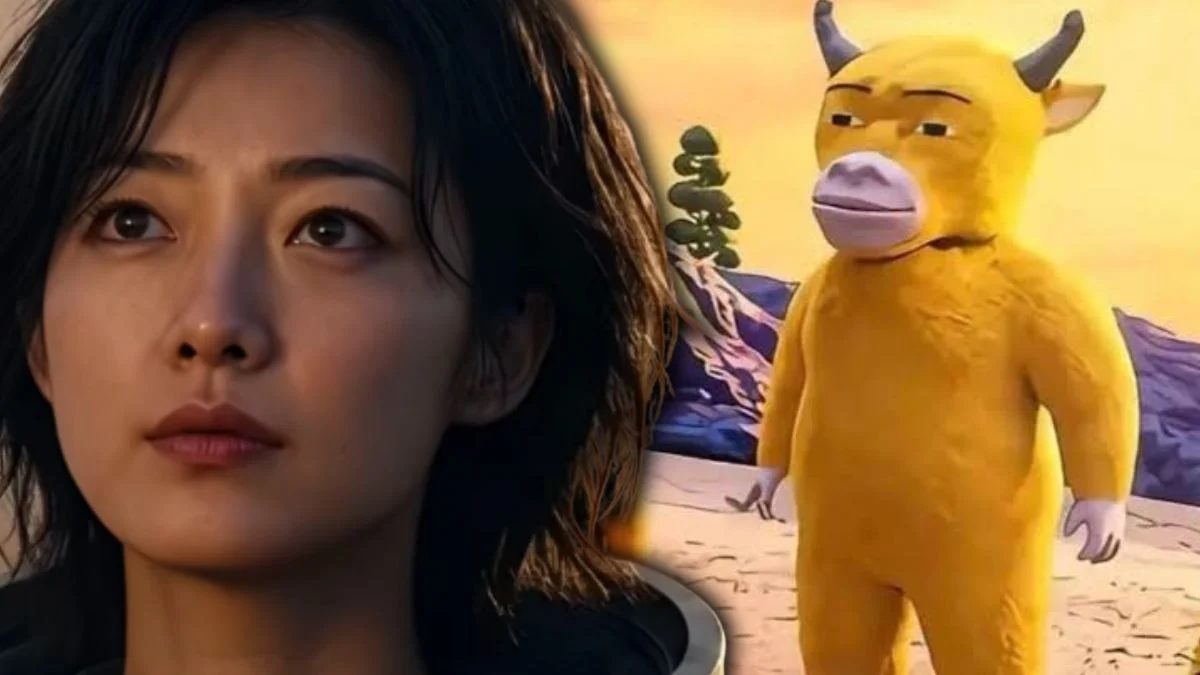

Few box office stories this year have been as strange as the one unfolding in China. On one side is a handmade animated film that audiences mocked for looking so rough it was “worse than AI.” On the other is a big-budget movie that was supposed to prove AI could make a feature film, and has now struggled to find viewers.
The first of those films is ‘Niu Lai’, which roughly translates to “The Cow Is Coming”. Director Xin Yumeng and his mother, screenwriter Sun Lifang, spent about 5 years teaching themselves animation, modeling, voice acting and editing, working out of an old interior design office. The film reportedly cost around $200 to make, though some estimates put it closer to $1,000.
It opened on August 5 and initially looked like a complete failure, earning just 7,705 yuan, or less than $1,000, in its first 10 days, with fewer than 300 tickets sold. Then clips of its stiff, crude animation flooded Chinese social media, with amused viewers calling it “worse than AI.” The mockery turned into curiosity, screenings multiplied, and the film passed 17 million yuan within weeks, eventually grossing nearly $10 million.
The film at the center of the comparison is ‘Sanxingdui: Future Past’, which its producers say is China’s first fully AI-generated theatrical feature. Made by Bona Film Group, the sci-fi thriller follows an archaeologist who must save a future world enslaved by AI. It debuted on October 23 and, according to estimates, earned just 1.21 million yuan, or about $181,000, through Monday.
That is a fraction of its reported budget. Bona says the film cost more than 10 million yuan, or about $1.5 million, and took nearly 100 people over 2 years to complete. The team generated more than 1.2 million images with AI tools, and the film’s characters, voices and visuals are all AI-generated.
The numbers are especially stark because this was a serious release. More than 10,000 screens were scheduled for the film on opening day, which works out to less than $20 per screen so far. ‘Sanxingdui’ also cleared a regulatory milestone, becoming the first fully AI-generated film to receive a public screening permit in China, with the National Film Administration classifying it as animation.
The movie also leans on a cultural hook, drawing on the ancient Sanxingdui archaeological site. Even so, social media reactions have been mixed. Bona executive Jiang Defu acknowledged the lukewarm reception in an interview with Chinese outlet Yuli, while arguing the film was an important experiment.
A Chinese movie called "Cow is Coming" made only ¥$1,145 during its first 10 days–only 200 people. Some clips went viral because the animation looked so unbelievably bad that people started buying tickets just to watch it. The movie’s box office crossed $850k by Now. https://t.co/6A2uLTFq7v
— ChitChat China🇨🇳🇺🇸 (@ChitChatChina) August 17, 2026
The timing has made the comparison hard to resist. A film mocked for looking worse than AI has now earned more than 50 times as much as China’s supposedly groundbreaking AI feature. Xin has said he did not use AI for ‘Niu Lai’, noting that widely available AI models did not exist when he began the project.
Analysts see a broader lesson. Stanley Rosen, a University of Southern California professor who specializes in Chinese film, told Fortune that the public is highly skeptical about AI use in major feature films, even though short-form AI content is widely accepted. He added that the loss will push others considering AI features to tread more carefully.
That contrast with short-form content is real. According to Caixin, AI-generated microdramas accounted for more than 95% of the more than 120,000 releases in the first quarter of 2026, with production costs as low as $3,000. Audiences seem comfortable with AI in quick, cheap formats but less so in a full theatrical feature.
It is worth being careful here. As Cartoon Brew noted, neither film’s performance establishes a universal rule about audiences’ attitudes toward AI. The two films also reached viewers in very different ways, one through organic online ridicule and the other through a conventional marketing push.
‘Niu Lai’ benefited from an unusual viral moment that no studio could easily plan. Observers have credited its success to audiences responding to the human effort behind it, while ‘Sanxingdui’ has been criticized for inconsistent quality and a lack of emotional pull. Still, the contrast is a vivid reminder that cost and technology do not guarantee a hit.
For now, the story is a punchy snapshot of the state of AI filmmaking, a handmade cartoon that audiences embraced and a polished AI feature that they largely ignored. How producers respond could shape whether more AI feature films reach theaters.
Why do you think China’s fully AI-generated feature film ‘Sanxingdui: Future Past’ struggled at the box office?
Have something to add? Let us know in the comments!