‘Interview with the Vampire’ Book vs. Movie vs. TV Show: Does the AMC Series Actually Do More Justice to Anne Rice’s Novel Than the 1994 Film?

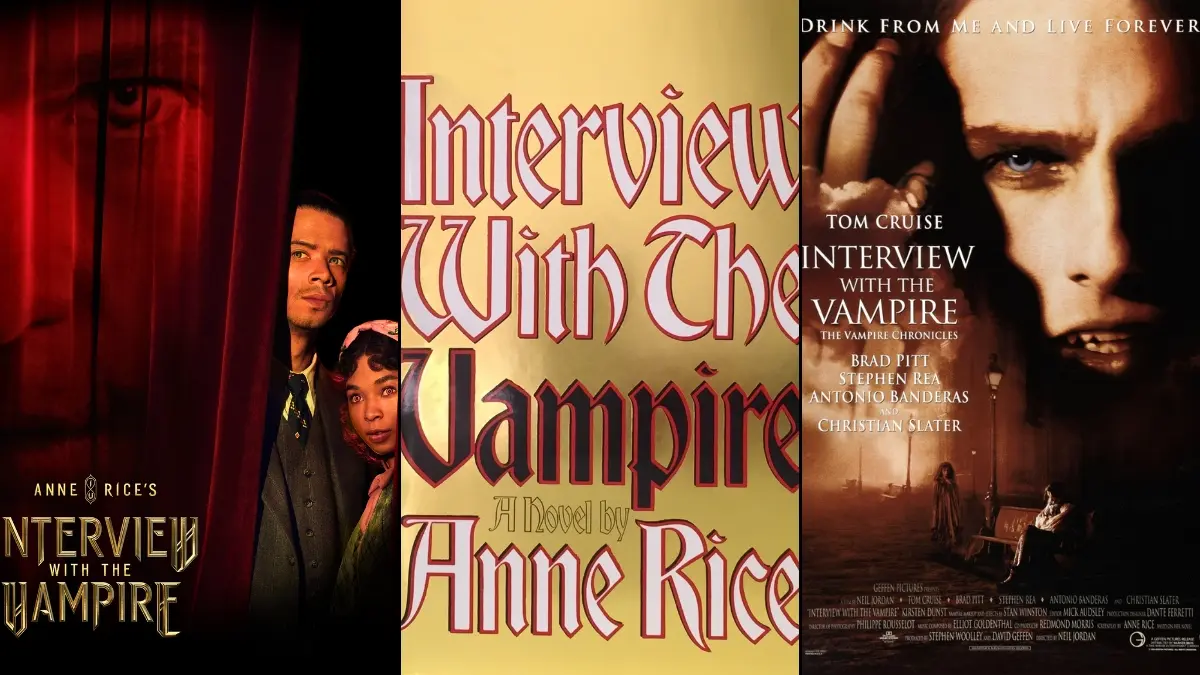

Thirty years after Brad Pitt and Tom Cruise gave the world its first big-screen taste of Anne Rice’s gothic masterpiece, the debate over which adaptation best honors its source material is more alive than ever. The AMC series has reignited that conversation in a big way, drawing in both lifelong fans of the Vampire Chronicles and a fresh wave of viewers discovering Rice’s world for the first time.
The question at the center of it all is deceptively simple: between the classic Hollywood film and AMC’s prestige drama, which version is truly more faithful to the novel that started it all? The answer, as it turns out, is far more layered than a side-by-side plot comparison could ever reveal.
Faithfulness to the Spirit of the Source Material
With both the books and the evocative 1994 film to contend with, AMC creator Rolin Jones took on an admittedly enormous challenge in figuring out how to stay faithful to what makes Rice’s novels so popular while bringing something genuinely new to the screen. That challenge speaks to a tension at the heart of all Rice adaptations, one that goes beyond simple accuracy.
The AMC supernatural drama, headed by showrunner Rolin Jones, is remarkably faithful to the Vampire Chronicles in spirit, though it has made some striking character and narrative changes.
The same could be said, in different ways, of the 1994 film. Anne Rice herself wrote the screenplay for the 1994 movie version, directed with lush, decadent style by Neil Jordan. That direct authorial involvement gave the film a significant advantage in terms of tonal authenticity, even when it was forced to compress and streamline.
Rice took out a full-page ad stating she was thoroughly satisfied with the film’s portrayal of her characters, despite the many changes, streamlining choices, and the removal of elements like Louis and Claudia’s journey through Eastern Europe searching for vampires, which was cut to send them directly to Paris and Armand.
Louis, Race, and the Rewriting of a Central Character
One of the most consequential decisions the AMC series made was to reimagine Louis as a Black man navigating racism in early twentieth-century New Orleans. In Rice’s original telling, the bulk of the story is set in colonial New Orleans of 1791, where Louis is not a white Creole plantation owner but, in the AMC version, a Black businessman running a saloon in the city’s red light district, where he wrestles with his sexuality and faces countless racist brutalities.
The most notable casting change was placing Black actors Jacob Anderson and Bailey Bass in the roles of Louis and Claudia, both of whom were white in the original books and the 1994 movie adaptation.
The film, by contrast, kept Louis as a white plantation owner. The 1994 film’s representation of race is notably weak: after Louis dramatically frees his slaves, no other Black characters appear again in the story. In that respect, the AMC series arguably engages more honestly with themes that were always embedded in Rice’s New Orleans setting, even if it does so through a radically altered lens.
By setting the show in 1910s New Orleans, race adds genuine narrative weight: Louis has to pretend to be Lestat’s valet when they travel Europe together, with the couple forced to hide their relationship both because of being queer and because of being in an interracial one.
The Queer Relationship at the Heart of the Books
Perhaps no single element better illustrates the gap between these two adaptations than how each handles the romantic and queer dimensions of Louis and Lestat’s bond. This was always central to Rice’s vision, and both versions treat it very differently.
Rice herself knew just how subversive the text’s implicit queerness was, and she worried its homoerotic leanings would stop ‘Interview with the Vampire‘ from ever making it to the big screen.
When she sat down to write the screenplay, Rice famously considered rewriting Louis as a woman, fearing that Hollywood’s ingrained homophobia would stop the film from being made. That anxiety shaped the final film in ways that are still felt today.
Director Neil Jordan was later asked if anyone ever told him to pull back on the homoeroticism, and he replied that the movie is true to the book, adding that Anne Rice wrote the script and that Cruise and Pitt played the dynamic more like master and slave, with dominance at the fore of the relationship rather than sexuality. The result was a version that was coded rather than explicit.
The AMC series has nothing to hide in its dialogue: Anderson’s Louis openly comes out as “queer,” and when he demands an answer from Reid’s Lestat about his own sexuality, Lestat cheekily responds “non-discriminating.”
There’s nothing queer-coded about the new television series, which presents Lestat and Louis’ relationship as far more than what journalist Daniel Molloy describes as “a messed-up Gothic romance,” presenting it instead as a story of sex and, at times, love, filled with trauma, manipulation, and other toxic elements that Louis has to actively grapple with.
Plot Changes, Compression, and the Vampire Chronicles Canon
Beyond character reinvention, both versions take liberties with the plot structure of the novel itself. The film, constrained by a two-hour runtime, was forced to collapse entire arcs.
According to showrunner Rolin Jones, season two of the AMC series adapts the second half of Rice’s original novel, covering the same ground as the second hour of the 1994 film, following Louis and Claudia as they flee New Orleans and Lestat to travel to Europe. The series’ expanded format allows the story to breathe in ways a film simply cannot.
Creator Rolin Jones has noted that the series actually has more knowledge to work from than Rice had when she wrote the original novel, building a universe informed by the full follow-up book series, with differences that are generally in locale, time, and setting rather than the emotional core of the story.
In Rice’s novel, the interviewer Daniel Malloy is a relatively passive listener to Louis’s life story. In the AMC series, Malloy is now a much bigger player in the narrative, aged up and given a very salty attitude, with Parkinson’s disease adding a ticking clock to his own mortality. The 1994 film kept Molloy closer to his original passive role, a functional framing device rather than a character with his own arc.
Which Adaptation Wins the Faithfulness Debate?
The honest answer is that faithfulness depends entirely on what you value in Rice’s novel. While changes to the sexuality, race, and age and time period of the main characters occur across both adaptations, one could argue that each iteration is faithful not in that it mirrors the original novel as closely as possible, but in that it keeps the spirit of the vampire intact, a spirit that is always changing, just as society and culture changes.
Both Rice and her son Christopher served as executive producers on the AMC project, so although some changes from the novel have been made, they appear to have been done with her knowledge and blessing.
The 1994 film, meanwhile, had Rice write the screenplay herself, an arrangement that allowed for intimate fidelity to the prose even while the homoerotic core was softened. It is something of a miracle that the AMC series is as good as it is, managing to be an excellent piece of television within AMC’s larger Anne Rice Immortal Universe.
If the film preserved the plot architecture while toning down the queerness and erasing the racial complexity, the AMC series inverted that bargain entirely: it transformed the surface while digging deeper than ever into the emotional and philosophical marrow that made Rice’s story immortal in the first place.
Which version speaks to you likely says as much about what you bring to the coffin as it does about what either adaptation puts inside it. So we want to know: do you think a more faithful-on-paper adaptation is actually better, or does the AMC series’ bold reinvention of Louis and Lestat’s love story feel closer to what Rice was truly reaching for all along?