Netflix’s Michael Jackson Documentary Covers What ‘Michael’ Biopic Missed and Wins Over Critics But Angers Audiences



Netflix has released a new three-part documentary series titled Michael Jackson: The Verdict, directed by Nick Green and produced by Candle True Stories.
The series focuses on the 2005 criminal trial of Michael Jackson. It looks at the full courtroom process, the accusations made against him, and the public reaction during one of the most watched celebrity trials in modern history.
The documentary uses interviews with people directly connected to the trial. This includes jurors, journalists who covered the case, eyewitnesses, and individuals linked to both the defense and prosecution teams. It also uses archival footage from the courtroom and media coverage at the time. The goal is to reconstruct what happened in court and how the case was understood by the public.
According to early review data, Michael Jackson: The Verdict currently holds a 71 percent rating on Rotten Tomatoes from critics, based on 7 reviews. However, audience response is much lower, sitting at around 6 percent on the Popcornmeter from more than 50 ratings. This split suggests a strong difference between critical reception and early viewer reactions.
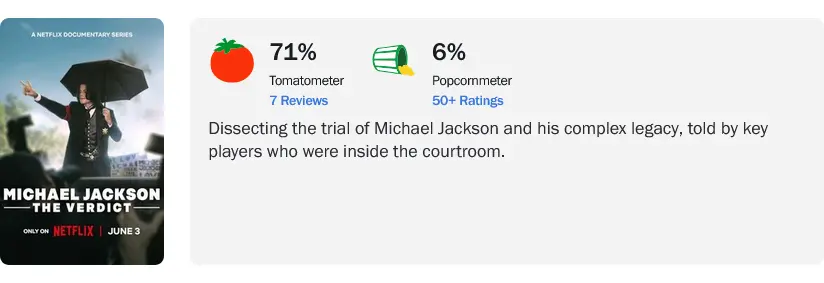
The documentary focuses heavily on the 2005 trial, where Michael Jackson faced charges of child molestation and conspiracy to commit child abduction, false imprisonment, and extortion. The case centered on allegations from a minor who claimed inappropriate conduct during time spent at Jackson’s Neverland Ranch. The trial included testimony from both sides, with prosecutors arguing that Jackson had used his fame and influence inappropriately, while the defense argued that the accusations were false and motivated by financial gain.
Jackson was ultimately found not guilty on all charges. The documentary revisits how the case unfolded step by step, including the intense media attention that surrounded the courtroom. It also highlights how public opinion was deeply divided at the time, with some supporting Jackson and others believing the accusations.
Critics have noted that the series tries to present multiple perspectives without focusing on a single narrative. Some reviewers have praised the use of courtroom footage and interviews, saying it helps recreate the pressure and confusion of the trial period. Others have pointed out that revisiting the case again may reopen sensitive debates about a highly controversial moment in pop culture history.
In contrast, the 2026 biopic Michael has received a much more negative critical response. The film currently holds a 39 percent score on Rotten Tomatoes from 290 reviews, despite a very strong audience score of 97 percent based on over 25,000 verified ratings. This difference shows a clear divide between critics and general viewers.
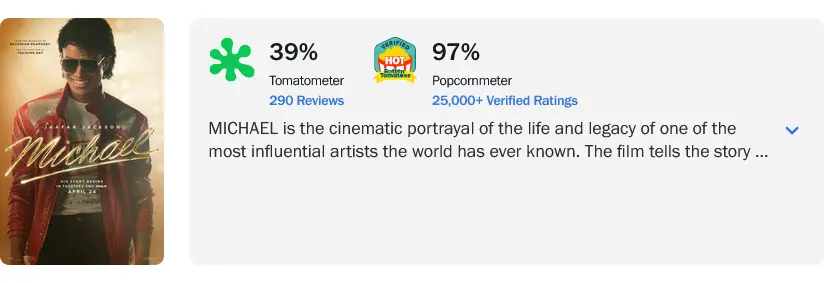
Critics of the biopic have focused on its storytelling choices and how it presents Michael Jackson’s life. Many reviews argue that the film avoids dealing with the more serious parts of his history, especially the allegations and legal cases that surrounded him during his career. One critic described the film by saying, “The biopic is an inherently imperious and extractive genre that mostly fails to deliver plots worthy of their subjects. This one leans into that ritual of gaudy shorthand, crisis-proofing itself in advance.”
Another review said, “As a cinematic biography, it leaves a constant sense of emotional distance. The feeling of watching a carefully edited version of a life too complicated to fit within such a controlled celebration.” Critics also said, “There is no interior to this version of this man. The facade is all that Michael can offer in a sympathetic biopic that shoots to that first star to the right and continues straight on until we are all mourning the honest portrayal that could have been.”
A major criticism of the biopic is that it avoids direct engagement with the accusations that followed Jackson throughout his life. These include multiple allegations of child sexual abuse that were investigated in both civil and criminal cases over several years. While Jackson was acquitted in the 2005 trial, civil settlements and continued public debate kept the subject in the spotlight long after. Critics argue that the film chooses not to address these events in detail, which they say creates an incomplete and overly polished version of his life.
Supporters of the biopic, however, argue that it focuses on Jackson’s music career and artistic impact rather than legal controversies. This approach has been popular with audiences, as shown by the strong viewer ratings, suggesting that many viewers respond positively to a more celebratory portrayal.
The documentary Michael Jackson: The Verdict takes a different approach by placing the legal case at the center. It does not try to build a full life story but instead focuses on a specific moment in Jackson’s history. By doing so, it directly engages with the accusations, courtroom testimony, and media pressure that shaped public perception of the trial.
The 2005 case itself remains one of the most discussed celebrity trials in modern history. It followed earlier allegations in the 1990s and came after years of speculation about Jackson’s relationships with children who visited Neverland Ranch. During the trial, prosecutors presented testimony from the family involved, while the defense argued that inconsistencies and financial motivations undermined the claims. The jury ultimately acquitted Jackson on all counts.
By revisiting this case, Netflix’s documentary brings back a highly sensitive and complex moment in entertainment history. The strong critical response suggests interest in a more detailed examination of the trial, even as audience reactions remain mixed.
Together, the documentary and the biopic show two very different ways of telling Michael Jackson’s story. One focuses on legal history and public controversy, while the other focuses on legacy and performance. The contrast between their reception highlights how divided opinions remain about how his life should be represented on screen.
Have something to add? Let us know in the comments!