Only Nolan Can Do It: The Fall of Troy in ‘The Odyssey’ Was Filmed With Zero Green Screen


Christopher Nolan has spent his entire career avoiding digital shortcuts whenever humanly possible, but ‘The Odyssey’ pushed that philosophy to its most extreme conclusion yet. From puppet Cyclopes to fully practical giant battles, the film has become a genuine showcase for what old-fashioned filmmaking can still accomplish in an era dominated by computer-generated spectacle.
That commitment reached its most ambitious extreme during one of the film’s most pivotal sequences, the fall of Troy itself. Rather than relying on visual effects to bring one of mythology’s most iconic images to life, Nolan chose to build the entire moment from the ground up using real materials, real fire, and real people crammed into impossibly tight spaces.
For the fall of Troy, the production built more than 1,000 custom four-foot LED panels called Pyrohedrons, programmed with natural flame flicker profiles to illuminate set pieces up to a mile away, avoiding the massive fire hazards and exposure problems that real open flames would have created. That kind of analog problem-solving became the defining approach across nearly every major sequence in the film.
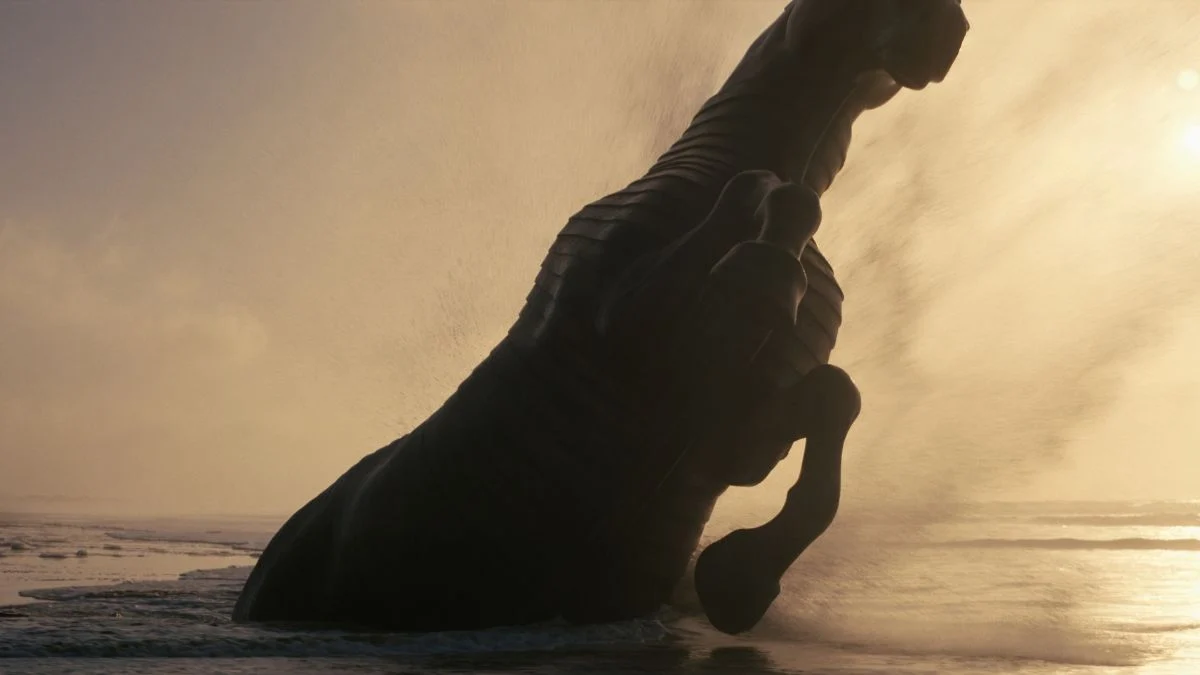
The Trojan Horse itself represented an even bigger physical undertaking. Multiple 35 foot tall horses were built for the production, with one even submerged on a beach so real men could physically pull it from the sand and roll it into position, all captured on camera to feel as authentic as possible.
Filming the sequence inside the horse turned into a genuinely improvised, claustrophobic experience for everyone involved. Matt Damon recalled asking Nolan the day before filming how exactly they planned to shoot the scene, only to be told, according to what Damon told GamesRadar+, that they would simply cram inside and figure it out together.
That lack of pre-planning led to a chaotic but genuinely organic shoot. John Leguizamo, who plays Odysseus’s companion Eumaeus in the film, described searching for Nolan on set only to discover the director, cinematographer Hoyte van Hoytema and an IMAX camera crammed inside the wooden structure alongside 20 actors, all working together in real time to capture the sequence.
Damon has spoken extensively about the physical toll of that shoot, noting that the sense of claustrophobia audiences feel on screen developed naturally rather than through performance alone. He described watching van Hoytema look through the lens with Nolan positioned right beside him as they built the scene from scratch inside the cramped structure.
This particular sequence had reportedly been on Nolan’s mind for decades, dating back to when he was briefly attached to direct 2004’s ‘Troy’ before that project eventually went to Wolfgang Petersen instead. Nolan has described carrying an image of the horse sinking into the sand in his head for roughly 20 years before finally getting the chance to bring it to life.
How impressive is Christopher Nolan's practical approach to filming the fall of Troy in 'The Odyssey'?
That level of dedication extended across the entire production, which spanned 91 days of principal photography across six countries including Italy, Iceland, Greece, Morocco and Scotland. The film’s Trojan set alone covered more than 110,000 square feet and could hold over 2,000 extras, complete with a recreated temple of Athena built directly into the tiered hillside city.

With ‘The Odyssey’ continuing to dominate box office charts weeks after its release, this level of behind-the-scenes commitment to practical filmmaking has clearly resonated with audiences drawn to seeing something genuinely built rather than digitally rendered. Given how much physical risk and improvisation went into capturing this single sequence, it stands as one of the most striking examples yet of just how far Nolan is willing to go for authenticity on screen.
Have something to add? Let us know in the comments!