Why Only Odysseus Could String That Legendary Bow, and What It Means For Nolan’s ‘The Odyssey’?


‘The Odyssey‘ has finally arrived in theaters, and Christopher Nolan’s IMAX take on Homer’s ancient poem is bringing a whole new audience face to face with one of literature’s most famous weapons. Matt Damon leads the film as the wandering king of Ithaca, and the story builds toward a moment that has puzzled and fascinated readers for thousands of years, the trial of the bow.
Fans walking out of theaters are asking a very old question with fresh curiosity, why couldn’t a single one of Penelope’s suitors string that bow, even though dozens of them tried. The answer says a lot about who Odysseus really is, and it explains why Nolan’s adaptation treats the scene as such a pivotal turning point.
The Trial of the Bow Explained
In Homer’s original text, Penelope announces a contest to the men who have overrun her home for years, waiting for her to give up hope that her husband is still alive. She devises a test requiring the suitors to string Odysseus’s bow and shoot it through the handles of twelve axes. Whoever manages it will win her hand in marriage.
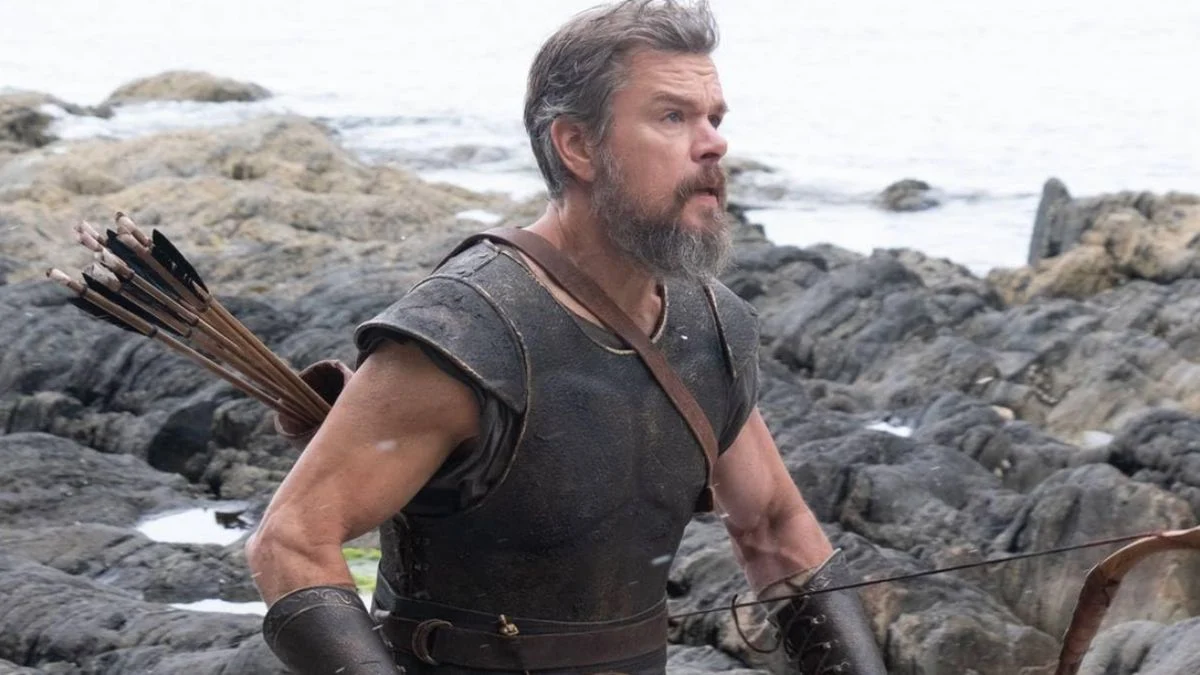
Telemachus, Odysseus’s own son, attempts to string the bow first and fails three times, coming close on a fourth attempt before his father secretly signals him to stop. One by one, the suitors step up and fail in humiliating fashion. The suitor Leodes tries the bow and cannot even bend it because it is too stiff, and the other suitors simply lack the strength to string it as well.
Antinous, one of the most arrogant suitors, feels disgraced that he cannot string it, because he knows the failure proves his inferiority to Odysseus, and he suggests the group adjourn until the next day so they can sacrifice to Apollo before trying again. It is a telling detail, the suitors themselves sense something is wrong with them, not the bow.
Odysseus Strings His Bow With Ease
The disguised beggar at the edge of the hall finally asks for a turn. Odysseus, still in disguise, offers to try the bow himself while the suitors rest, framing it as a bit of amusement, which only provokes Antinous into angrily warning him he could end up mauled like the drunken centaur Eurythion.
The result is instant and stunning. Odysseus wins the contest disguised as a beggar, and the suitors mock him and claim he will never marry Penelope regardless because of his low social standing as a beggar. Odysseus easily strings the weapon and fires an arrow straight through the axes, then stands beside Telemachus to face the suitors as his identity is revealed.
Homer does not simply state that Odysseus succeeds, he lingers on the physical grace of the act. The poet compares the stringing of the bow to a skilled musician tuning a lyre, describing how Odysseus held it in one hand and plucked the string with the other, and it rang out sweetly like a swallow’s call. That comparison to music rather than brute combat is deliberate, and it hints at why the bow responds to him at all.
Why the Bow Only Answers to Odysseus
The bow itself is not an ordinary hunting weapon. It was a gift of friendship from Iphitus, coming from the line of Eurytus, and Odysseus never took it to war, keeping it instead as a memento of home. That backstory matters because the bow’s power is tied entirely to its connection with him personally, not to raw muscle alone.
Stringing it was never going to be a simple task for anyone. When unstrung, a composite bow like this one curves away from the archer, so stringing it means bending the limbs back against their natural set, an action that demands both technical knowledge and considerable upper body strength. The difficulty is not merely a matter of muscle but of understanding how the weapon works, and Odysseus succeeds because of his intimate familiarity with an object no one else in the room had ever handled.
Scholars who study the original Greek text point to specific language Homer uses to underline this dual nature of the hero’s advantage. Odysseus alone has the strength to string his own bow while all the suitors fail to show any matching strength, making him a paragon not only of mētis, meaning mind and intelligence, but also of biē, meaning force and violence and raw strength. In other words, the bow tests both body and mind at once, and only the man it was fitted to over years of ownership passes both halves of that test.
The symbolism runs even deeper than physical mastery. The bow functions as a recognition token, a form of identification that cannot be faked, operating not through appearance or verbal claims but through physical competence, since only the man whose hands shaped themselves to this particular weapon over years of use can string it and shoot it. By reclaiming the bow, Odysseus effectively reclaims his household, his marriage, and his throne, proving that kingship in this story is a matter of inherent quality rather than mere title.
How This Legend Fits Into Nolan’s Vision
Nolan’s decision to adapt ‘The Odyssey’ for the big screen leans directly into this idea of proof through action rather than proof through words. Damon leads the ensemble as Odysseus, the ancient Greek king of Ithaca, in a story that follows his perilous journey home after the Trojan War while he tries to reunite with his wife Penelope. He is joined by Anne Hathaway as Penelope, Tom Holland as his son Telemachus, Robert Pattinson as the suitor Antinous, Zendaya as the goddess Athena, and Charlize Theron as the witch goddess Circe.
Nolan has spoken about why he was drawn to bringing this specific myth to IMAX screens with a full blockbuster budget behind it. As he put it in comments reported by Hollywood Life, “As a filmmaker, you’re looking for gaps in cinematic culture, things that haven’t been done before. And what I saw is that all of this great mythological cinematic work that I had grown up with, Ray Harryhausen movies and other things, I’d never seen that done with the sort of weight and credibility that an A budget and a big Hollywood, IMAX production could do.”
The film was written and directed by Nolan, produced by Emma Thomas and Nolan, shot by cinematographer Hoyte van Hoytema, and scored by Ludwig Göransson, carrying a reported budget of 250 million dollars. The entire production was filmed with IMAX 70mm cameras, turning it into a major premium format cinematic event. The film officially opened on July 17, 2026, and estimates put its opening weekend at more than 264 million dollars in global ticket sales, surpassing the first weekend numbers for Oppenheimer.
Given that scale of ambition, it makes sense that a scene built entirely around identity, patience, and quiet mastery, rather than spectacle for its own sake, becomes one of the emotional anchors of the whole film. The bow was always Homer’s proof that a king’s worth cannot be faked or inherited by force, and Nolan’s IMAX treatment of that idea gives modern audiences a chance to feel the weight of that reveal the way ancient listeners once did around a fire.
Now that Damon’s Odysseus has finally strung that bow on the big screen, how do you think Nolan’s staging of the moment compares to the way you always pictured it reading Homer’s original poem?