Why Telemachus and Circe End Up Married in Greek Mythology’s Wildest Twist



The love story between Telemachus and Circe sounds like something dreamed up for a streaming fantasy series, but it actually comes straight out of ancient Greek myth. It is one of those genealogical curveballs that shows up in the lesser known sequels to Homer’s original epic, and it tends to surprise readers who only know the story from ‘The Odyssey’ itself.
With Christopher Nolan’s big screen adaptation bringing renewed attention to these characters, more fans are digging into what happens after the events of the poem, and the answer involves a family tree that gets tangled in a hurry.
The Odyssey Mythology Behind Their Union
Telemachus never marries Circe within Homer’s actual ‘Odyssey’. That union comes from post-Homeric traditions, in which Telemachus married the sorceress Circe after his father Odysseus was accidentally killed by Telegonus, who was the son of Circe and Odysseus. The story picks up long after the suitors are dealt with and Ithaca has settled back into peace.
According to the ancient writer Hyginus, Telegonus was Circe’s son sent to find his father, only to end up killing Odysseus after being mistaken for an intruder. Once the truth came out, the survivors were left to sort through the wreckage of a family that had just lost its patriarch in the strangest possible way.
After the accidental killing, Telegonus returned to his mother’s island of Aeaea, bringing along Odysseus’s widow Penelope and her son Telemachus. That single boat trip set up the entire twist that follows.
Telegonus and the Circe Connection
The marriage only makes sense once you understand the strange doubling that happens on Circe’s island. Telegonus married Penelope, while Circe herself married Telemachus, meaning the two half brothers essentially swapped mothers as wives. It is a plot point that would raise eyebrows in any modern writers room, yet it was treated as a fitting resolution in ancient storytelling.
Some ancient sources credit the goddess Minerva with directing the arrangement, and note that Telegonus married Penelope while Telemachus married Circe under her guidance. The gods, in other words, apparently had a hand in tidying up the mess Odysseus left behind.
The source for all of this is the Telegony, a now lost epic from the Epic Cycle, which describes Telemachus marrying Circe after she had become immortal. Because the text itself no longer survives in full, most of what we know comes filtered through later summaries and references from other ancient writers.
Circe herself is remembered primarily for the episode in the Odyssey where she turns Odysseus’s men into swine before becoming his lover for a year, but she shows up in several other myths as well, including this later marriage to his son. It is a reminder that her character was never confined to just one chapter of the wider saga.
What Their Marriage Produced
The Telemachus and Circe pairing was not just a footnote, it apparently produced offspring who carried real symbolic weight. Ancient sources state that Circe and Telemachus had a son named Latinus, who gave his name to the Latin language, while Penelope and Telemachus had a son named Italus, who gave his name to Italy. That means this odd little myth was later used to explain the origins of entire nations and languages.
Other traditions add a daughter named Cassiphone into the mix, described as the daughter of Odysseus and Circe and therefore Telemachus’s own half sister, further complicating an already tangled family tree. Some versions even go so far as to resurrect Odysseus at some point in this telling.
Not every ancient source agrees on Telemachus settling down with Circe either, since other writers like Aristotle and Dictys of Crete instead have him marrying Nausicaa, the daughter of King Alcinous. Mythology from this era was rarely a single agreed upon canon, and different regions and poets clearly preferred different endings for these characters.
How The Odyssey Movie Fits In
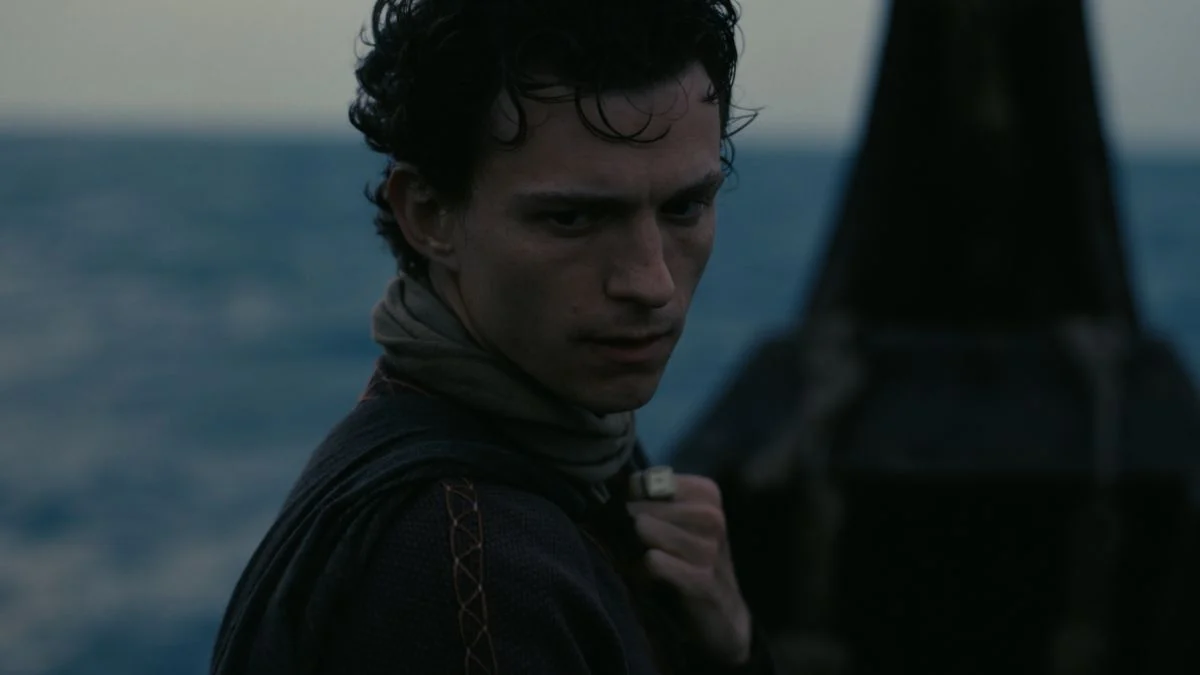
This mythological detour has picked up fresh relevance thanks to Christopher Nolan’s upcoming film adaptation, which casts Tom Holland as Telemachus alongside Matt Damon as Odysseus, Anne Hathaway as Penelope, Charlize Theron as Circe, and Zendaya as Athena. None of this post-Telegony material is confirmed to appear in the movie itself, since Nolan’s film is understood to be adapting Homer’s original text rather than its ancient sequel.
Still, the casting of Theron as Circe alongside Holland’s Telemachus has fans revisiting the myth’s stranger corners, if only out of curiosity about how deep the film’s mythology might go. Whether Nolan leaves this thread untouched or drops in a subtle nod for eagle eyed viewers remains to be seen.
Does the idea of Telemachus and Circe ending up together strike you as a strange twist of fate or a satisfying way to close out Odysseus’s story, and would you want to see any of it hinted at in Nolan’s film?