Best Way to Protect Comic Books From UV Damage: Do Slabs Actually Block It?

That pristine 9.8 you hung in the window? Six weeks later the reds look washed, the grade feels pointless, and the value has nosedived.
Ultraviolet light bleaches ink, yellows paper, and never gives color back. Collectors lose thousands of dollars to a force they can’t even see.
We’re about to show you why UV is the true arch-villain, bust the slab-equals-shield myth, and hand you the simple, proven moves that keep your comics vibrant for decades.
Why UV light is the arch-nemesis of comics
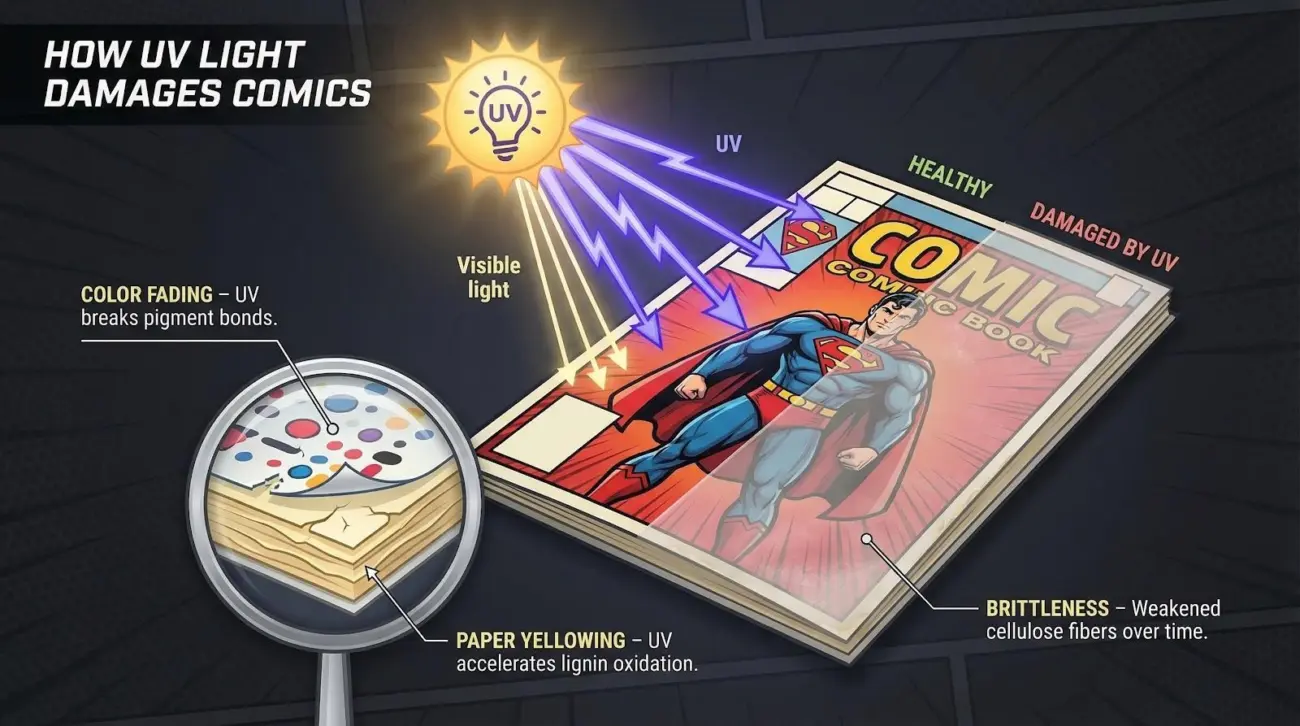
Think of comic ink as vibrant paint on a fragile canvas. Ultraviolet photons slam into those pigments with far more energy than visible light, snapping chemical bonds and bleaching color in the process. Reds shift to pink, blacks drain to tired gray, and the rich gradient that gives a cover its punch slowly evaporates.
Conservators blame ultraviolet for roughly 40 percent of all color loss, with visible light and heat sharing the rest. That single number shows why exposure control isn’t optional; it preserves every shade you paid for.
The paper takes a beating, too. Older newsprint is loaded with lignin, and UV speeds up lignin oxidation, turning crisp off-white pages into brittle amber sheets that flake at the edges. Modern glossy stock lasts a bit longer, but the chemistry never changes. Light keeps attacking cellulose fibers until they weaken and crack.
Damage compounds quietly. Ten minutes of sun on Tuesday plus an overhead fluorescent all week add up. Molecules never heal in the dark; the harm just pauses. Every fresh burst of UV picks up where the last left off.
Museums solve this with ruthless discipline: lux meters, blackout curtains, and strict rotation schedules. Most home displays rely on hope and a decent frame. Hope fades faster than ink.
If you want your Amazing Fantasy #15 reprint to stay cherry red, and your real copy to keep its grade, start by respecting the enemy. UV is relentless, invisible, and permanent. Our next job is to make it irrelevant.
Do slabs block UV? The myth meets the microscope
Graded slabs look bulletproof. Thick acrylic, sonic-sealed edges, holograms, and barcodes feel like mini vaults. That sense of permanence can fool us into believing the case doubles as museum glass.
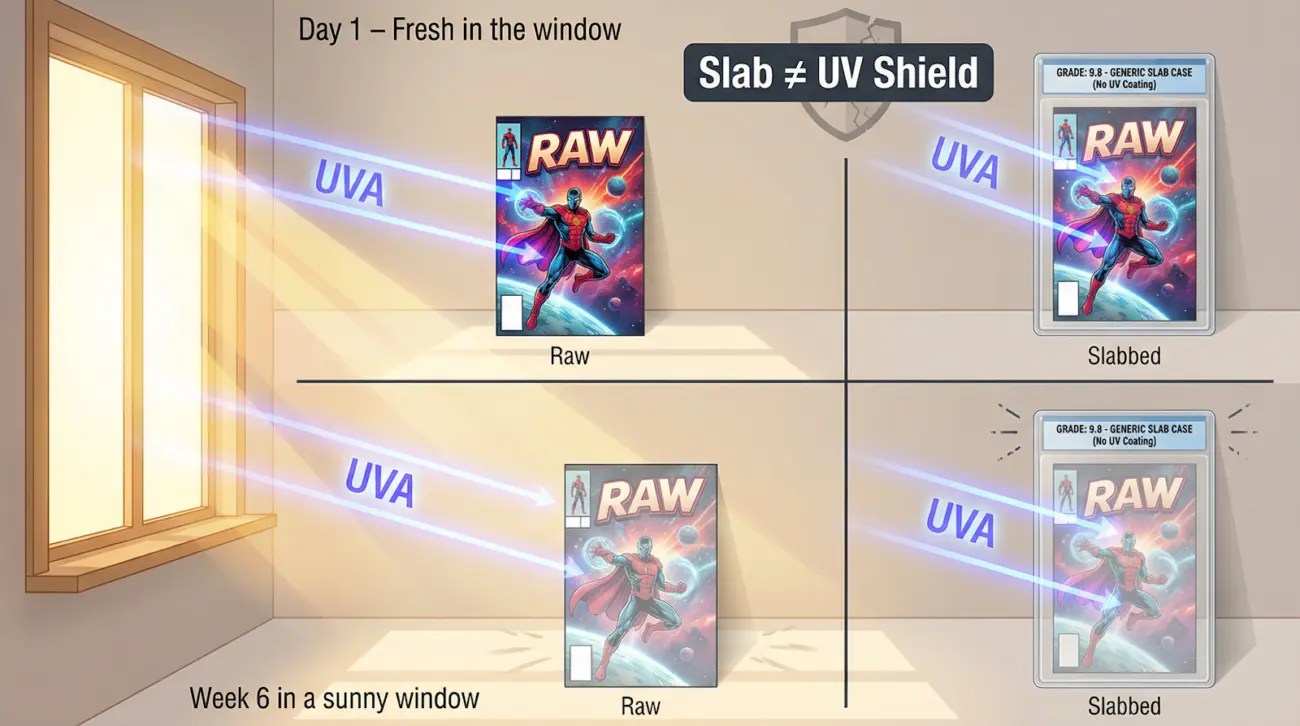
Here’s the blunt truth: CGC and CBCS never publish a UV rating. Collectors asked for numbers and got silence. Independent testing cited by SlabSaver found that standard slab plastic stops some UVB yet allows most high-energy UVA to pass.
The fallout is visible. A Reddit user hung two identical issues in a sunny window, one raw and one slabbed. After six weeks the colors on both dulled at nearly the same pace. The slab blocked scratches, not sunlight.
Forum anecdotes echo the test: a once-vibrant 9.8 now looks pastel, a signature once jet-black now reads charcoal. Every story ends the same way, “I thought the case was UV proof.”
The science backs them up. Plain acrylic blocks part of the UVB spectrum, but without an added absorber it transmits most UVA. UVA has enough energy to break pigment bonds yet not enough to alert our eyes, so covers fade while we admire them.
Recalibrate those assumptions. A slab stops fingerprints, humidity swings, and shipping knocks. It is not a light shield. Treat a graded book like a raw one: keep it in the dark or add a proven barrier on top.
Bags and boards: why Mylar is your baseline defense
Most comics live in clear plastic sleeves. Unfortunately, most of those sleeves are polyethylene or polypropylene, the same plastic that wraps a loaf of bread. They keep fingerprints off the cover, but they block virtually zero ultraviolet light. Set a poly-bagged issue in daylight and it fades at the same pace as a naked book.
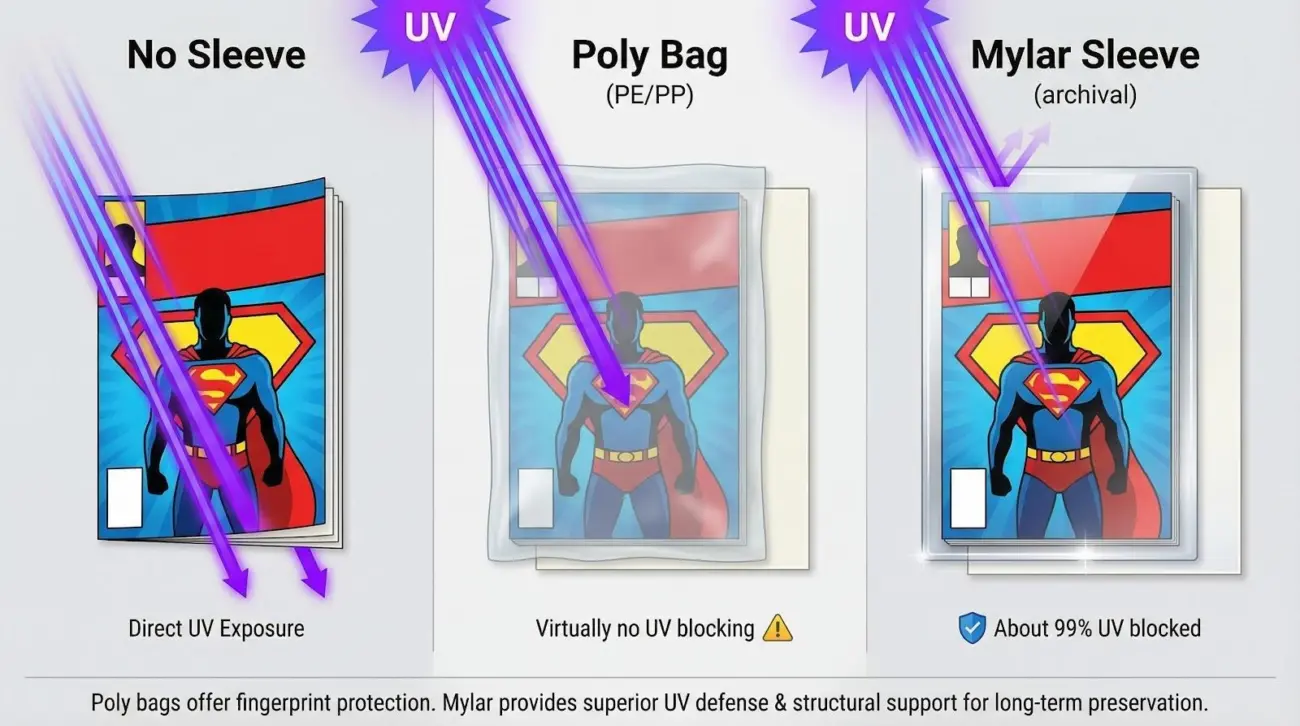
Archival Mylar flips that story. The film is biaxially oriented polyester engineered for long-term document storage. Manufacturers embed UV absorbers that stop about ninety-nine percent of the harmful spectrum. Slip the same comic into a Mylar sleeve and the cover survives months of incidental room light that would wreck an unprotected copy in weeks.
You feel the difference the moment you handle it. Mylar is stiffer, glossier, and nearly airtight when heat-sealed. That rigidity means the sleeve works as both light shield and mini board, keeping warps at bay. The trade-offs are minor: a touch more glare and a few extra cents per bag. For keys you plan to display, or even store, those pennies buy years of preserved color.
Boards still matter. Always pair the sleeve with an acid-free backing to buffer moisture and keep the comic from sagging. Mylar alone solves the UV problem, but Mylar plus a quality board solves the structural one, too.
In short, if poly is a rain poncho, Mylar is a storm shelter. Every other strategy we cover stacks on top of this simple upgrade, so start here before you think about frames or cases.
Slab plus outer sleeve: turning a case into a vault
We’ve established that a slab alone isn’t a sun shield. The fix costs pocket change.
Slide the entire graded comic into an oversized Mylar sleeve (often sold as Mylites for slabs) and you give it the same ninety-nine percent UV block raw books enjoy. The move takes seconds. You need no tools, pay no reseal fees, and risk no damage to the label.
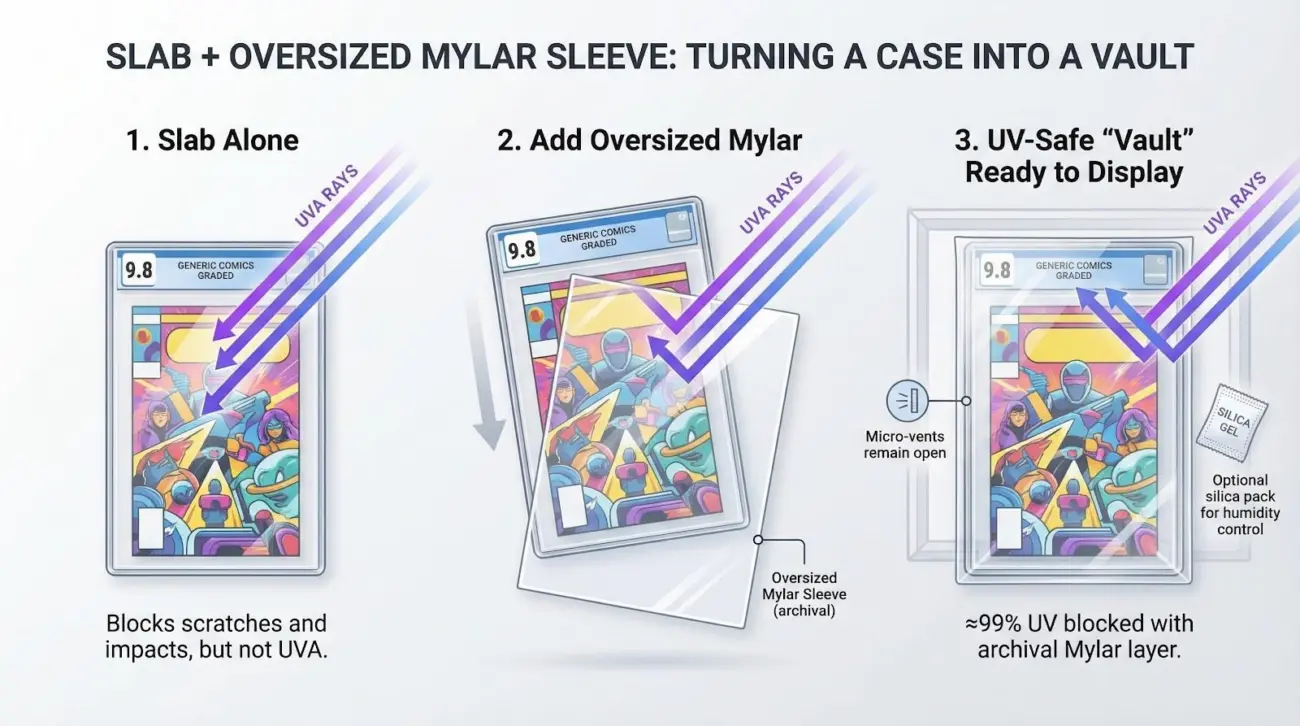
Collectors who display Signature Series books back this two-layer approach. The slab supplies rigidity, tamper evidence, and display flair. The sleeve supplies the science. Together they create a clear, glossy capsule that shrugs off light while letting colors pop.
Heat and moisture stay in check. CGC cases breathe through micro-vents, and the sleeve doesn’t seal them shut. If you live in a humid climate, drop a slim silica pack behind the slab before you close the frame. Now you have UV defense, physical armor, and humidity insurance in one tidy package.
Think of it like adding a fireproof liner to a safe. The safe still does its job; the liner just broadens the threats it can handle. For a few dollars per book, that peace of mind is hard to beat.
UV-filtering frames and displays: museum tech for your wall
Frames are where preservation meets pride. The right front panel turns a bright room into a safe gallery, while the wrong one turns your grail into a pastel.
Premium glazing, often labeled museum glass or OP3 acrylic, absorbs about ninety-nine percent of ultraviolet radiation and stays crystal clear. Slip a comic behind that sheet and the ink sees less UV in a year than it would in an afternoon of direct sun.
Ready-made comic frames now ship with that protection built in. One popular option, the Vaulted Comic Display, uses a magnetic acrylic window that locks over a CGC slab, blocks nearly all UV, and secures the book in an EVA-foam Friction Fit cradle you never have to adjust. That slim foam bezel creates the clean, floating gallery look collectors love, minus the slow color bleed of household glass.
The upgrade is instant. Colors stay punchy, whites stay white, and signatures refuse to ghost. OP3 also diffuses hotspots better than basic glass, so paper fibers stay cool instead of baking.
Yes, the price beats a drug-store poster frame, but damage costs more. Put one key issue in a UV frame and it pays for itself the first sunny morning you forget to draw the blinds.
Pair the frame with a Mylar-sleeved book and hang it on an interior wall. You now have two proven barriers standing between light and lore. We will stack environmental tricks next, but hardware like this does the heaviest lifting.
Controlling light and environment: winning the long game
Hardware gets you most of the way, but room conditions decide whether that protection lasts a decade or a lifetime.
Start with the windows. Clear UV-blocking film turns regular glass into a silent bodyguard. It looks invisible, installs in an afternoon, and strips almost all ultraviolet before it reaches your frames. Add blinds or blackout curtains for extra insurance during peak sun, then skip the daily scramble to chase stray beams across the floor.
Swap every bulb near your collection for LED. LEDs emit practically no UV and far less heat than incandescent or fluorescent tubes. That single change cuts two fading factors—radiation and temperature—with one twist of the wrist. Keep brightness modest and flip the switch off when you leave; the saved hours add up fast.
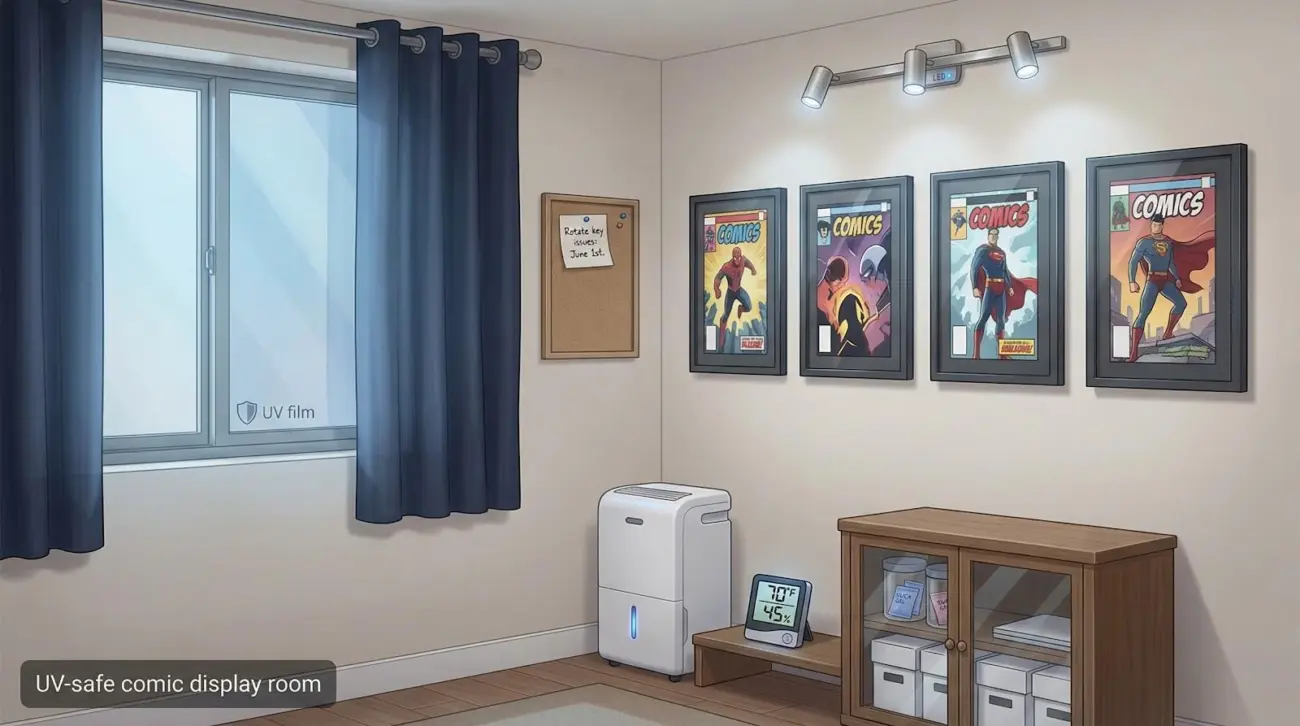
Placement matters. Hang comics on interior walls that never face direct sunlight. Even the best UV glass leaks a sliver of light, and removing the source beats filtering it.
Give your stars a vacation. Rotate key issues out of display for a few months of dark storage. Rotation resets the exposure clock, spreads risk across the collection, and lets you enjoy different covers through the year.
Finally, mind climate. Cool, dry air slows every chemical reaction inside paper fibers. Aim for about seventy degrees and forty to fifty percent humidity. A small dehumidifier or silica packs in display cabinets keep moisture spikes from inviting mold or foxing.
Combine smart room design with the physical shields we covered earlier and UV becomes a powerless villain, locked outside while your comics stay vibrant inside.
Best practices for UV-safe comic display and storage
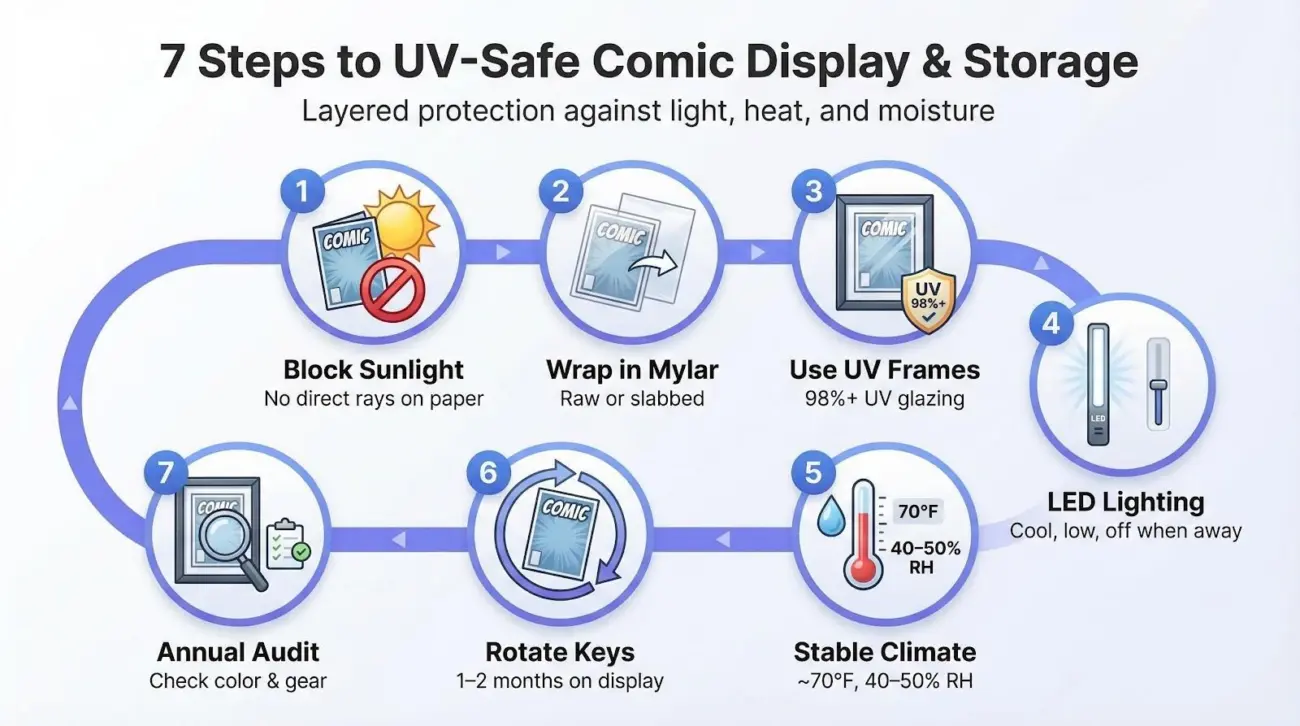
- Keep sunlight off paper. If a ray can touch the book, move the book or block the ray. There’s no safe exposure window.
- Always wrap the comic first. Raw issue? Mylar sleeve. Graded slab? Oversized Mylar. The sleeve is the universal starting layer you never skip.
- Add certified UV glazing for anything on a wall. Frames or display cases should advertise at least ninety-eight percent UV absorption. If they don’t, replace the panel.
- Light the room with LEDs and moderation. Cool bulbs, low lumens, and a quick switch-off when you leave save hours of exposure over time.
- Control climate. Aim for about seventy degrees and forty to fifty percent humidity. Drop desiccant packs in cabinets and run a dehumidifier if your basement feels sticky.
- Rotate prized books on a schedule. Display a key issue for one to two months, then give it a dark vacation. Rotation spreads risk and keeps the gallery fresh.
- Audit once a year. Compare colors with stored copies or high-res scans, replace scratched glazing, refresh silica packs, and confirm window film is still clear.
FAQ quick answers to common UV questions
Do CGC slabs have built-in UV protection?
No. The acrylic blocks a slice of UVB, but most UVA still reaches the paper. Treat a slabbed comic like a raw one and add external protection.
Will LED lights fade my comics?
LEDs emit negligible ultraviolet, so they’re the safest mainstream option. High-output LEDs can still cause slow visible-light fading, so keep intensity low and switch them off when you’re not in the room.
How fast can sunlight ruin a cover?
Direct sun can bleach bright reds in as little as six weeks. Indirect daylight takes longer, but damage is cumulative and irreversible.
Does “99 percent UV blocking” mean the comic is safe forever?
It means the book will fade about one hundred times slower, not zero. Visible light and heat still work, and the remaining one percent of UV builds up over years. Darkness is the only absolute.
What’s the single best upgrade I can make today?
Replace every poly bag with an archival Mylar sleeve. It costs pocket change and removes ninety-nine percent of the most destructive light overnight.
Conclusion
Follow this seven-step loop and you’ll build a layered defense that treats light, heat, and moisture as one integrated threat, keeping your comics as bold as the day they rolled off the press.