Inside the Real-World Locations That Brought Netflix’s ‘Avatar: The Last Airbender’ to Life


When Netflix’s live-action adaptation of ‘Avatar: The Last Airbender‘ arrived on the platform, audiences were immediately struck by the richness of its world-building. The sprawling kingdoms, ancient forests, and elemental battlegrounds all felt convincingly alive, which naturally led many viewers to wonder where exactly this fantastical universe was physically constructed.
The answer turns out to be closer to Earth Kingdom than you might expect. Netflix’s live-action ‘Avatar: The Last Airbender’ was filmed in Vancouver and British Columbia, Canada, with a combination of outdoor locations and cutting-edge indoor technology working together to recreate an entire animated world for a new generation of fans.
The British Columbia Filming Locations Behind the Four Nations
The production took place in several areas of Metro Vancouver, also known as Greater Vancouver, in British Columbia, with the cast and crew visiting the southwestern part of the province, particularly the port city of Vancouver in the Lower Mainland region. Canada has long been a favored stand-in for major productions seeking diverse landscapes without Hollywood price tags, and ‘Avatar: The Last Airbender’ leaned into this fully.
Four municipalities specifically, including Maple Ridge, Burnaby, Langley, and Surrey, were used as filming locations, which Netflix highlighted as part of its Netflix in Your Neighbourhood series. The geographic variety across these four cities proved essential, since the show demands environments ranging from arctic tundras to dense jungles within the same season.
Production reportedly began under the working titles ‘Trade Winds’ and ‘Blue Dawn,’ with principal photography getting underway in mid-November 2021. The filming unit took a break during the Christmas season, which was further extended due to the surge of the Omicron variant. That extended timeline ultimately allowed the production team to build out one of the most technically ambitious setups in recent streaming history.
The Record-Breaking LED Soundstage at the Heart of It All
The indoor component of the production is where things get truly remarkable. Situated at the Canadian Motion Picture Park in South Burnaby, the LED soundstage used for ‘Avatar: The Last Airbender’ is a collaborative venture between the visual effects company Pixomondo and the Canadian film equipment rental firm William F. White International.
The stage spans 22,000 square feet and measures 80 feet by 27 feet 6 inches, lined with 2,500 LED wall panels and 760 LED ceiling panels, and was officially confirmed as the world’s largest LED stage by Guinness World Records. That achievement was secured while the show was still in production, making it a landmark moment for Canadian filmmaking infrastructure.
The LED wall technology works by generating photorealistic three-dimensional background scenes whose perspective follows the camera’s movements, dramatically reducing production costs, improving efficiencies, speeding up the shooting process, and even providing realistic lighting that can be easily adjusted. Green screens, by contrast, are static and require time-intensive repositioning work. For a show that demands the visual complexity of ‘Avatar: The Last Airbender’, this made an enormous practical difference.
Specific Outdoor Scenes and Where They Were Actually Shot
Beyond the soundstage, a number of recognizable real-world spots across British Columbia doubled as iconic locations from the series. The local high rope and zipline park WildPlay Maple Ridge was heavily featured in the show as Jet’s forest hideaway on the outskirts of Omashu, with sections of the course visible when Jet brings Katara to his hideout for the first time.
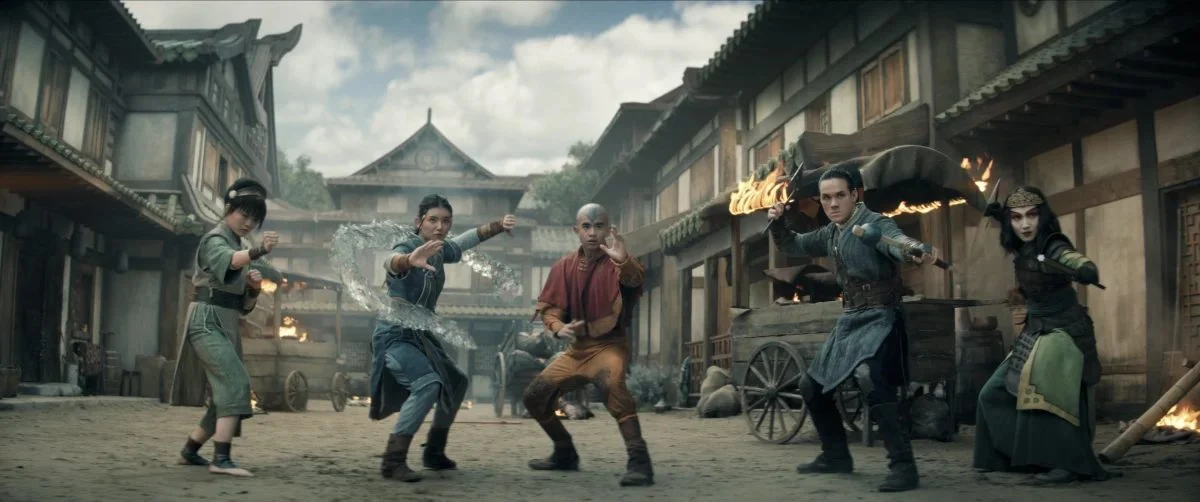
The shots of Aang and Teo exploring a cavern in episode three were actually filmed in a real cave at the Jamestown movie set on MacInnes Farms in Langley. The Farm on 264th, another Langley studio frequented by both Canadian and international productions, was the site of all the shots of Zuko and Iroh exploring the town of Senlin in episode five.
Aang’s trip to the spirit world, where he first meets the legendary Avatar Kyoshi, was shot in Robert Burnaby Park. Surrey also contributed to the production, with local spots including the Panther Paintball park and the sprawling 18-acre A Rocha property appearing in the series.
How the Production Team Built 26 Sets in One Province
The sheer scale of what was accomplished across British Columbia is worth appreciating on its own terms. Josh Kerekes, Virtual Production Supervisor and Head of Production at Pixomondo, described the challenge in an interview with IGN, noting that the show functions like a fantasy travel series where each episode lands in a different biome entirely, moving from the South Pole to mountains to tropical seaports to ships at sea, sometimes all within the same week.
Kerekes elaborated that the team created approximately 26 sets with a vast number of scenarios, probably around 100, including the Northern Water Kingdom both before the attack and at varying stages of destruction. That kind of scope required the blend of real outdoor British Columbia terrain and the controlled flexibility of the Burnaby LED stage working in tandem.
Netflix’s showrunner Albert Kim captured the ambition of the whole setup in a statement from November 2021, expressing enthusiasm about working with the technology at Pixomondo to create the world of ‘Avatar: The Last Airbender’ using the most advanced techniques available to filmmakers anywhere in the world. Given that the production earned a Guinness World Record before the first episode even aired, that ambition clearly translated into something genuinely historic.
If you have visited any of the British Columbia locations that appear in ‘Avatar: The Last Airbender’ or spotted a recognizable landscape during your watch, share which scene stopped you in your tracks.